Many readers pause when they see taylored vs tailored. The words look almost the same, so the brain assumes both must be correct. But then spellcheck screams, and doubt appears.
Students, writers, and ESL learners often search this phrase because they fear making a visible mistake in emails, resumes, or social posts.Now the confusion matters because spelling shapes trust.
A small error can make formal writing look rushed. So this guide explains the difference in a calm, simple way. You will learn which spelling is real, why the wrong form exists, and how to avoid the mistake forever.
Taylored vs tailored – Quick Answer
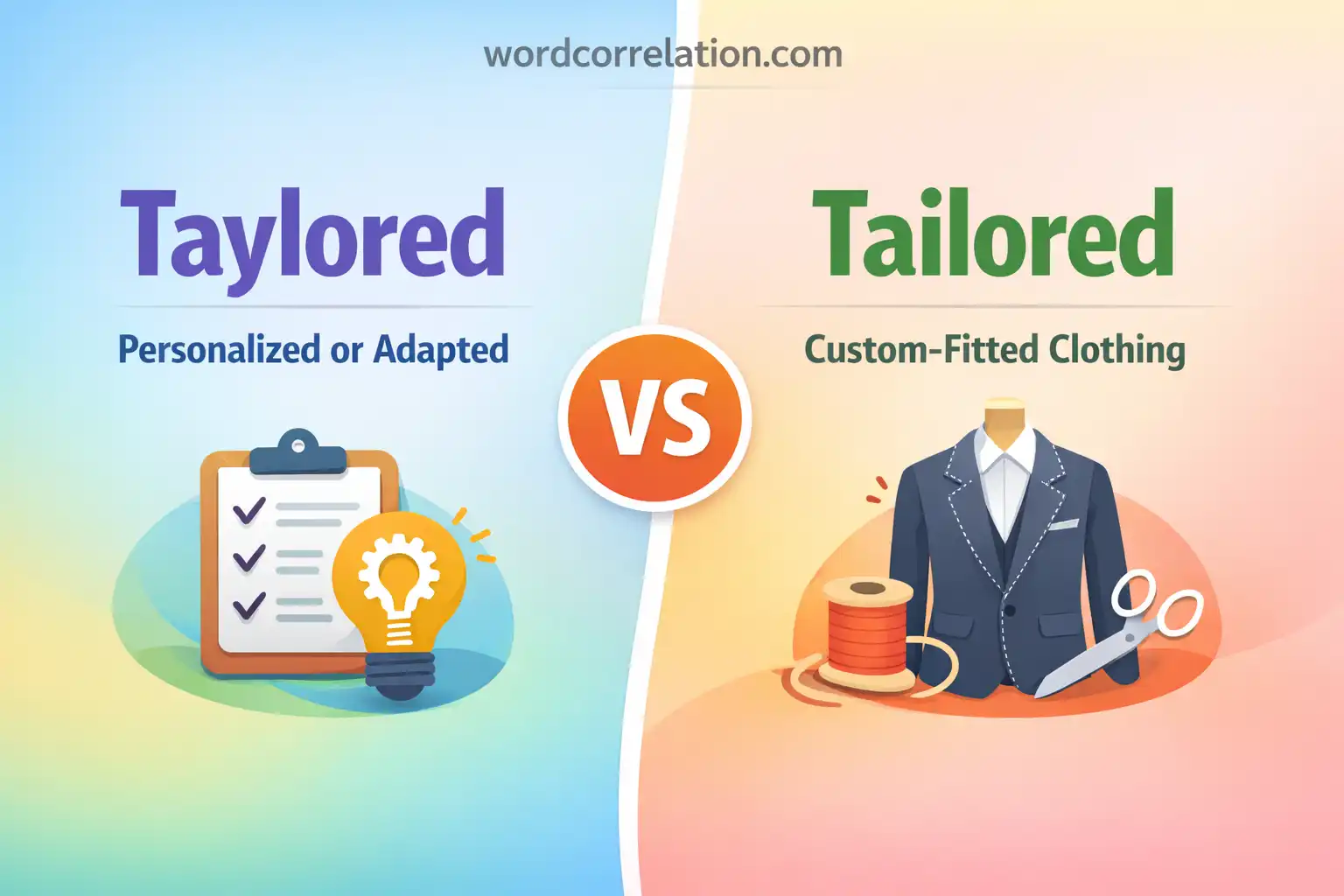
“Tailored” is correct. “Taylored” is a misspelling.
- ✅ The suit was tailored perfectly.
- ❌ The suit was taylored perfectly.
Easy rule:
If the word relates to clothing or customization, always use tailored.
The Origin of Taylored vs tailored
The word tailored comes from the noun tailor. A tailor is a person who makes or adjusts clothes. The verb form developed later. It means to adjust something so it fits a person or situation.
People started using the word beyond clothing. For example, writers say a plan is tailored to a client. Teachers say lessons are tailored to students. The meaning expanded, but the spelling stayed the same.
So where did taylored come from? The answer is simple. It comes from sound confusion. English learners often write words the way they hear them. The long “a” sound in the tailor tricks the ear. Writers replace ai with ay because both can sound similar.
Editors often see this mistake in drafts. The brain guesses a pattern that does not exist. However, English spelling keeps the ai form because it connects to the root word tailor.
British English vs American English Spelling
Unlike many English words, tailored does not change between British and American spelling. Both regions use the same form.
However, confusion still appears because English has many vowel patterns that look alike. Writers expect variation, so they invent one by accident.
Here is a quick comparison:
| Region | Correct spelling | Variant allowed? |
| US | tailored | No |
| UK | tailored | No |
| Canada | tailored | No |
| Global | tailored | No |
In contrast to words like color/colour, this word has no regional split. The spelling stays stable worldwide.
Which Spelling Should You Use?
You should always use tailored. There is no audience where taylored becomes correct.
For US readers, tailored is standard in academic, business, and casual writing, UK and Commonwealth audiences, the same rule applies.
For global communication, tailored remains the only accepted form.
Now this simplicity helps writers. You never need to guess based on region. You only need to remember the root word tailor. If the base word keeps ai, the derived word keeps it too.
Common Mistakes with Taylored vs tailored
Writers repeat a few predictable errors. These mistakes often appear in fast typing or phonetic spelling.
❌ This program is taylored to beginners.
✅ This program is tailored to beginners.
Explanation: The verb comes from tailor, so the vowel stays ai.
❌ She taylored her speech to the audience.
✅ She tailored her speech to the audience.
Explanation: No English rule supports the ay change.
❌ Custom taylored solutions available.
✅ Custom tailored solutions available.
Explanation: Professional writing requires the standard form.
Spellcheck usually catches this mistake. However, writers who disable grammar tools may miss it. That is why awareness matters.
Taylored vs tailored in Everyday Examples
The word tailored appears in many contexts. It no longer belongs only to clothing.
Emails
“Our service is tailored to your needs.”
News writing
“The campaign tailored its message for young voters.”
Social media
“I finally found a workout plan tailored for busy people!”
Professional writing
“The software offers tailored solutions for each department.”
Each example shows customization. The meaning always points to careful adjustment.
Taylored vs tailored – Usage Patterns & Search Interest
Search interest for this phrase comes mostly from learners and early-career writers. Students often meet the word in textbooks. Then they hesitate when typing it. ESL learners search for it because vowel patterns in English feel unpredictable.
Writers also check the spelling during resume editing. Job applications use the word frequently. People describe tailored cover letters or tailored experiences. A misspelling in that context can harm credibility.
One real-world scenario highlights the risk. Imagine a marketing agency promising “taylored solutions” on its homepage. Visitors may question professionalism immediately. The service might be strong, but the spelling weakens trust.
Quick Comparison Table
| Feature | Tailored | Taylored |
| Meaning | Adjusted to fit | None (misspelling) |
| Part of speech | Verb / adjective | Not a real word |
| Context of use | Clothing, plans, services | Error only |
| Formal usage | Fully accepted | Incorrect |
| Common mistake | Replacing ai with ay | Phonetic spelling |
| Correct example | “A tailored strategy works best.” | Not applicable |
This table removes the confusion quickly. Only one spelling carries meaning.
FAQs
Is taylored the same as tailored?
No. Taylored is a spelling error. Tailored is the real word.
Which one is correct in formal writing?
Only tailored is correct in formal writing.
Can they be used interchangeably?
No. One is valid, and the other is not a word.
Why do people confuse them?
They write the word based on sound instead of origin.
Can grammar tools catch this mistake?
Yes. Most spellcheck systems flag taylored instantly.
Is there a British vs American difference?
No. Both regions are tailored.
Does tailored always relate to clothes?
No. It now means customized in many situations.
Conclusion
The confusion around taylored vs tailored looks small, but it reflects a bigger pattern in English spelling. Writers trust their ears, yet English often follows history instead of sound. The correct word connects directly to tailor, and that root keeps the ai spelling.
Overall, the mistake happens because the brain simplifies vowel patterns. However, professional writing rewards accuracy. A tailored message looks polished. A misspelled one distracts readers.
In short, remember the origin and the rule becomes easy. If the idea involves adjustment or customization, the spelling must match the tailor who performs the work. Finally, the safest memory trick is simple:
If a tailor makes it, the word keeps AI.
That single rule prevents the error every time.

James Holloway writes detailed guides on confusing English words and grammar usage with clear side-by-side comparisons.