Have you ever written a sentence and used the word describe again and again? It starts to feel boring. Your writing sounds flat. You wish you had better words.
For example, a student may write: “Please describe your favorite place.” A blogger may write: “Let me describe this product.” A storyteller may write: “She described the scene.” The word works, but it gets repeated too much.
The word describe means to tell what something looks like, feels like, or is like. It helps us paint a picture with words. Students use it in essays. Bloggers use it in posts. Content writers use it in articles. We all use it in daily English.
Learning synonyms of describe helps your writing sound fresh, clear, and smart. It makes your words more interesting and easier to read. Let’s explore how.
What is Describe?
Describe means to explain or tell about something using words. You share details so others can imagine it.
Related ideas:
- Explain
- Tell
- Show with words
- Give details
When you describe well, the reader can see the picture in their mind.
Benefits of Synonyms of Describe
Using synonyms of describe can:
- Improve your writing style
- Avoid repeating the same word
- Make your content more engaging
- Help readers understand better
- Make essays and blogs sound professional
- Improve vocabulary for students and writers
How Synonyms of Describe Improve Writing Quality
Imagine reading a story where every line says describe. It feels dull. But when you use words like explain, portray, outline, or illustrate, the text feels alive.
Writers, teachers, marketers, and students all benefit from this.
Common Uses of Synonyms of Describe in Writing
These words are used in:
- School essays
- Blog posts
- Product descriptions
- Stories and novels
- Emails and reports
- Daily conversations
Tips and Best Practices for Using Synonyms of Describe
- Pick the synonym that fits the sentence.
- Do not force big words. Keep it simple.
- Read your sentence aloud. See if it sounds natural.
- Use different words in long content.
- Practice using new words in daily writing.
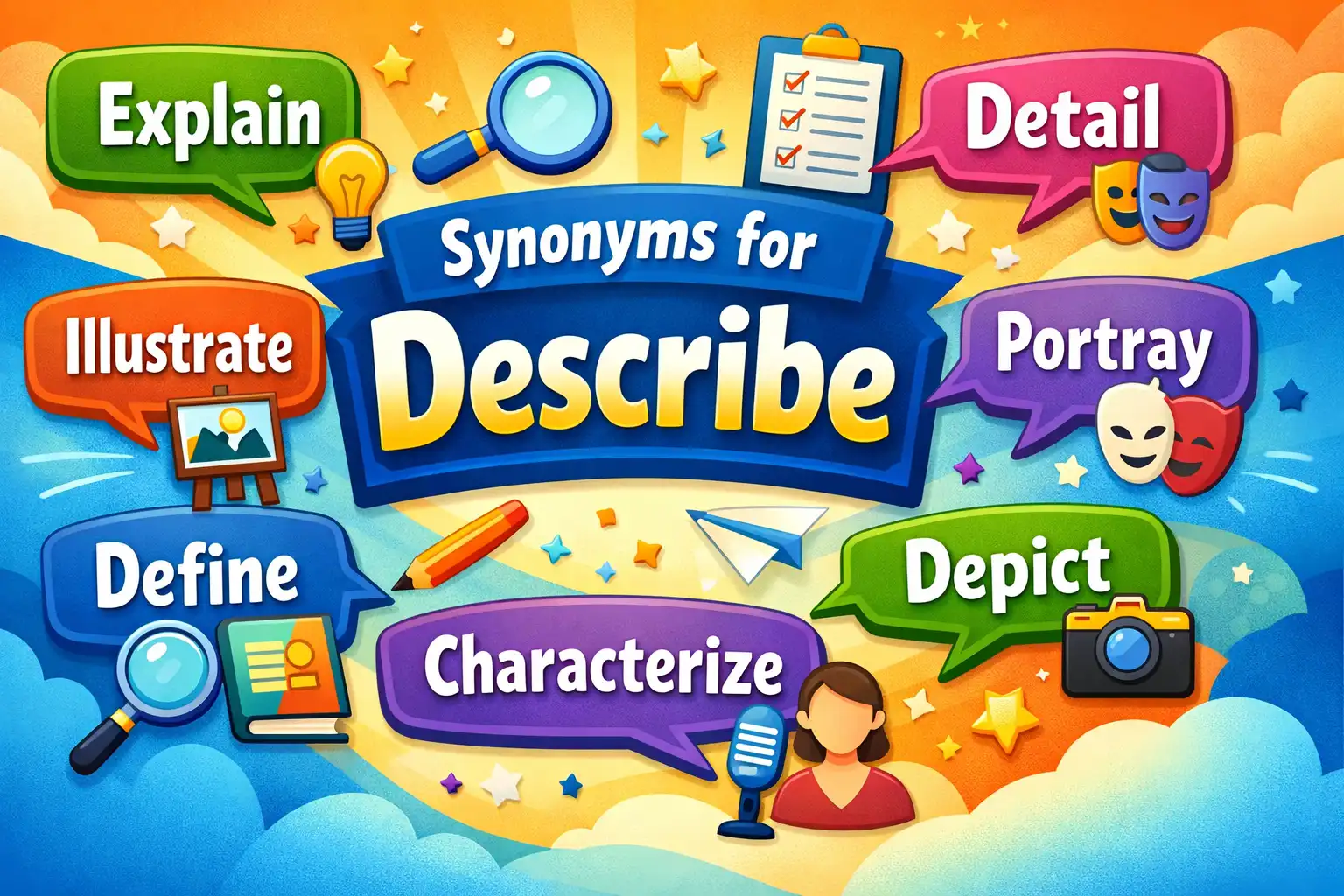
SYNONYMS LIST (50 Synonyms of Describe)
1. Explain
Meaning: To make something clear with words.
Examples:
- Please explain the rule to me.
- She explained the game well.
2. Illustrate
Meaning: To show an idea with words or pictures.
Examples:
- He illustrated the story nicely.
- The teacher illustrated the point.
3. Portray
Meaning: To show how something is.
Examples:
- The movie portrays village life.
- She portrayed her feelings clearly.
4. Outline
Meaning: To give the main points.
Examples:
- He outlined the plan.
- Please outline the steps.
5. Depict
Meaning: To show something in words or art.
Examples:
- The book depicts war times.
- She depicted the scene well.
6. Detail
Meaning: To give full information.
Examples:
- He detailed the event.
- Please detail your idea.
7. Define
Meaning: To tell the exact meaning.
Examples:
- Can you define this word?
- The teacher defined the term.
8. Clarify
Meaning: To make something easy to understand.
Examples:
- She clarified the doubt.
- Please clarify your point.
9. Narrate
Meaning: To tell a story.
Examples:
- Grandpa narrated a story.
- She narrated her trip.
10. Recount
Meaning: To tell what happened.
Examples:
- He recounted the event.
- She recounted her day.
11. Express
Meaning: To show thoughts or feelings.
Examples:
- She expressed her joy.
- He expressed his idea.
12. Present
Meaning: To show or share information.
Examples:
- She presented her project.
- He presented the facts.
13. State
Meaning: To say something clearly.
Examples:
- He stated his name.
- She stated the rule.
14. Report
Meaning: To tell information.
Examples:
- He reported the news.
- She reported the issue.
15. Communicate
Meaning: To share information.
Examples:
- We communicate daily.
- She communicated her plan.
16. Reveal
Meaning: To show something hidden.
Examples:
- He revealed the secret.
- The book revealed truth.
17. Mention
Meaning: To say something briefly.
Examples:
- She mentioned the topic.
- He mentioned your name.
18. Note
Meaning: To point out.
Examples:
- Please note this fact.
- She noted the mistake.
19. Summarize
Meaning: To tell the main idea shortly.
Examples:
- He summarized the story.
- She summarized the lesson.
20. Interpret
Meaning: To explain the meaning.
Examples:
- She interpreted the sign.
- He interpreted the poem.
21. Characterize
Meaning: To show the qualities.
Examples:
- The book characterizes him well.
- She characterized the hero.
22. Represent
Meaning: To stand for or show.
Examples:
- This sign represents peace.
- He represents the team.
23. Demonstrate
Meaning: To show clearly.
Examples:
- He demonstrated the trick.
- She demonstrated the method.
24. Convey
Meaning: To carry or share a message.
Examples:
- The song conveys love.
- She conveyed her idea.
25. Relate
Meaning: To tell or connect.
Examples:
- He related the story.
- She related to the topic.
26. Sketch
Meaning: To give a short picture with words.
Examples:
- He sketched the plan.
- She sketched the idea.
27. Chronicle
Meaning: To record events in order.
Examples:
- The book chronicles history.
- He chronicled his life.
28. Tell
Meaning: To say something in words.
Examples:
- Please tell me.
- She told the truth.
29. Write
Meaning: To put words on paper.
Examples:
- He wrote about it.
- She wrote a note.
30. Voice
Meaning: To speak thoughts aloud.
Examples:
- She voiced her worry.
- He voiced his opinion.
31. Articulate
Meaning: To speak clearly.
Examples:
- She articulated her idea.
- He articulated the answer.
32. Spell out
Meaning: To explain very clearly.
Examples:
- He spelled out the rule.
- She spelled out the steps.
33. Break down
Meaning: To explain step by step.
Examples:
- She broke down the task.
- He broke down the lesson.
34. Map out
Meaning: To show the plan clearly.
Examples:
- He mapped out the route.
- She mapped out the plan.
35. Lay out
Meaning: To arrange ideas clearly.
Examples:
- She laid out the points.
- He laid out the plan.
36. Depose
Meaning: To give details formally.
Examples:
- He deposed the facts.
- She deposed her view.
37. Recap
Meaning: To review shortly.
Examples:
- He recapped the lesson.
- She recapped the talk.
38. Unfold
Meaning: To show step by step.
Examples:
- The story unfolded slowly.
- Events unfolded quickly.
39. Cite
Meaning: To mention as proof.
Examples:
- He cited an example.
- She cited the rule.
40. Quote
Meaning: To repeat exact words.
Examples:
- He quoted the line.
- She quoted her teacher.
41. Account
Meaning: To tell in detail.
Examples:
- He accounted the event.
- She accounted her day.
42. Specify
Meaning: To give exact details.
Examples:
- Please specify the time.
- She specified the color.
43. Label
Meaning: To give a name.
Examples:
- He labeled the box.
- She labeled the file.
44. Identify
Meaning: To recognize and name.
Examples:
- He identified the bird.
- She identified the problem.
45. Describe vividly
Meaning: To show clearly with strong words.
Examples:
- He described vividly the place.
- She described vividly her dream.
46. Paint
Meaning: To create a picture with words.
Examples:
- She painted a picture with words.
- He painted the scene well.
47. Set forth
Meaning: To explain clearly.
Examples:
- He set forth the rules.
- She set forth her plan.
48. Disclose
Meaning: To make known.
Examples:
- He disclosed the truth.
- She disclosed the plan.
49. Indicate
Meaning: To point out.
Examples:
- The sign indicates danger.
- She indicated the door.
50. Explain in detail
Meaning: To tell fully and clearly.
Examples:
- He explained in detail the task.
- She explained in detail her idea.
Common Mistakes to Avoid with Describe
- Using describe too many times
- Choosing hard synonyms that don’t fit
- Writing long, confusing sentences
- Forgetting the context of the sentence
Keep it simple and natural.
FAQ
Q1: Why should I learn synonyms of describe?
To improve your writing and avoid repetition.
Q2: Are these words useful for students?
Yes, they help in essays and exams.
Q3: Can bloggers use these synonyms?
Yes, it makes blogs more engaging.
Conclusion
Learning synonyms of describe helps you write better, clearer, and more interesting content. It improves vocabulary and makes your writing sound fresh. Start using these words today in your daily writing.

James Holloway writes detailed guides on confusing English words and grammar usage with clear side-by-side comparisons.