A student once asked why their spell checker kept changing superceded. They felt sure they had typed it right. The word looked correct, sounded correct, and even matched how they said it. Yet the red underline stayed. This tiny spelling fight happens to thousands of writers every day.
Now the confusion matters because spelling errors reduce trust. Teachers notice. Editors notice. Search engines notice. Many people search “superseded vs superceded” because they want certainty, not guesses.
In this guide, you will see the real difference, why the mistake spreads, and how to avoid it forever.
Superseded vs Superceded – Quick Answer
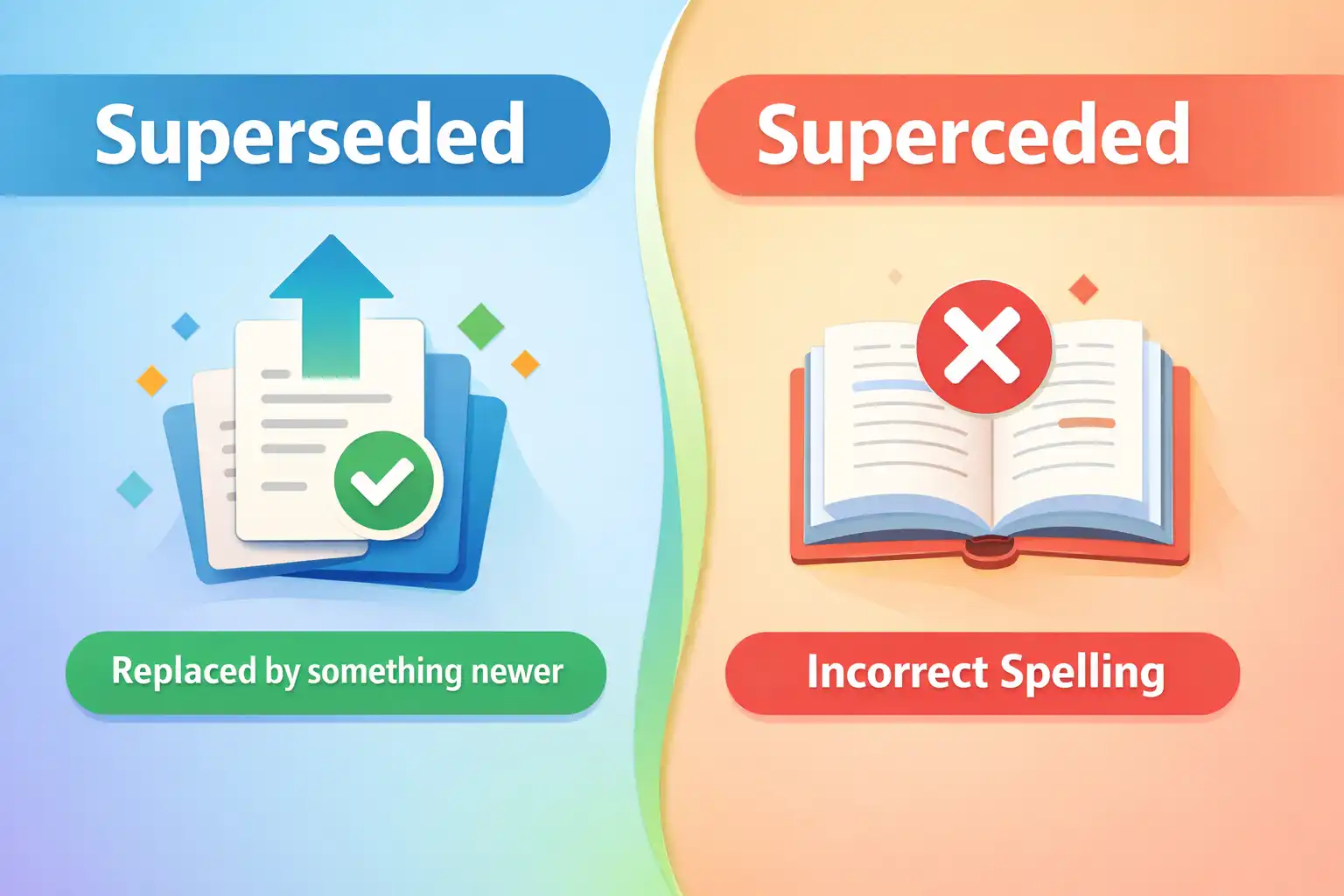
- Superseded is the only correct spelling
- Superceded is always wrong
- The correct word means replaced or made outdated
Example:
- The old law was superseded
- New software superseded the old version
Easy rule: If you write it, always use S-E-D-E-D.
Why “Supersede” Is Spelled with -SEDE (Etymology)
The word superseded comes from Latin. It combines super (above) and sedere (to sit). Long ago, it meant “to sit above something.” Over time, the meaning changed. It began to mean to replace or take the place of something older.
However, the spelling causes trouble because English has many -cede words. People see words like precede and recede. Then they assume supercede must follow the same pattern. That assumption feels logical, but it is wrong.
Meanwhile, English kept the Latin spelling for this word. So the correct form stayed supersede, not supercede. Writers often confuse it because English spelling does not always follow simple rules.
British vs American Spelling (No Difference)
Here is the surprising part. There is no spelling difference between British and American English.
| Region | Correct spelling |
| US English | superseded |
| UK English | superseded |
| Australia | superseded |
| Canada | superseded |
In contrast to many other words, this spelling stays identical worldwide. So learners cannot switch versions to justify superceded. Every major dictionary agrees.
How to Remember the Correct Spelling (Fast Rule)
The choice is simple because only one word exists.
- US: Use superseded
- UK/Commonwealth: Use superseded
- Professional/global writing: Use superseded
There is no alternate spelling. If you see superceded, treat it as a typo.
Think of it like a password. One letter wrong makes the whole word invalid.
Common Mistakes with Superseded
Writers repeat the same error because they rely on sound instead of spelling.
❌ This rule got superceded last year
✅ This rule got superseded last year
❌ The update superceded previous files
✅ The update superseded previous files
The mistake happens because the brain expects -cede. Yet this word breaks the pattern. Editors often say this error appears in essays, business emails, and even news drafts.
Superseded vs Superceded in Everyday Examples
You will see superseded in many real situations.
Emails:
“The new policy has superseded the old one.”
News writing:
“The recent law superseded earlier regulations.”
Social media:
“This model superseded last year’s version.”
Professional writing:
“The revised contract superseded all prior agreements.”
Each example shows replacement. Something new pushes something old aside.
Why People Misspell It (and How to Avoid It)
Search data shows strong interest in this spelling question. Students search it while writing essays. ESL learners search it during grammar study. Professionals search it before sending formal documents.
Overall, the confusion spreads because the wrong spelling looks believable. Spell check tools often catch it, but writers still doubt the correction.
A real scenario shows why it matters. Imagine a legal or academic document that includes superceded. Readers may question the writer’s accuracy. Even a small error can reduce credibility.
Supersede vs Supercede: Side-by-Side Comparison
| Feature | Superseded | Superceded |
| Meaning | Replaced | Not a real word |
| Part of speech | Verb (past tense) | Misspelling |
| Context | Formal & everyday | Incorrect usage |
| Formal vs informal | Accepted everywhere | Never accepted |
| Common mistake | None | Used by confusion |
| Correct example | “The rule was superseded.” | ❌ No correct example |
This table removes all doubt. Only one version works.
FAQs: Superseded vs Superceded
Is superseded the same as superceded?
No. Superseded is correct. Superceded is a spelling error.
Which spelling works in formal writing?
Only superseded works in formal writing.
Can they be used interchangeably?
No. One is valid. The other is wrong.
Why do people confuse them?
They copy the spelling pattern of other -cede words.
Can grammar tools catch this mistake?
Yes. Most spell checkers flag superceded instantly.
Is there a British vs American difference?
No difference exists. Both use superseded.
Final Answer: Always Write “Superseded”
Spelling mistakes feel small, but they carry weight. The word superseded causes confusion because English mixes patterns. Writers expect supercede, yet history locked in a different spelling. That mismatch tricks the brain.
Overall, remember that the correct form never changes across countries. Teachers, editors, and dictionaries all agree. In short, the only safe choice is superseded. Finally, keep one rule in mind: If it replaces something old, it must be spelled S-E-D-E-D.
That simple memory trick prevents the mistake forever.

Moses Jhon is a dedicated content writer known for producing high-quality, reader-focused, and SEO-optimized content. He has experience crafting blog posts, website content, articles, and marketing copy across different niches. His writing style combines creativity, clarity, and strategy to help businesses grow their online presence and engage their target audience effectively.