Many people search for suffix vs postfix because the two words look almost the same. Both refer to something added after another word or element. Because of this, students, writers, and programmers often think they mean the same thing.
However, they are not used in the same context. A suffix belongs to language and grammar. It changes the meaning of a word. A postfix, on the other hand, appears mostly in computer science and programming. It describes a position or notation that comes after something.
This confusion happens often. Writers see both words in dictionaries. Programmers see postfix in code. ESL learners then assume the terms can replace each other. That mistake can cause problems in school papers, coding tutorials, and technical discussions.
This article solves that confusion. You will learn the clear meaning of suffix and postfix, their history, where each word is used, and how to choose the correct one quickly. You will also see real examples, common mistakes, and usage patterns so the difference becomes easy to remember.
Suffix vs Postfix – Quick Answer
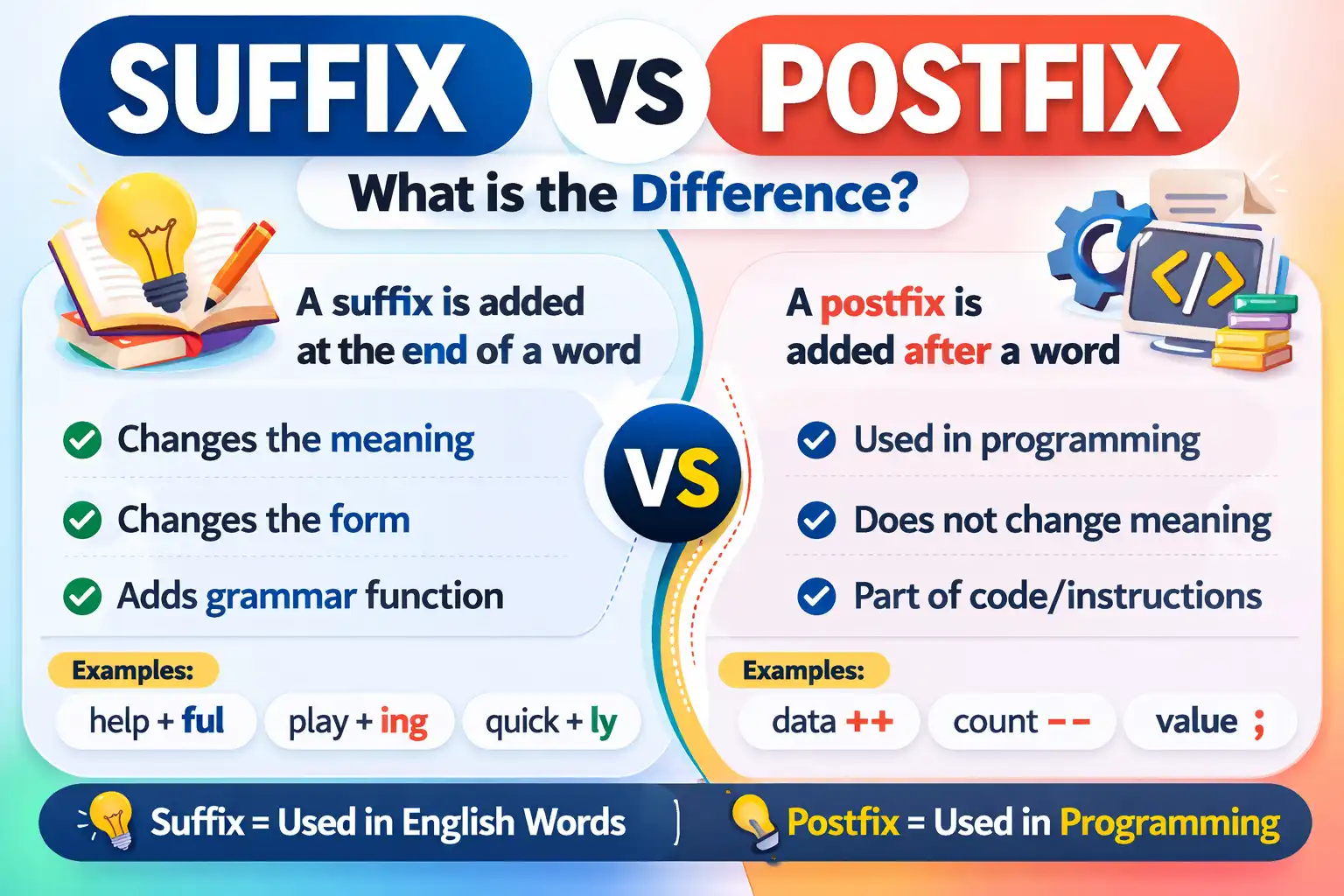
A suffix is a group of letters added to the end of a word to change its meaning.
A postfix describes something placed after another element, mainly in programming or notation systems.
Examples:
• happy → happiness (suffix)
• run → runner (suffix)
• a b + (postfix notation in programming)
Easy rule:
Use suffix for language, use postfix for computing or technical notation.
The Origin of Suffix vs Postfix
Understanding the origin helps explain why people mix them up today.
The word suffix comes from the Latin word “suffixus.” It means attached below or added at the end. Linguists began using it centuries ago to describe word endings that change meaning or grammar.
Examples appeared early in English:
- hope → hopeful
- child → childhood
- quick → quickly
In each case, the added letters create a new word or grammatical form.
The word postfix also has Latin roots. It comes from “post” (after) and “fixus” (attached). The meaning literally becomes “attached after.”
However, this term became popular much later. It appeared mostly in mathematics and computer science. In programming, postfix describes a notation where the operator comes after the operands.
Example:
Infix: A + B
Postfix: A B +
Because both words contain “fix” and both involve something placed after, confusion is natural. Yet their fields of use are very different.
British vs American English Spelling
For this comparison, spelling differences do not exist between British and American English.
Both regions use the same spelling:
| Word | American English | British English |
| Suffix | suffix | suffix |
| Postfix | postfix | postfix |
So the confusion does not come from spelling differences. Instead, it comes from context and subject area.
However, usage varies slightly.
In linguistic discussions worldwide, suffix appears very often. In contrast, postfix appears mostly in technical or programming topics.
Example sentences:
American or British writing
- The word “teacher” uses the suffix -er.
- The calculator evaluates expressions in postfix notation.
Both forms stay the same across English varieties.
How to Choose the Right Word Fast
Choosing between suffix and postfix becomes simple when you look at the topic of discussion.
Use “suffix” when talking about language or grammar
Examples:
- English word formation
- grammar lessons
- linguistics studies
Sentence example:
“Adding the suffix -ly turns an adjective into an adverb.”
Use “postfix” when discussing computing or notation
Examples:
- programming languages
- data structures
- algorithm explanations
Sentence example:
“The compiler converts the equation into postfix notation.”
For global professional writing
If your audience includes both programmers and general readers, use the correct technical word. Linguistic discussions should stay with suffix, while technical explanations should use postfix.
A quick trick helps many writers.
If the topic is words, choose suffix.
If the topic is code or formulas, choose postfix.
Common Mistakes with Suffix vs Postfix
Writers and learners often mix these words because they focus on the idea of “something added at the end.”
Here are common mistakes.
❌ Incorrect: The word “kindness” uses the postfix -ness.
✅ Correct: The word “kindness” uses the suffix -ness.
Explanation:
This is a grammar example, so suffix is correct.
❌ Incorrect: The calculator converts expressions to suffix notation.
✅ Correct: The calculator converts expressions to postfix notation.
Explanation:
This belongs to programming and mathematics.
❌ Incorrect: Programmers use suffix operators in stack evaluation.
✅ Correct: Programmers use postfix operators in stack evaluation.
Explanation:
Programming terminology requires postfix.
Editors often notice this error in beginner coding blogs and student essays. The writer understands the idea but chooses the wrong term.
Suffix vs Postfix in Real Life Examples
The difference becomes clearer when we see real usage.
Email communication
A teacher might write:
“Please review common suffixes such as -ed, -ing, and -ful before the test.”
A programming instructor might write:
“Tomorrow we will study postfix expressions and stack evaluation.”
News or educational articles
Language article:
“Children learn prefixes and suffixes early in school.”
Technology article:
“Many compilers convert infix expressions to postfix form.”
Social media posts
Language learning page:
“Tip of the day: Add the suffix -less to show absence.”
Programming page:
“Stack calculators work best with postfix notation.”
Professional or academic writing
Linguistics paper:
“The suffix -ment forms many English nouns.”
Computer science paper:
“Postfix notation simplifies expression evaluation.”
Each example shows the clear boundary between grammar and computing.
Suffix vs Postfix Comparison Table
| Feature | Suffix | Postfix |
| Meaning | Letters added to the end of a word | Element placed after another in notation |
| Part of Speech | Linguistic term | Technical / computing term |
| Context of Use | Grammar, vocabulary, linguistics | Programming, mathematics, algorithms |
| Formal vs Informal | Used in education and writing | Used mainly in technical fields |
| Common Mistake | Calling a suffix a postfix | Calling postfix notation a suffix |
| Correct Example | “Careful uses the suffix -ful.” | “The expression converts to postfix form.” |
This table helps readers see the difference quickly.
Suffix vs Postfix – Word Usage Patterns and Search Trends
Online search behavior shows interesting patterns.
Students often search “suffix meaning” or “common suffixes in English.” ESL learners and language teachers form the largest group using this word.
In contrast, postfix appears more often in programming tutorials, data structure courses, and coding forums. Computer science students search it frequently when learning about stack algorithms or expression parsing.
Sometimes confusion appears in mixed fields.
For example, a beginner coding student may write:
“The equation converts to suffix notation.”
This statement can confuse readers because programmers expect the word postfix. A teacher or reviewer may then need to clarify the correct term.
So correct usage matters, especially in technical documentation and learning materials.
Frequently Asked Questions
Is suffix the same as postfix?
No. A suffix belongs to language and word formation. A postfix belongs mainly to programming and mathematical notation.
Which word is correct in formal writing?
Both are correct, but only in the right context. Use suffix for grammar and postfix for computing.
Can suffix and postfix be interchangeable?
No. They share a similar idea, but their fields are different. Replacing one with the other often creates confusion.
Why do people confuse suffix and postfix?
Both words describe something placed after another element. Their similar structure and Latin roots make them look interchangeable.
Can grammar tools detect this mistake?
Sometimes they can. However, many tools focus on spelling, so they may not detect the context error.
Is there a British vs American difference?
No. Both English varieties use the same spelling and meaning for suffix and postfix.
Is postfix used in everyday language?
Rarely. Most people outside programming and mathematics use suffix, while postfix stays mostly in technical discussions.
Conclusion
The confusion around suffix vs postfix happens because both words describe something added after another element. Yet their meaning changes depending on the field.
A suffix belongs to language. It is a group of letters added to the end of a word. These endings help create new meanings or grammatical forms. Examples include -ness, -ful, -ly, and -er.
A postfix, however, appears mainly in technical subjects like programming and mathematics. It describes a notation style where operators come after operands. Many computer science students encounter this when learning algorithms and stack operations.
Understanding this difference prevents common mistakes in writing, teaching, and technical documentation. Writers often confuse the two when switching between language and coding topics.
Overall, the easiest way to remember the rule is simple.
If the topic involves word endings, use suffix.
If the topic involves code, formulas, or notation, use postfix.
Keeping this small distinction in mind will help you choose the correct word every time.

James Holloway writes detailed guides on confusing English words and grammar usage with clear side-by-side comparisons.