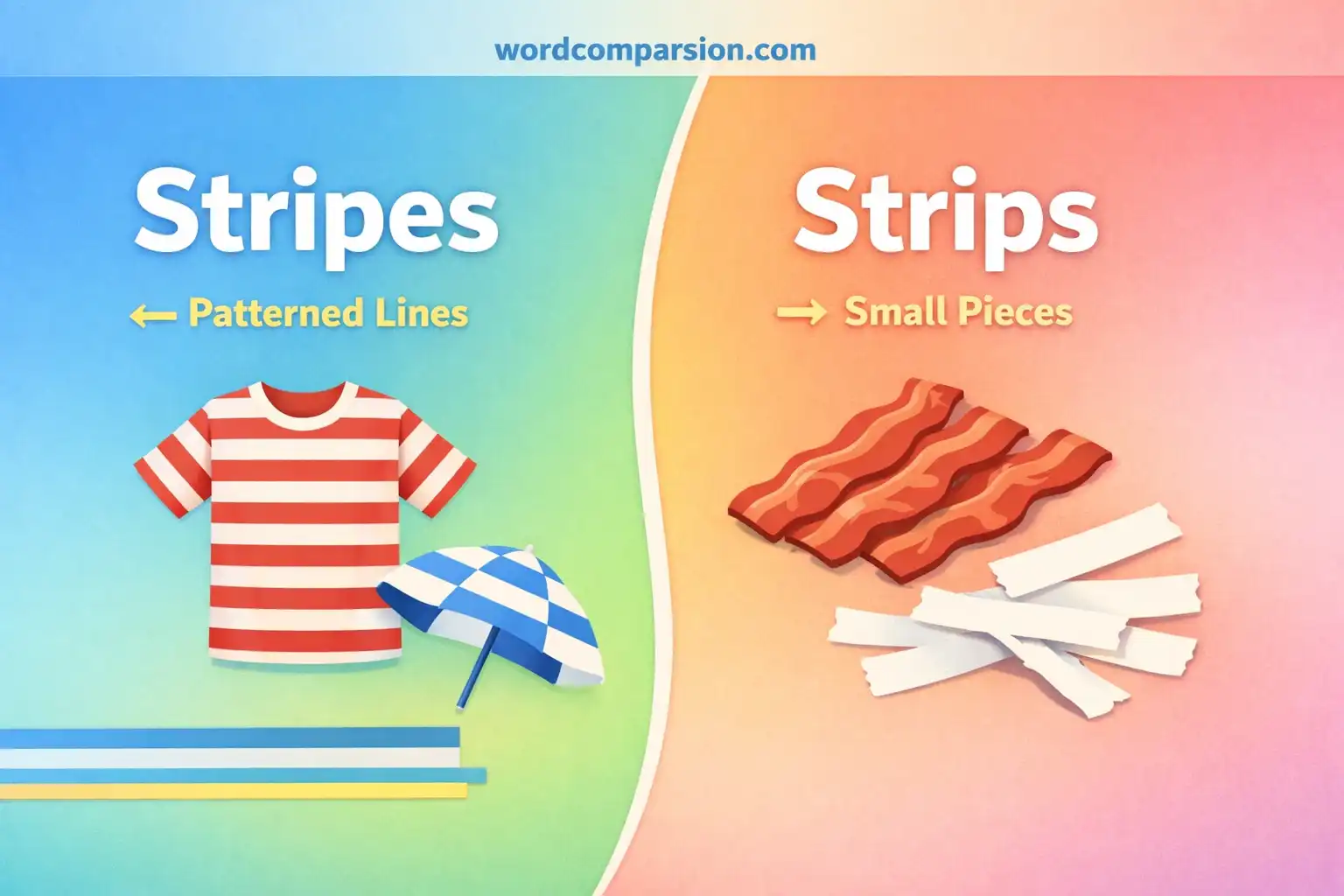
You read a sentence like this: “The shirt has blue strips.”
Something feels wrong. But why?
Many learners, writers, and even native speakers mix up stripes and strips. The words look almost the same. They sound close too. So, people often use one when they really mean the other. This mistake happens in school essays, emails, product descriptions, and even news posts.
The confusion matters because the two words mean very different things. One talks about lines or patterns. The other talks about long, narrow pieces of something. When you mix them up, the meaning of your sentence changes.
So, this article will make it simple. You will learn the real difference, see clear examples, and know exactly when to use each word.
Stripes vs Strips – Quick Answer
- Stripes = lines or bands in a pattern
- Strips = long, thin pieces cut from something
Examples:
- The zebra has black stripes.
- Cut the paper into thin strips.
Easy rule:
If you see a pattern, use stripes.
If you cut pieces, use strips.
The Origin of Stripes vs Strips
Both words come from old Germanic roots. Long ago, people used similar sounds to talk about tearing or marking things.
- Strip came first. It meant to pull off or to tear away. Later, it also meant a long narrow piece.
- Stripe came later. It described a mark made by striking or brushing something.
Over time, stripe started to mean a colored line or band. Meanwhile, strip kept its meaning of a thin piece.
However, because the words look so similar, people often confuse them today. Writers often type fast and choose the wrong one without noticing. Editors usually see this mistake in clothing descriptions and craft instructions.
British English vs American English Spelling
There is no spelling difference between British and American English for these words.
| Word | US Spelling | UK Spelling | Meaning |
|---|---|---|---|
| Stripes | Stripes | Stripes | Pattern lines |
| Strips | Strips | Strips | Thin pieces |
So, the confusion is not about spelling style. It is about meaning.
Which Spelling Should You Use?
This is not about region. It is about context.
- Use stripes when you describe patterns, designs, or markings.
- Use strips when you talk about pieces you cut, tear, or separate.
This rule works in the US, the UK, and everywhere else.
In global or professional writing, choosing the right word shows care and clarity.
Common Mistakes with Stripes vs Strips
Here are mistakes editors often see:
❌ The tiger has orange and black strips.
✅ The tiger has orange and black stripes.
❌ She wore a dress with white strips.
✅ She wore a dress with white stripes.
The mistake usually happens when people think about long shapes and forget whether it is a pattern or a piece.
Stripes vs Strips in Everyday Examples
You can see the difference in daily writing.
Emails
- “Please send the logo with blue stripes.”
- “Cut the banner into three strips.”
News
- “The team wore jerseys with red stripes.”
- “Police found metal strips on the road.”
Social Media
- “Love these rainbow stripes!”
- “DIY craft using paper strips.”
Professional Writing
- “The design uses vertical stripes for contrast.”
- “Apply adhesive strips to the back.”
Stripes vs Strips – Usage Patterns & Search Interest
Many students and ESL learners search this because spellcheck tools do not always catch the error. Both words are correct English words. So, grammar tools often miss the mistake.
Writers often confuse them in fashion, design, cooking, and craft topics.
A real problem happens in product descriptions. For example, saying “shirt with blue strips” can confuse buyers. They may imagine pieces of cloth instead of a pattern.
So, this small word choice can change how people understand your message.
Comparison Table
| Feature | Stripes | Strips |
|---|---|---|
| Meaning | Lines or bands in a pattern | Long, thin pieces |
| Part of speech | Noun (plural of stripe) | Noun (plural of strip) |
| Context of use | Clothing, animals, design, flags | Cooking, crafts, cutting materials |
| Formal vs informal | Used in all writing | Used in all writing |
| Common mistake | Used when talking about cut pieces | Used when talking about patterns |
| Correct example | The flag has red stripes | Cut the carrot into strips |
FAQs
Is stripes the same as strips?
No. Stripes are pattern lines. Strips are thin pieces.
Which one is correct in formal writing?
Both are correct. You must choose based on meaning.
Can they be used interchangeably?
No. Using the wrong one changes the meaning.
Why do people confuse them?
They look and sound similar, and both describe long shapes.
Can grammar tools catch this mistake?
Often, no. Both words are spelled correctly.
Is there a British vs American difference?
No. The words are the same in both styles.
What is an easy way to remember?
Pattern = stripes. Pieces = strips.
Conclusion
The confusion between stripes and strips is common, but the fix is simple. One word talks about lines in a pattern. The other talks about thin pieces you cut or tear.
This mistake happens because both words describe long shapes. However, the context tells you which one to use. When you write about clothes, animals, or designs, you usually need stripes. When you write about food, paper, cloth, or materials, you usually need strips.
Overall, the key is to stop and ask: Is this a pattern or a piece?
Finally, remember this easy rule:
If you see lines, write stripes. If you cut pieces, write strips.

James Holloway writes detailed guides on confusing English words and grammar usage with clear side-by-side comparisons.