When it comes to the words “straight” and “strait,” many people get confused, often using them interchangeably. While they may sound similar, these two words have distinct meanings and applications in English.
If you’ve ever been unsure about which one to use, you’re not alone. Whether you’re writing an email, preparing a report, or just chatting with friends, using the right word can make all the difference.
This article will help clear up any confusion and guide you on when to use each word correctly.
Straight vs Strait – Quick Answer
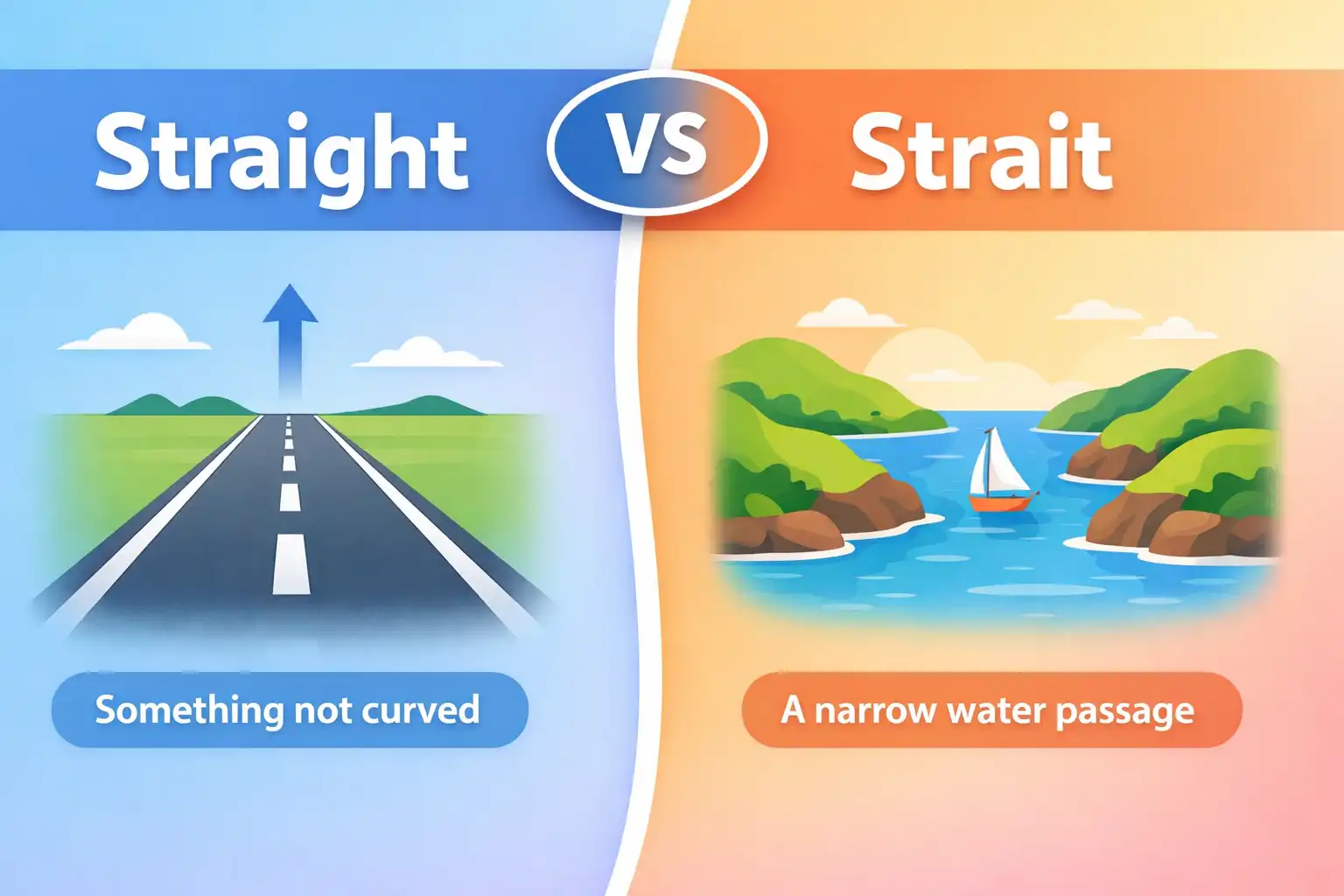
- Straight: Refers to something that is direct, not curved, or without deviation.
- Strait: Refers to a narrow waterway connecting two larger bodies of water or a difficult situation.
Easy rule: Use “straight” for direction or clarity, and “strait” for geographic features or difficult circumstances.
Etymology: Origin of Straight vs. Strait
The words “straight” and “strait” both come from different roots and evolved separately in the English language.
- Straight comes from the Old English word “streht,” which meant direct or without bend.
- Strait comes from the Old French word “estreit,” meaning narrow or tight, which was derived from the Latin “strictus,” meaning tight or narrow.
Though they sound alike today, their origins show that they were always meant to convey different concepts.
Why People Confuse Straight and Strait (Common Errors)
The confusion between “straight” and “strait” is common, especially because they sound very similar. The key reason people mix them up is that they are often used in similar contexts, like describing things that are narrow or direct. However, understanding the specific contexts in which each word should be used can help prevent errors.
One of the most common mistakes is when people use “strait” to describe something that is straightforward or not curved, as in “He took the strait path,” which should actually be “straight path.”
Spelling + Meaning: No US/UK Difference (But Usage Matters)
Interestingly, both “straight” and “strait” are spelled the same way in both British and American English. There’s no difference in spelling, so the distinction comes down to how these words are used rather than where you are writing from.
For example, in both British and American English, the word “strait” will always refer to a narrow body of water, like the Bering Strait or Gibraltar Strait. On the other hand, “straight” will always describe something that doesn’t curve, like a straight line or straightforward approach.
How to Choose the Right Word Fast
- In US English: Use “straight” for directness, alignment, or simplicity. “Strait” will always be used for narrow water passages or when describing a challenging situation.
- In UK/Commonwealth English: The same rules apply. “Straight” is for directness or clarity, and “strait” refers to water or difficulty.
- In Global or Professional Writing: Stick with “straight” when referring to direction, clarity, or without bends. Use “strait” only for geographic features or tight situations.
Common Mistakes with Straight vs Strait
Mistake #1: Incorrect → Strait path
- Correct → Straight path
- “Straight” refers to something that doesn’t bend. “Strait” is for narrow or difficult contexts.
Mistake #2: Incorrect → He is in a straight of financial trouble
- Correct → He is in a strait of financial trouble
- “Strait” refers to a difficult situation or a challenging circumstance.
- Correct → The strait of Magellan
- “Strait” is used for narrow water passages between larger bodies of water.
Straight vs Strait in Everyday Examples
- Emails
- Correct: “The meeting was straight to the point.”
- Incorrect: “The meeting was strait to the point.” (This would be wrong because “strait” refers to something narrow or difficult, not direct.)
- News
- Correct: “The politician’s speech was straight and clear.”
- Incorrect: “The politician’s speech was strait and clear.”
- Social Media
- Correct: “Follow the straight road for the best results.”
- Incorrect: “Follow the strait road for the best results.”
- Professional Writing
- Correct: “She took a straight approach to solving the problem.”
- Incorrect: “She took a strait approach to solving the problem.”
Who Confuses These Words (And Why It Matters)
Many learners and writers mix up straight and strait because the words sound the same and are used in contexts related to direction or narrowness. This confusion often happens in real writing and communication.
Who tends to make this mistake?
- Students (especially ESL learners)
Learners of English often hear the words before they see them. Because they sound alike, students sometimes pick the wrong spelling when writing sentences. - Early-stage writers
Writers who are still building their vocabulary might choose strait when they mean straight. This especially happens in informal notes or quick writing apps. - Casual online users
On social media or chats, people may type strait when they mean straight ahead — simply because autocorrect doesn’t catch the meaning. - Even experienced writers
Editors sometimes see the error in formal texts, especially when the context involves narrow spaces or difficult situations.
Why does this confusion matter?
Using the wrong word can make a sentence unclear or even misleading:
- If you write “follow the strait line,” a reader might pause or misinterpret your meaning.
- In geography, using straight instead of strait can change the meaning entirely (for example, the Strait of Gibraltar is a named place — not the Straight of Gibraltar).
- In professional writing, such errors can reduce the reader’s trust in the content.
Where the confusion shows up most
- School essays and homework
- Emails and messages
- Blogs and social media posts
- Travel or geography writing
- Professional documents with technical terms
Overall, knowing the difference helps you write more accurately and communicate clearly. A small word change can make your meaning precise and confident.
Comparison Table
| Aspect | Straight | Strait |
| Meaning | Direct, without a curve, clear | Narrow waterway, difficult situation |
| Part of Speech | Adjective, Noun (e.g., straight path, straight line) | Noun (e.g., the Strait of Gibraltar) |
| Context of Use | Directions, clarity, alignment | Geography, difficulties, challenges |
| Formal vs Informal | Formal & Informal | Formal (geographical context) |
| Common Mistakes | Using “strait” to mean direct or not curved | Using “straight” for narrow water features |
| Correct Example | “He walked straight into the room.” | “They sailed through the strait.” |
Semantic FAQs
- Is “Straight” the same as “Strait”?
- No, “straight” refers to directness or alignment, while “strait” refers to narrow water passages or difficult situations.
- Which one is correct in formal writing?
- “Straight” is used for directness or alignment, while “strait” is used for narrow water passages or challenging circumstances.
- Can they be used interchangeably?
- No, they cannot be used interchangeably. They have different meanings and contexts.
- Why do people confuse them?
- People confuse “straight” and “strait” because they sound similar and can both refer to direct or narrow things.
- Can grammar tools catch this mistake?
- Grammar tools may catch it, but it’s best to understand the difference between the two to avoid confusion.
- Is there a British vs American difference?
- No, both “straight” and “strait” are used the same way in both British and American English.
Conclusion
To wrap up, the key difference between “straight” and “strait” comes down to their meaning and usage. “Straight” is used when something is direct, aligned, or clear, while “strait” is reserved for narrow geographical features or difficult situations.
The most common mistake to avoid is using “strait” when you mean “straight,” especially in everyday contexts like describing directions or clarity.
Quick Rule to Remember: Use “straight” for things that are direct or aligned, and “strait” for narrow or difficult situations.

Smith Grame is a research-focused writer specializing in word comparison and language analysis. His work centers on examining how words differ in meaning, usage, tone, and context, with an emphasis on clarity and accuracy. Drawing on a background in analytical writing and semantic research, he approaches language as a system shaped by history, usage patterns, and real-world communication needs.
Grame’s writing is grounded in careful source evaluation, dictionary standards, corpus-based evidence, and contextual examples. He is particularly experienced in comparing near-synonyms, commonly confused terms, and subtle semantic distinctions that affect interpretation in academic, professional, and everyday writing. Rather than simplifying language, his goal is to explain it precisely, helping readers understand why one word fits better than another in a given context.
His articles are written for readers who value accuracy and trustworthiness, including students, educators, editors, and professionals. By focusing on evidence-based explanations and clear structure, Grame helps readers make confident, informed choices about language use.