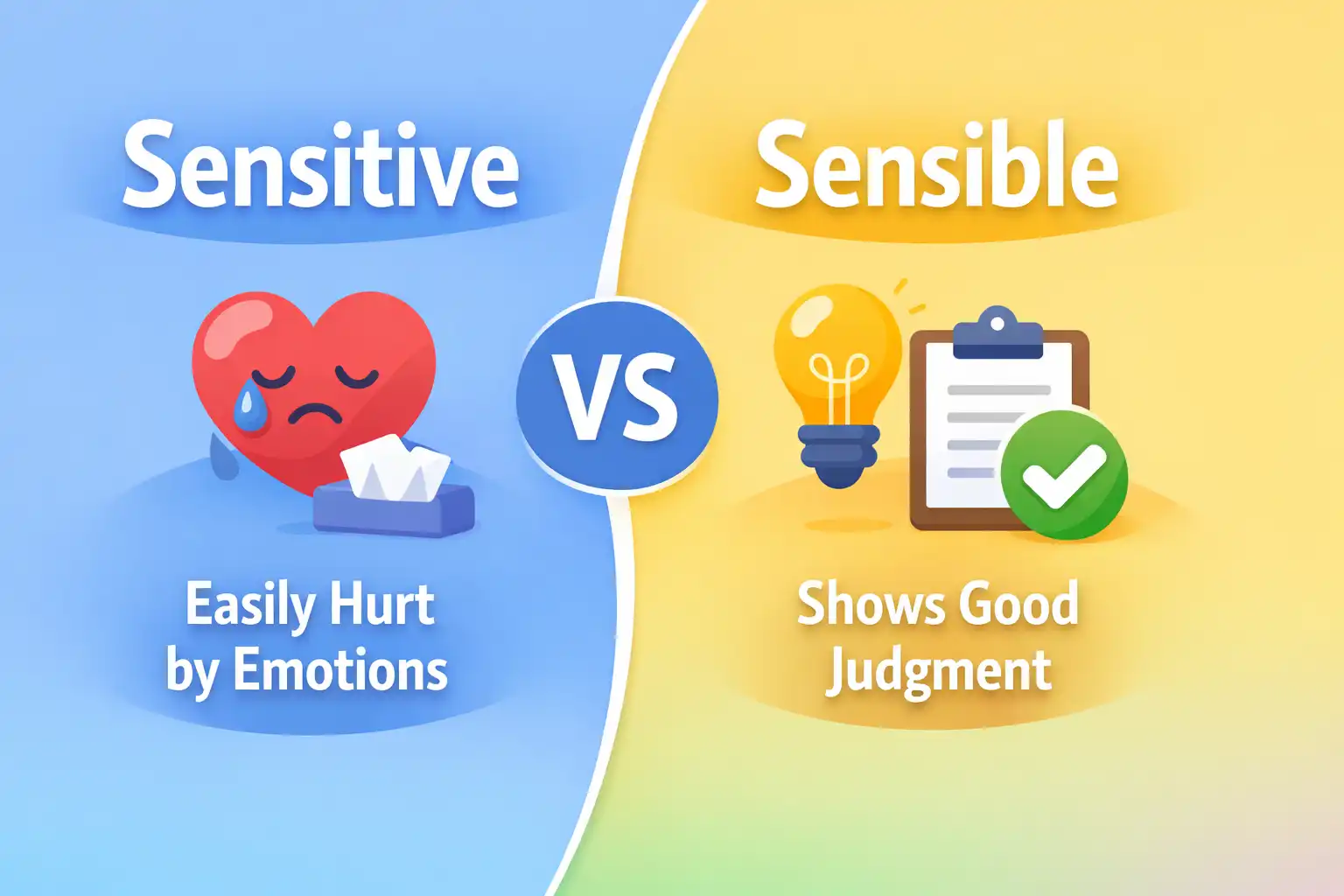
When you’re learning English, some words might look very similar but mean completely different things. A good example is the difference between “sensitive” and “sensible.” Although both words describe a kind of reaction or feeling, they are used in distinct situations. Understanding when to use each word can be tricky, and many learners confuse them.
This confusion is common because both words are connected to emotions and behavior, but their meanings and contexts are not the same.
In this article, we’ll explore the meanings, correct uses, and common mistakes made with these words. By the end, you’ll know exactly when to use “sensitive” and when to choose “sensible.” Let’s clear up the confusion once and for all!
Sensitive: Meaning + Fast Examples
- Meaning: “Sensitive” describes someone or something that reacts strongly to external influences, emotions, or physical sensations.
- Real-World Example:
- Sensitive person: “She’s very sensitive to criticism.”
- Sensitive skin: “I have sensitive skin that reacts easily to strong soaps.”
- Decision Rule: Use “sensitive” when talking about emotions or physical reactions to things.
Word Origins (Etymology) + Reliable Source Note
To understand how these words became confusing, let’s look at where they come from.
- Sensitive: This word comes from the Latin word “sensibilis,” meaning “that can be perceived.” Over time, it evolved to describe people, animals, or things that are easily affected or influenced by external stimuli, whether physically or emotionally.
- Sensible: This word originates from the Latin “sensibilis,” too, but it evolved differently. “Sensible” refers to someone who shows good judgment or common sense. The Latin root here is “sensus,” meaning “feeling” or “sense,” but it focuses on mental clarity, not emotional reactions.
Today, both words share a common origin but serve distinct purposes in English.
Reason for Confusion Today
The confusion arises because “sensitive” and “sensible” both relate to how we perceive or react to things, but in very different ways. “Sensitive” often refers to emotions, reactions, or physical conditions, while “sensible” refers to rational thinking and good judgment.
It’s easy to mix them up in conversation or writing, especially when someone is describing how someone feels or behaves. However, they should never be used interchangeably.
British English vs American English Spelling
There is no major difference in the spelling of “sensitive” and “sensible” between British and American English. Both spellings are the same in both regions.
| Word | British English | American English |
| Sensitive | Sensitive | Sensitive |
| Sensible | Sensible | Sensible |
Since there are no spelling differences, the focus should be on how and when to use each word.
How to Choose the Right Word Fast
Here’s a quick guide on when to use “sensitive” vs “sensible.”
- For a person’s feelings or emotions: Use sensitive.
- Example: “He is very sensitive to noise.”
- For logical thinking or good judgment: Use sensible.
- Example: “It’s sensible to wear a jacket in the cold.”
Audience-based Guidance
- US Writers: Use “sensitive” for emotional reactions and “sensible” for reasoned thinking.
- UK Writers: The rules are the same as in American English.
- Global or Professional Writing: Ensure you’re distinguishing between emotional sensitivity and logical judgment. In professional settings, it’s important to communicate these differences clearly.
Common Mistakes with Sensitive vs Sensible
Writers often mix up “sensitive” and “sensible” because both relate to emotions and reactions. Here are some common mistakes and their correct forms:
❌ Incorrect → ✅ Correct Format
- Incorrect: “It’s not sensitive to cry during the meeting.”
- Correct: “It’s not sensible to cry during the meeting.”
- Explanation: Crying during a meeting is often seen as an impractical action, so “sensible” (which refers to good judgment) is the correct word.
- Incorrect: “You should be sensible when making decisions about your health.”
- Correct: “You should be sensitive when making decisions about your health.”
- Explanation: In this case, “sensitive” is the better choice because it refers to being emotionally considerate of a person’s health, rather than showing judgment.
- Incorrect: “She is very sensible to criticism.”
- Correct: “She is very sensitive to criticism.”
- Explanation: If someone reacts emotionally to criticism, they are “sensitive” to it, not “sensible.”
- Incorrect: “It was a sensible decision to apologize.”
- Correct: “It was a sensitive decision to apologize.”
- Explanation: Apologizing can be a delicate action that requires emotional understanding, so “sensitive” fits better in this case.
By paying attention to these examples, you’ll avoid the most common mistakes and use “sensitive” and “sensible” correctly in your writing!
Sensitive vs Sensible in Everyday Examples
Let’s look at more natural examples of how “sensitive” and “sensible” are used in everyday situations.
Emails:
- Sensitive: “Please be sensitive to her feelings after the bad news.”
- Sensible: “It’s sensible to reply to emails promptly to maintain clear communication.”
News:
- Sensitive: “The reporter had to handle a sensitive topic with care.”
- Sensible: “It was sensible for the government to announce the new policy in stages.”
Social Media:
- Sensitive: “She shared a sensitive post about mental health, so be mindful of the comments.”
- Sensible: “It’s sensible to set your social media privacy settings to protect your information.”
Formal or Professional Writing:
- Sensitive: “The company’s report covered a sensitive issue regarding employee well-being.”
- Sensible: “It’s sensible to consider all possible outcomes before making a decision.”
These examples show how each word fits naturally in different contexts. “Sensitive” is often used when discussing emotions, delicate situations, or issues requiring careful handling, while “sensible” is used for actions or decisions based on sound judgment.
Sensitive vs Sensible – Usage Patterns & Search Interest
Many learners and writers search for the difference between “sensitive” and “sensible” to ensure they’re using the right word in different contexts. Here are some common reasons why people look up these words:
- Confusion between emotional and logical contexts: Learners often get confused because both words relate to reactions or behaviors, but “sensitive” is about emotional or physical reactions, while “sensible” refers to sound judgment or practical thinking.
- Clarifying their usage in professional writing: People want to know which word is appropriate in formal emails or reports. They may need to distinguish between emotional responses (“sensitive”) and rational decision-making (“sensible”).
- ESL learners: Non-native English speakers may struggle to grasp the nuances of these words since many languages don’t have an equivalent for “sensible” in the same context, making the distinction more difficult.
- Common mistakes in everyday conversation: Writers or students may search for examples to avoid misusing these words in casual speech or writing, ensuring they sound natural and correct.
For example, a person might search for “sensitive vs sensible” when trying to write a formal email that requires clear decision-making but ends up mistakenly using “sensitive” when “sensible” would be more appropriate.
Comparison Table: Sensitive vs Sensible
Here’s a comparison table to help you easily spot the differences:
| Aspect | Sensitive | Sensible |
| Meaning | Easily affected by emotions or external factors | Showing good judgment or common sense |
| Part of Speech | Adjective | Adjective |
| Context of Use | Emotional reactions, physical reactions | Reasonable thinking, logical decision-making |
| Formal vs Informal | Often used in both formal and informal contexts | Used in both formal and informal settings |
| Common Mistakes | Confusing it with “sensible” in decision-making | Using “sensible” when referring to emotions |
| Correct Example | “She’s very sensitive to loud sounds.” | “It’s sensible to save money for emergencies.” |
FAQs – People Also Ask
- Is sensitive the same as sensible?
No, “sensitive” refers to emotional or physical reactions, while “sensible” refers to good judgment. - Which one is correct in formal writing?
Both can be used in formal writing, but make sure to use them in the right context. - Can they be used interchangeably?
No, they cannot be used interchangeably. “Sensitive” is for emotional or physical responses, and “sensible” is for logical thinking. - Why do people confuse them?
People confuse them because both deal with perception, but one relates to emotions and the other to judgment. - Can grammar tools catch this mistake?
Some advanced grammar tools might catch this mistake, but it’s best to learn the difference for clearer writing. - Is there a British vs American difference?
No, there is no spelling difference between “sensitive” and “sensible” in British or American English.
Conclusion
In short, “sensitive” and “sensible” are two distinct words with different meanings and uses. Remember:
- “Sensitive” refers to emotional or physical reactions, like being easily affected by feelings or stimuli.
- “Sensible” refers to good judgment or rational thinking, like making decisions based on reason.
A common mistake to avoid is using “sensitive” when you mean “sensible” (and vice versa). For example, you should say, “It’s sensible to save money,” not “It’s sensitive to save money.”
Memory Trick: Think of “sensitive” as related to “senses” (how you feel or react), and “sensible” as related to “sense” (good judgment or common sense).
Example:
- Sensitive: “He’s very sensitive to loud noises.” (He reacts strongly to noise.)
- Sensible: “It’s sensible to turn off the lights when you leave a room.” (A practical and reasonable decision.)
With these simple rules and examples, you’ll confidently choose the right word every time.

Moses Jhon is a dedicated content writer known for producing high-quality, reader-focused, and SEO-optimized content. He has experience crafting blog posts, website content, articles, and marketing copy across different niches. His writing style combines creativity, clarity, and strategy to help businesses grow their online presence and engage their target audience effectively.