Many people mix up sale vs sell, and the confusion happens more often than you think. You may see both words in shops, emails, and ads. Still, using the wrong one can change the meaning of your sentence. This is why students, writers, and even professionals stop and wonder which word fits best.
Now the problem is simple. Both words come from the same idea, which is buying and selling things. But their roles are very different. One is a noun, and the other is a verb. So, if you swap them, your sentence becomes incorrect or sounds unnatural.
In this guide, you will learn the exact difference between sale and sell, how to use them in real life, and how to avoid common mistakes. By the end, you will not feel confused again.
Sale vs Sell – Quick Answer
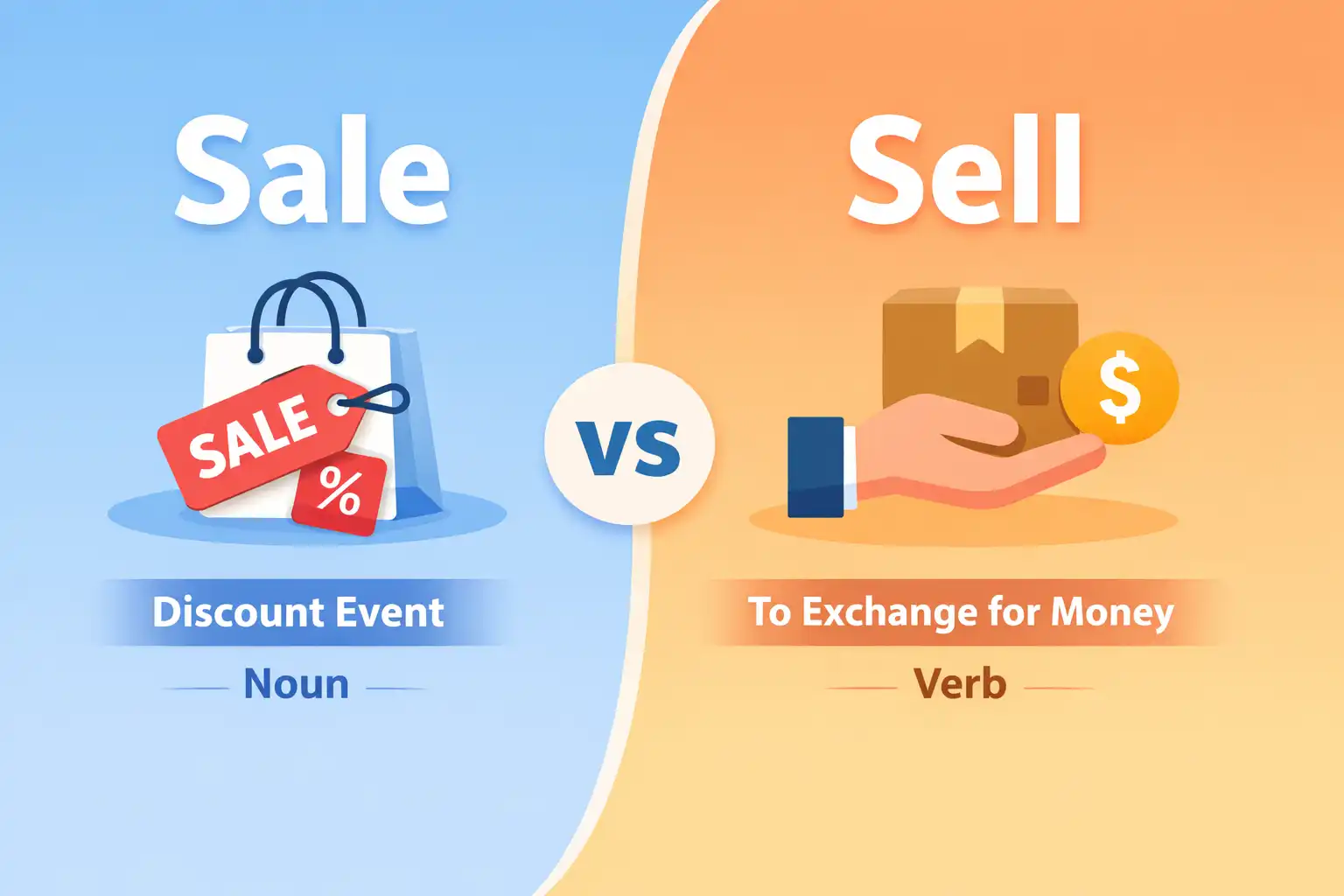
Sale means the act or event of selling something. It is a noun.
Sell means to give something in exchange for money. It is a verb.
- Use sale when you talk about a thing or event
- Use sell when you talk about an action
Examples:
- The shop has a big sale today
- I want to sell my old phone
Easy rule: If you need an action, use “sell.” If you need a thing or event, use “sale.”
Meaning of Sale
- A noun
- Refers to a transaction or event
- Often used in business or shopping
Examples:
- The store is having a winter sale
- That was the final sale of the year
Meaning of Sell
- A verb
- Shows an action
- Used when someone gives something for money
Examples:
- I will sell my car next week
- They sell clothes online
The Origin of Sale vs Sell
The words sale and sell come from old English roots. The word “sell” comes from an old term that means “to give or hand over.” Over time, it took the meaning of exchanging goods for money. On the other hand, “sale” developed as a noun from the same root, but it focused on the result or event of selling.
Now, the confusion exists because both words look and sound similar. Also, they are closely related in meaning. Writers often confuse them when they rush or translate from another language. Editors usually see this mistake in beginner writing and ESL content.
British vs American English Spelling
There is no spelling difference between sale vs sell in British and American English. Both regions use the same forms.
However, the usage context remains the same:
- Sale = noun
- Sell = verb
Example comparison:
| Context | British English | American English |
| Event | Big sale | Big sale |
| Action | Sell items | Sell items |
So, there is no regional confusion here. The main issue is usage, not spelling.
How to Choose the Right Word Fast
Choosing between sale vs sell becomes easy when you follow a simple method.
For US users:
Use “sale” for events like discounts. Use “sell” when you talk about actions.
For UK or Commonwealth users:
The same rule applies. There is no difference in usage.
For global or professional writing:
Focus on sentence structure. Ask yourself one question:
Is this an action or a thing?
- Action → use sell
- Thing/event → use sale
This method works in emails, reports, and daily writing.
Common Mistakes with Sale vs Sell
Writers often make small but important mistakes with these words. Here are the most common ones.
❌ I want to make a sell today
✅ I want to make a sale today
Explanation: “Sell” is a verb, not a noun.
❌ The shop will sale all items
✅ The shop will sell all items
Explanation: “Sale” cannot be used as a verb.
❌ They are doing a sell on shoes
✅ They are having a sale on shoes
Explanation: Use “sale” for events or offers.
These mistakes happen because both words are related. Still, once you know their roles, you can avoid errors easily.
Sale vs Sell in Real Life Examples
You will see these words everywhere. Here are simple examples from daily life.
Emails:
- We plan to sell our products online
- Our summer sale starts tomorrow
News:
- The company sold its shares
- The sale of assets was completed
Social media:
- Selling my bike, DM me
- Flash sale live now
Professional writing:
- The firm will sell its division next year
- The final sale agreement is signed
These examples show how context changes the word choice.
Sale vs Sell – Word Usage Patterns and Search Trends
People search for sale vs sell because the words look similar. Students, ESL learners, and beginner writers often face this issue. Also, people who write emails or business content want to avoid mistakes.
Now, in real-world situations, using the wrong word can cause confusion. For example, if a business writes “We will sale items,” it looks unprofessional. This can affect trust and clarity.
So, learning the correct usage is not just about grammar. It also improves communication.
Sale vs Sell – Comparison Table
| Feature | Sale | Sell |
| Meaning | Event or act of selling | Action of giving for money |
| Part of Speech | Noun | Verb |
| Context | Shopping, business events | Actions in sentences |
| Formal vs Informal | Used in both | Used in both |
| Common Mistake | Used as a verb | Used as a noun |
| Correct Example | The store has a sale | I want to sell my laptop |
This table helps you understand the difference at a glance.
FAQs About Sale vs Sell
Is sale the same as sell?
No. Sale is a noun, and sell is a verb. They have different roles.
Which one is correct in formal writing?
Both are correct when used properly. The context decides which one to use.
Can they be used interchangeably?
No. You cannot replace one with the other because they serve different functions.
Why do people confuse them?
They come from the same root and look similar. This causes confusion.
Can grammar tools catch this mistake?
Some tools can detect it, but not always. So, understanding the rule is better.
Is there a British vs American difference?
No. Both forms are the same in British and American English.
How can I remember the difference?
Think of “sell” as an action and “sale” as a result or event.
Conclusion
Understanding sale vs sell is simple once you know their roles. “Sell” is an action, and “sale” is the result or event. This one difference explains everything.
Now, many people confuse these words because they look similar. However, using the wrong one can make your writing unclear. This matters in emails, business writing, and even casual messages.
Overall, the best way to avoid mistakes is to focus on the sentence. Ask yourself if you are describing an action or a thing. Then choose the word based on that.
In short, remember this rule:
If you can replace the word with “action,” use sell. If you mean an event or result, use sale.
This simple tip will help you use both words correctly every time.

Moses Jhon is a dedicated content writer known for producing high-quality, reader-focused, and SEO-optimized content. He has experience crafting blog posts, website content, articles, and marketing copy across different niches. His writing style combines creativity, clarity, and strategy to help businesses grow their online presence and engage their target audience effectively.