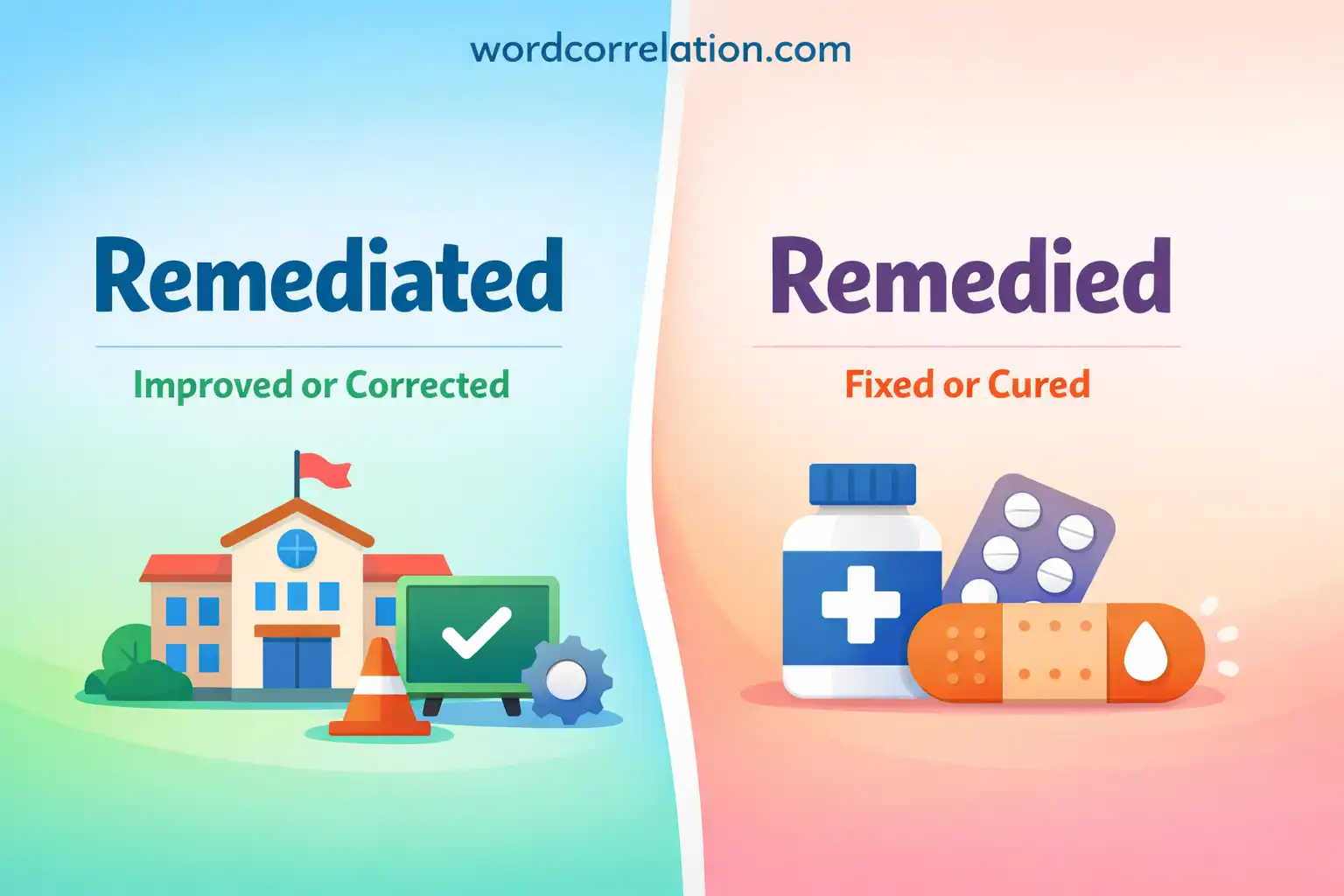
Many people pause when they see remediated and remedied. Both words look alike. Both talk about fixing a problem. So writers often think they mean the same thing. But they do not work the same way in real life. This small difference can change tone, clarity, and even professionalism.
Now imagine sending a report at work. You write, “The issue was remedied.” A technical team may expect “remediated” instead. The sentence still makes sense, but it sounds less precise. Readers may wonder what you actually fixed. This confusion happens often because the words share the same root. However, they live in different usage worlds.
This article explains the difference in very simple terms. You will learn meaning, origin, spelling, and real examples. You will also see common mistakes and an easy rule to remember.
Remediated vs Remedied – Quick Answer
Remediated means fixed through a process or system.
Remedied means fixed in a general or simple way.
- Use remediated for technical or formal problems
- Use remedied for everyday situations
Example:
✔ The company remediated the security risk
✔ She remedied the mistake with an apology
Easy rule: technical = remediated, general = remedied
The Origin of Remediated vs Remedied
Both words come from the Latin root remedium, which means cure or solution. That shared origin explains why they look so close. Early English used remedy as a noun first. Then people turned it into a verb. Later, professional fields shaped new forms.
“Remedied” grew from everyday English. People used it in stories, law, and daily speech. It described fixing a wrong or solving a problem. The word sounded natural and broad.
However, modern industries needed a stricter term. Science, IT, medicine, and environmental work needed a word that showed a planned correction. So “remediated” became popular in formal settings. It suggests a structured fix, not just a casual solution.
Writers often confuse them today because the difference is about context, not grammar. Both are correct words. The problem is choosing the right tone.
British English vs American English Spelling
There is no spelling difference between British and American English for these words. Both regions use remediated and remedied exactly the same way.
However, tone can differ slightly. British writing sometimes prefers simpler wording in public communication. American corporate writing often favors technical language. That means “remediated” appears more in formal US reports. Still, the spelling stays identical.
| Region | Spelling | Usage Difference |
| US | Remediated / Remedied | More technical tone common |
| UK | Remediated / Remedied | Slight preference for plain style |
So spelling is not the issue. Context is the real factor.
Which Spelling Should You Use?
Since spelling does not change, the choice depends on audience and purpose.
For US professional writing, “remediated” often sounds more precise in reports, audits, and technical documents. It signals a structured correction.
For UK or Commonwealth audiences, both forms appear. Writers may choose “remedied” when tone needs to feel simple and human.
For global or online writing, clarity matters more than region. If your topic is technical, choose remediated. If the message is general, choose remedied.
When in doubt, match the language of the field you are writing in.
Common Mistakes with Remediated vs Remedied
Writers mix these words because they focus only on meaning, not context.
❌ The company remedied the cybersecurity vulnerability
✅ The company remediated the cybersecurity vulnerability
(Technical system fix → use remediated)
❌ She remediated her late homework
✅ She remedied her late homework
(Everyday situation → use remedied)
❌ The pollution problem was remedied through a formal cleanup plan
✅ The pollution problem was remediated through a formal cleanup plan
(Structured process → remediated)
Editors usually see mistakes when casual writing sounds too technical or technical writing sounds too casual.
Remediated vs Remedied in Everyday Examples
Emails
“I have remedied the billing error and updated your account.”
News
“The agency remediated contaminated soil at the site.”
Social media
“She remedied the situation with a quick fix.”
Formal writing
“The organization remediated compliance failures after the audit.”
Each sentence fixes something. The difference is tone and system level.
Remediated vs Remedied – Usage Patterns & Search Interest
People search this comparison because the words appear in work emails, academic writing, and software reports. Students often see them in textbooks. ESL learners struggle because dictionaries show similar meanings.
Professionals in IT, law, and environmental science use “remediated” often. Teachers and editors prefer “remedied” in general prose.
A real-world confusion happens in compliance reports. If a company writes “remedied” instead of “remediated,” auditors may think the fix was informal. That small word choice can change how serious the solution appears.
Comparison Table
| Feature | Remediated | Remedied |
| Meaning | Fixed through structured action | Fixed in a general way |
| Part of speech | Verb (past tense) | Verb (past tense) |
| Context | Technical, professional | Everyday, broad |
| Tone | Formal and procedural | Neutral and natural |
| Common mistake | Used in casual speech | Used in technical reports |
| Correct example | The team remediated the data breach | She remedied the error |
FAQs
Is remediated the same as remedied?
No. Both mean fixed, but remediated sounds technical.
Which one is correct in formal writing?
Remediated fits structured or professional fixes.
Can they be used interchangeably?
Sometimes, but tone may feel wrong.
Why do people confuse them?
They share the same root and look alike.
Can grammar tools catch this mistake?
Most tools miss context differences.
Is there a British vs American difference?
No spelling change exists.
Which word sounds more technical?
Remediated sounds more procedural.
Conclusion
Overall, both words talk about solving problems. The difference lies in how the solution happens. Remediated suggests a planned, technical process. Remedied describes a general fix in everyday language. That distinction matters because tone shapes how readers interpret seriousness and professionalism.
In short, writers should match the word to the situation. Use remediated when systems, audits, or formal corrections appear. Choose remedied for personal mistakes or simple issues. Mixing them will not break grammar, but it may confuse readers about the scale of the solution.
Finally, remember this easy rule:
Technical process = remediated. Simple fix = remedied.
That single guideline prevents almost every mistake.

James Holloway writes detailed guides on confusing English words and grammar usage with clear side-by-side comparisons.