Many learners struggle with nominal vs notional because the two words look similar and appear in similar topics, especially grammar, economics, and finance. At first glance, both words seem to describe something that exists in name or idea rather than reality. So confusion happens easily.
Writers, students, and ESL learners often mix them when discussing value, meaning, or grammar structure. For example, someone may write nominal meaning when they actually mean notional meaning. Editors see this mistake often because the words share Latin roots and sound alike.
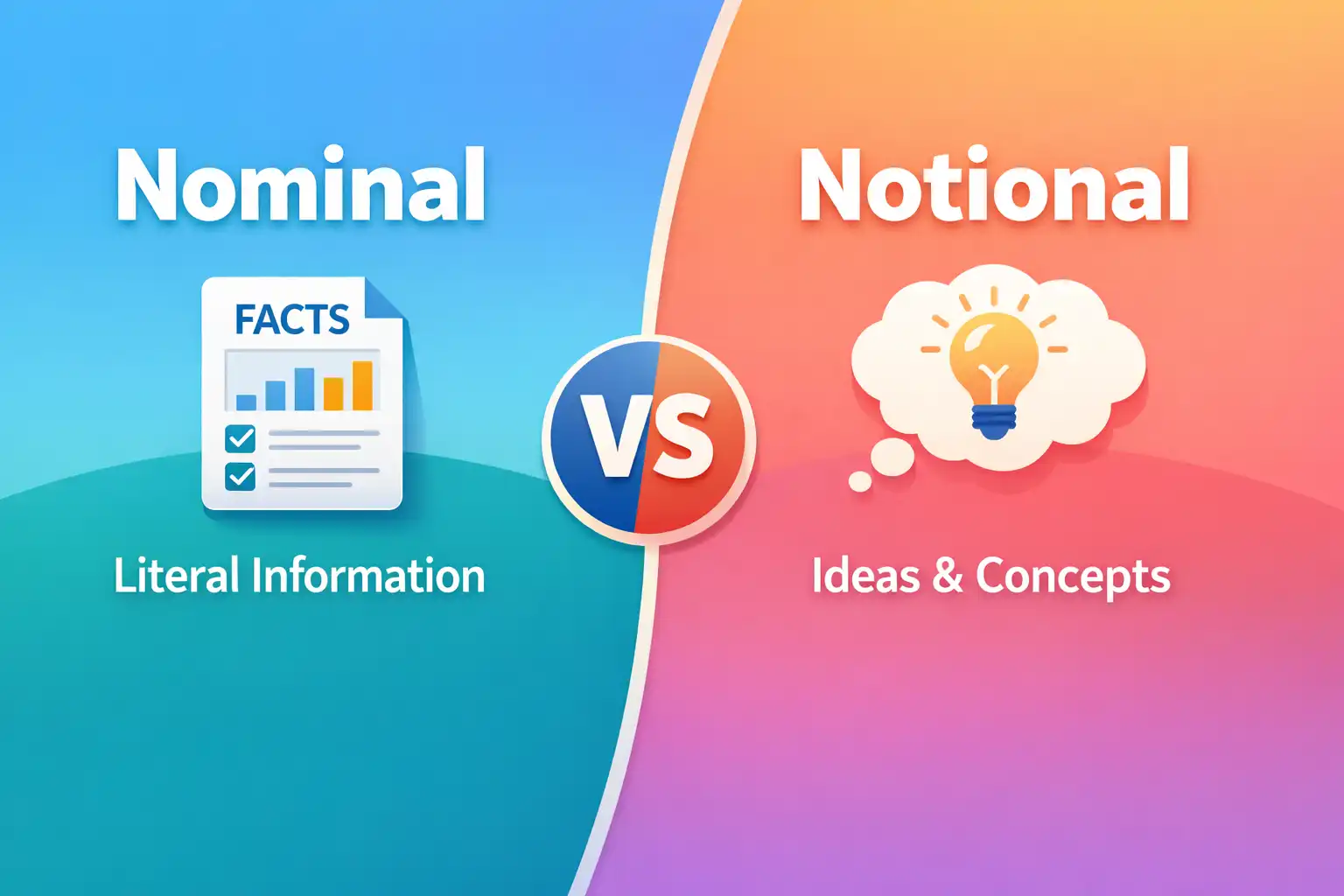
However, the meanings are different. Each word works in a specific context. Nominal usually relates to name, label, or official value. Meanwhile, notional refers to idea, concept, or imagined value.
This guide explains the difference in very clear language. You will learn the meaning, origin, correct usage, and common mistakes. By the end, you will know exactly when to use nominal and when to use notional.
Nominal vs Notional – Quick Answer
Meaning of Nominal
Nominal means something exists in name, label, or official value, but it may not reflect real value.
- Used for official names or values
- Often appears in finance and grammar
Examples
- The nominal fee was only five dollars.
- The nominal head of the organization attended the event.
Meaning of Notional
Notional refers to something based on an idea, concept, or theoretical amount.
- Used for conceptual or theoretical values
- Common in finance and grammar meaning
Examples
- The notional value of the contract is one million dollars.
- The group has notional agreement even though the grammar looks singular.
Easy rule:
Use nominal for name or official value, but use notional for conceptual meaning or theoretical amount.
The Origin of Nominal vs Notional
Understanding the origin of these words helps explain why people confuse them.
The word nominal comes from the Latin word nomen, which means name. Because of this origin, the word relates to something connected to a name, title, or label.
In language studies, nominal describes nouns or noun forms. In economics, it refers to an official value that does not adjust for real changes, such as inflation.
The word notional also comes from Latin. It comes from notio, which means idea or concept. Because of this origin, the word describes something based on thought, theory, or concept rather than physical reality.
Over time, both words entered English through academic writing. Their similar spelling caused confusion, especially in finance and grammar.
Today the confusion happens because both words sometimes describe things that are not completely real or practical. Yet their focus differs. One focuses on names or labels, while the other focuses on ideas or concepts.
British vs American English Spelling
There is no spelling difference between British English and American English for these words. Both regions use the same spelling.
However, usage patterns can differ slightly depending on the field.
| Word | Meaning | Example |
| Nominal | Official name or labeled value | Nominal interest rate |
| Notional | Conceptual or theoretical amount | Notional value of derivatives |
In contrast to many English words, there are no alternative spellings like colour/color. Writers across the US, UK, and Commonwealth countries all use the same forms.
How to Choose the Right Word Fast
Choosing between nominal vs notional becomes easy when you focus on the context.
For US writing
Nominal often appears in finance, economics, and general writing.
Example: nominal price, nominal leader.
For UK and Commonwealth writing
Usage stays the same. Academic and financial texts also use notional when discussing theoretical amounts or conceptual meaning.
For global or professional writing
Use nominal when referring to labels, official roles, or stated values.
Use notional when referring to ideas, theoretical numbers, or conceptual meaning.
Quick shortcut:
If the topic is name or official label → nominal.
If the topic is idea or theoretical value → notional.
Common Mistakes with Nominal vs Notional
Many writers mix these words because they seem interchangeable. However, they are not.
❌ Incorrect: The notional fee for membership is ten dollars.
✅ Correct: The nominal fee for membership is ten dollars.
Explanation: The fee refers to a labeled or official price.
❌ Incorrect: The nominal value of the derivative contract is huge.
✅ Correct: The notional value of the derivative contract is huge.
Explanation: Finance uses notional value for theoretical contract value.
❌ Incorrect: The team has nominal agreement.
✅ Correct: The team has notional agreement.
Explanation: In grammar, notional agreement means the meaning controls the verb.
Editors often see these mistakes in academic essays, finance articles, and grammar discussions.
Nominal vs Notional in Real Life Examples
Understanding real examples helps the difference become clear.
Emails
“The company charges a nominal fee for account maintenance.”
News writing
“The derivative market has trillions in notional value.”
Social media
“This course only has a nominal cost, so anyone can join.”
Professional writing
“The board chair serves as the nominal leader, while managers handle daily decisions.”
Grammar discussion
“The phrase ‘a number of people’ uses notional agreement because the meaning is plural.”
These examples show how the two words work in different contexts.
Nominal vs Notional – Word Usage Patterns and Search Trends
Search behavior shows that people often look up nominal vs notional when studying grammar, economics, or business writing.
Students and ESL learners search for this comparison when writing essays. They often see both words in textbooks and assume they mean the same thing.
Finance professionals also search the term because nominal value and notional value appear in financial reports.
Writers and editors usually notice confusion in sentences about prices, value, and conceptual meaning.
One real-world problem appears in financial communication. If someone writes nominal value instead of notional value in a derivatives report, readers may misunderstand the type of value being discussed.
Clear usage prevents this confusion.
Nominal vs Notional Comparison Table
| Feature | Nominal | Notional |
| Meaning | Exists in name or official label | Exists as concept or theoretical value |
| Part of speech | Adjective | Adjective |
| Context | Finance, general writing, grammar | Finance, grammar theory |
| Usage tone | Neutral and common | Slightly technical |
| Common mistake | Used instead of notional value | Used instead of nominal fee |
| Example | The course costs a nominal fee | The contract has large notional value |
This table shows the key differences at a glance.
FAQs
Is nominal the same as notional?
No. Nominal refers to name or official value, while notional refers to conceptual or theoretical value.
Which word is correct in formal writing?
Both are correct. The right choice depends on the context. Use nominal for labels or official values, but notional for theoretical concepts.
Can nominal and notional be used interchangeably?
No. They may appear in similar topics, but their meanings differ. Using the wrong word can change the meaning.
Why do people confuse nominal and notional?
They look and sound similar. Both also appear in finance and grammar discussions, so writers mix them easily.
Can grammar tools detect this mistake?
Sometimes they can. However, automated tools may miss the context. Writers still need to understand the meaning.
Is there a British vs American difference?
No. Both forms stay the same in US and UK English.
Where is notional commonly used?
It appears often in finance, grammar theory, and conceptual discussions.
Conclusion
The difference between nominal vs notional becomes clear once you focus on their core ideas.
Nominal relates to names, labels, or official values. For example, a nominal fee means the stated price is small or symbolic. The word often appears in economics, finance, and general writing.
Notional relates to ideas, concepts, or theoretical values. In finance, a notional amount represents the value used to calculate payments in contracts. In grammar, notional agreement means the verb follows meaning rather than strict form.
Writers often confuse these words because they look similar and appear in the same subjects. However, their meanings point in different directions.
Overall, the easiest rule is simple.
If something relates to a name or official label, use nominal.
If something refers to a concept or theoretical value, use notional.
Remember this rule and the confusion between these two words disappears.

James Holloway writes detailed guides on confusing English words and grammar usage with clear side-by-side comparisons.