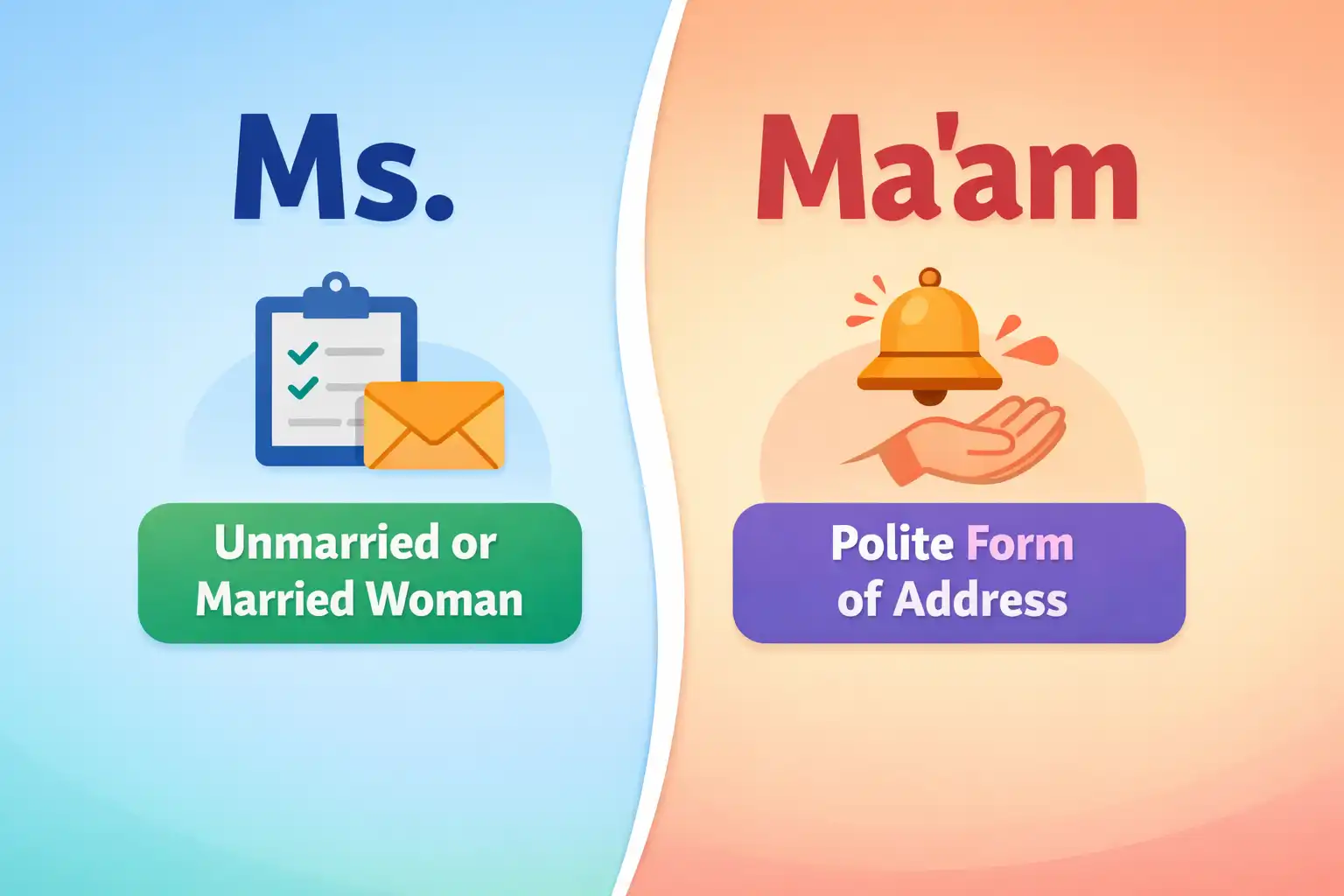
Many English learners and even native speakers feel confused about ms vs ma’am. Both words appear when people speak politely to women. But they are not the same. People often mix them up in emails, conversations, or formal writing.
The confusion happens because English has several female titles. Words like Ms., Mrs., Miss, and Ma’am all refer to women, but they show different things. Some refer to marital status. Others show respect. Also, usage changes across cultures and workplaces.
Because of this, mistakes happen easily. Someone may write Ms in an email when they should say Ma’am, or use Ma’am in a situation where it sounds too formal.
So, what is the real difference?
In this guide, you will learn the meaning, origin, and correct use of Ms and Ma’am. You will also see examples from emails, news, and everyday speech. By the end, you will know when to use each word and how to avoid common mistakes.
Ms vs Ma’am – Quick Answer
Ms vs Ma’am refers to two different ways to address a woman politely.
- Ms. is a title placed before a woman’s name.
- Ma’am is a polite word used when speaking directly to a woman.
Examples:
- Email: Dear Ms. Smith
- Conversation: Yes, Ma’am, I understand.
Easy rule:
Use Ms. before a name and Ma’am when speaking politely to a woman.
Meaning of ms vs ma’am
- Ms. – a neutral title for women, regardless of marital status.
- Ma’am – a respectful spoken form used when addressing a woman.
The Origin of ms vs ma’am
Word origin and background
The titles Ms. and Ma’am both come from older forms of English that showed respect.
Ms. appeared in the early 1900s but became popular in the 1970s. It solved a common problem. English had Miss for unmarried women and Mrs. for married women. But many people felt that a woman’s marital status should not matter. So Ms. became a neutral title.
Ma’am, however, comes from the French phrase “madame.” It entered English centuries ago. People used it to show respect to women of higher social status. Over time, it became a polite way to address any woman.
Reason for confusion today
The confusion today happens because:
- Both words show respect
- Both refer to women
- Learners often see them in formal communication
But their roles are very different.
- Ms. = written title before a name
- Ma’am = spoken form of respect
Understanding this difference removes most confusion.
British English vs American English Spelling
In most cases, spelling does not change between British and American English for these two words.
Both English varieties use:
- Ms.
- Ma’am
However, punctuation can vary slightly.
Clear spelling rules
- American English often uses Ms. (with a period)
- British English sometimes uses Ms (without a period)
The word Ma’am stays the same in both forms.
Short examples
American style:
- Dear Ms. Johnson
- Yes, Ma’am, I will do that.
British style:
- Dear Ms Johnson
- Excuse me, Ma’am
Small comparison table
| Word | American English | British English |
| Ms | Ms. Johnson | Ms Johnson |
| Ma’am | Ma’am | Ma’am |
So overall, spelling rarely changes, but punctuation may differ slightly.
How to Choose the Right Word Fast
Choosing between Ms vs Ma’am becomes easy once you know the context.
US
In the United States:
- Ms. is common in emails, business writing, and official documents.
- Ma’am is common in polite conversation.
Example:
- Dear Ms. Carter (email)
- Yes, Ma’am (conversation)
UK / Commonwealth
In the UK and Commonwealth countries:
- Ms is widely used in formal writing.
- Ma’am may appear in very formal speech or when speaking to royalty or authority figures.
Example:
- Police officer: Yes, Ma’am
- Letter: Dear Ms Patel
Global or professional writing
In international workplaces:
- Ms. is safest when writing emails or documents.
- Ma’am is mainly used when speaking politely.
So if you are unsure, use Ms before the person’s name.
Common Mistakes with ms vs ma’am
Many mistakes happen because people confuse spoken and written titles.
Frequent errors
- Using Ma’am in emails
- Using Ms without a name
- Confusing Ms with Mrs
Incorrect → Correct
❌ Dear Ma’am Johnson
✅ Dear Ms. Johnson
Explanation: Ma’am is not used before a name.
❌ Thank you Ms for your help
✅ Thank you Ma’am for your help
Explanation: Ms must be followed by a name.
❌ Dear Mrs. Taylor (when marital status unknown)
✅ Dear Ms. Taylor
Explanation: Ms is neutral.
Ms vs Ma’am in Everyday Examples
Emails
- Dear Ms. Lee, thank you for your message.
- Dear Ms. Ahmed, I look forward to meeting you.
News
Journalists usually use Ms. when mentioning women.
Example:
- Police said Ms. Brown reported the incident.
Social media
On social platforms, Ma’am often appears in polite replies.
Example:
- Yes, Ma’am, I will send the file.
Formal or professional writing
Professional communication usually uses Ms.
Example:
- The report was prepared by Ms. Rivera.
Ms vs Ma’am – Usage Patterns & Search Interest
People search for ms vs ma’am because they want to avoid sounding rude or incorrect.
Typical user groups
Common users include:
- English learners
- Students
- Writers
- Customer service workers
- Professionals writing emails
Popularity trends
Interest in Ms has grown because many workplaces prefer neutral titles. People also avoid asking about marital status.
Ma’am still appears often in polite speech, especially in customer service.
Real-world confusion example
Imagine a job applicant writing:
Dear Ma’am Williams
This sounds incorrect. The correct form is:
Dear Ms. Williams
Small mistakes like this can affect professional communication.
Comparison Table
| Feature | Ms. | Ma’am |
| Meaning | Neutral title for a woman | Polite spoken address |
| Part of Speech | Title before a name | Form of address |
| Context of Use | Emails, documents, formal writing | Spoken conversation |
| Formal vs Informal | Mostly formal | Polite spoken form |
| Common Mistakes | Using without a name | Using before a name |
| Correct Example | Dear Ms. Taylor | Yes, Ma’am, I understand |
This table shows the core difference clearly: Ms is a title, Ma’am is spoken respect.
People Also Ask
What are female titles?
Common female titles include Ms., Mrs., Miss, and Ma’am. These words help show respect or identify someone politely in conversation or writing.
Is Ms for a girl or boy?
Ms is used only for women. It is a neutral title that does not show marital status.
Can I call my girlfriend Mrs.?
Usually no. Mrs. traditionally refers to a married woman. People normally use Miss or simply the person’s name instead.
Is Ma’am for married?
No. Ma’am does not show marital status. It is simply a respectful way to address a woman.
Is a lady higher than a dame?
In modern everyday language, both words mean a woman. However, “lady” is more common and polite. “Dame” often appears in British honors or historical contexts.
Is Ms married or single?
Ms. does not show marital status. A woman can be married, single, or divorced and still use Ms.
Is MS for divorced?
No. Ms. is neutral. It does not indicate whether someone is married, single, or divorced.
Is there a male version of MS?
The closest male equivalent is Mr. Unlike women’s titles, Mr. does not show marital status.
Is it rude to call a Mrs. MS?
Usually no. Many women prefer Ms because it does not mention marital status. But if someone specifically uses Mrs, it is polite to follow their preference.
Is ms the same as ma’am?
No. Ms is a written title used before a name, while Ma’am is a spoken word used to address a woman politely.
Which one is correct in formal writing?
In formal writing, Ms. is correct. Ma’am is mostly used in spoken communication.
Conclusion
The difference between ms vs ma’am becomes simple once you know their roles.
Ms. is a written title placed before a woman’s name. It is neutral and does not show whether she is married or single. Because of this, it is widely used in emails, business writing, and news reports.
Ma’am, however, is a spoken form of respect. People use it when addressing a woman directly in conversation. Customer service workers, police officers, and polite speakers often say it.
The biggest mistake people make is mixing the two forms. Many learners try to place Ma’am before a name, which is incorrect.
Overall, remember this simple rule:
- Ms = written title before a name
- Ma’am = spoken polite address
Finally, if you want to stay safe in professional communication, use Ms. in writing and Ma’am only in speech.

James Holloway writes detailed guides on confusing English words and grammar usage with clear side-by-side comparisons.