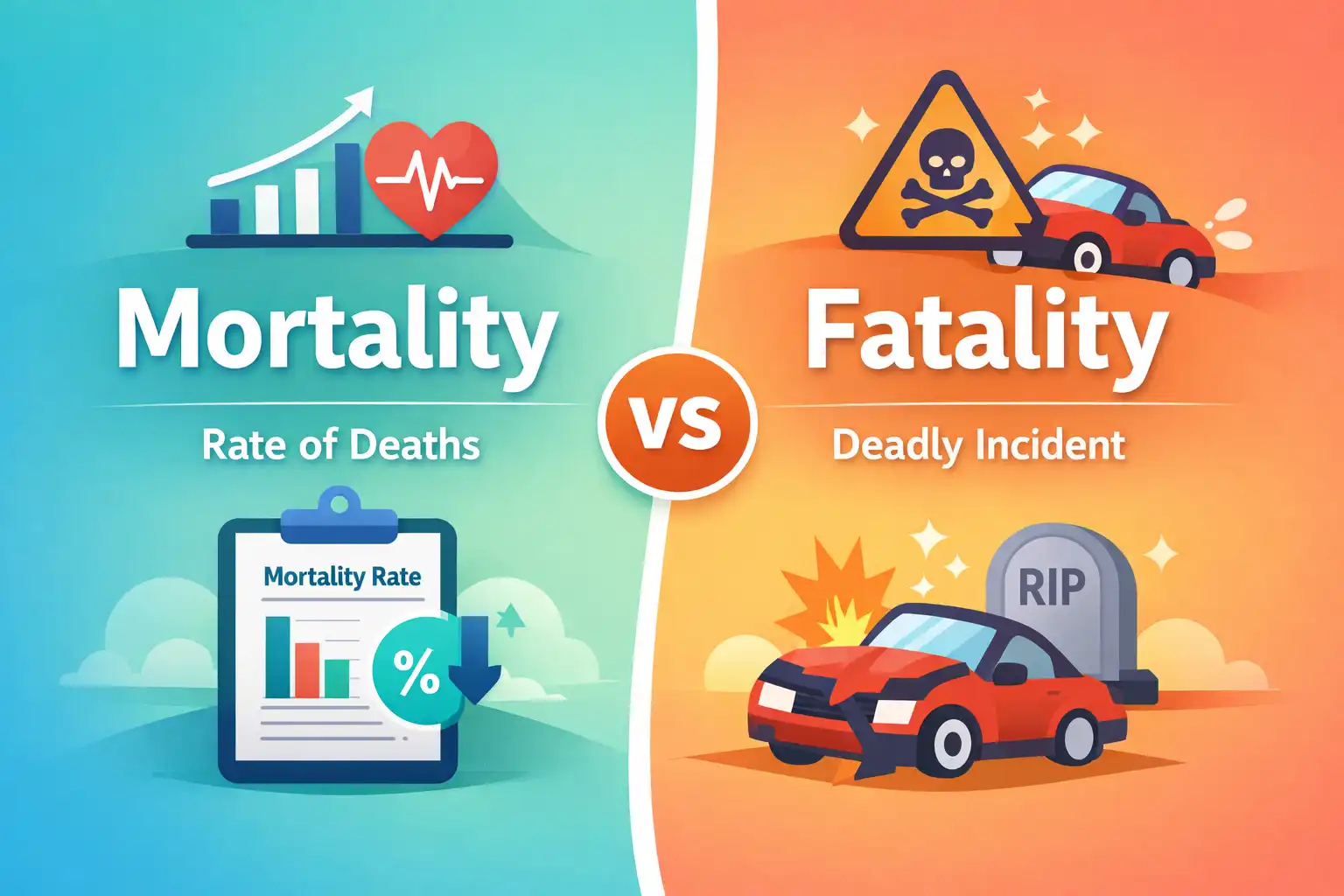
Many people search for mortality vs fatality because the two words seem almost the same. Both relate to death. Both appear in news reports, health articles, and statistics. So people often use them as if they mean the same thing.
However, writers and editors know there is a real difference. One word describes a general rate of death in a group, while the other describes a death caused by a specific event or condition. When someone mixes them up, the meaning can change a lot.
For example, a news report about a disease may mention mortality rate, but a traffic accident report often mentions fatalities. If a writer uses the wrong word, the reader may misunderstand the scale or cause of deaths.
This guide explains mortality vs fatality in very simple English. You will learn the meaning of each word, where people use them, and why the confusion happens. You will also see clear examples, common mistakes, and an easy rule that helps you choose the right word quickly.
Mortality vs Fatality – Quick Answer
Mortality refers to the number or rate of deaths in a population over time.
Fatality refers to a death caused by a specific event, accident, or condition.
Meaning of Mortality
- Describes overall death in a group
- Often used with statistics or rates
Examples
- The country reported high mortality during the epidemic.
- Infant mortality decreased last year.
Meaning of Fatality
- Describes a death from a specific cause
- Often used in accident or disaster reports
Examples
- The crash caused three fatalities.
- The storm led to several fatalities.
Easy rule:
Use mortality for statistics about deaths.
Use fatality for deaths caused by a specific event.
The Origin of Mortality vs Fatality
Understanding the origin of the words helps explain why their meanings differ today.
Mortality comes from the Latin word mortalis, which means “subject to death.” The root word mors means “death.” English began using the word in the 14th century. At that time, writers used it to describe the state of being human and able to die. Later, scientists and health experts used it for death statistics in populations.
Fatality, however, comes from the Latin word fatalis, which means “destined by fate.” The word originally described something that leads to death or is caused by fate. Over time, the meaning shifted. Modern English uses it mainly to describe a death caused by a specific event.
This historical difference explains the modern usage.
Mortality focuses on the fact that people die in general.
Fatality focuses on a death caused by something specific.
Because both words relate to death, confusion happens easily. Writers often see them used in news and assume they are interchangeable. In reality, they serve different purposes.
British vs American English Spelling
The words mortality and fatality do not change spelling between British and American English. Both regions use the same forms.
However, the way they appear in sentences may vary slightly depending on writing style.
| Word | British English | American English | Notes |
| Mortality | mortality | mortality | Same spelling |
| Fatality | fatality | fatality | Same spelling |
Examples:
British style
- The hospital reported lower mortality rates this year.
American style
- The accident caused two fatalities.
The spelling remains identical, but the context of use stays the same in both varieties of English.
How to Choose the Right Word Fast
Choosing between mortality vs fatality becomes easy once you understand the audience and context.
In the United States
News reports and medical writing follow a clear pattern.
Use mortality when talking about:
- health statistics
- disease studies
- population death rates
Example
- The study measured cancer mortality rates.
Use fatality when talking about:
- accidents
- disasters
- crashes or incidents
Example
- The highway crash resulted in one fatality.
In the UK and Commonwealth
The same rule usually applies.
Health organizations discuss mortality rates, while news reports about accidents describe fatalities.
Example
- Winter conditions increased road fatalities.
- The research examined heart disease mortality.
Global or Professional Writing
In academic or professional contexts, the difference is even clearer.
Researchers analyze mortality data.
Journalists report fatalities in specific incidents.
Quick tip:
If the sentence includes rates, statistics, or populations, use mortality.
If the sentence describes an event causing death, use fatality.
Common Mistakes with Mortality vs Fatality
Writers often mix these words because they both relate to death. Here are common mistakes editors frequently see.
❌ Incorrect: The accident increased the city’s mortality.
✅ Correct: The accident caused several fatalities.
Explanation: An accident causes fatalities, not mortality.
❌ Incorrect: The study measured the fatality of cancer.
✅ Correct: The study measured cancer mortality.
Explanation: Research about disease deaths usually discusses mortality rates.
❌ Incorrect: The storm increased national fatality rates.
✅ Correct: The storm caused many fatalities.
Explanation: Fatalities describe individual deaths, not long-term statistical rates.
These mistakes happen because writers try to use the words interchangeably. The meanings are close, but the context must match.
Mortality vs Fatality in Real Life Examples
Seeing real-life usage helps make the difference clear.
Emails
- The report focuses on infant mortality in rural areas.
- The accident yesterday resulted in one fatality.
News
- Health officials reported lower COVID mortality rates this year.
- The train crash caused five fatalities.
Social Media
- The new health program aims to reduce maternal mortality.
- The storm led to multiple fatalities across the region.
Professional Writing
- Researchers analyzed global child mortality trends.
- Authorities confirmed three fatalities after the explosion.
In each case, the word choice depends on whether the sentence discusses statistics or a specific deadly event.
Mortality vs Fatality – Word Usage Patterns and Search Trends
The search phrase mortality vs fatality has grown in popularity because many readers notice these words in different contexts but do not understand the difference.
Students and ESL learners often search this comparison while studying academic vocabulary. Journalists and bloggers also look for the difference when writing about disasters or health topics.
Search patterns show two common situations:
- A writer sees mortality rate in research articles.
- The same writer sees fatalities in news headlines.
Because the contexts look similar, the writer assumes the words mean the same thing. That assumption leads to mistakes.
For example, a health article might incorrectly say:
“The accident increased national mortality.”
Readers may feel confused because mortality refers to overall death statistics, not a single incident.
Understanding the correct context helps writers communicate more clearly and avoid misleading statements.
Mortality vs Fatality Comparison Table
| Feature | Mortality | Fatality |
| Meaning | General death rate in a population | A death caused by a specific event |
| Part of Speech | Noun | Noun |
| Context | Health statistics, research, population studies | Accidents, disasters, incidents |
| Formal vs Informal | Common in formal and academic writing | Common in news and reporting |
| Common Mistake | Used when describing single accidents | Used when discussing statistical rates |
| Correct Example | The disease has a high mortality rate. | The crash caused two fatalities. |
This table shows the difference clearly. Mortality describes patterns of death, while fatality describes individual deaths caused by events.
Frequently Asked Questions
Is mortality the same as fatality?
No. Mortality refers to death rates in a population, while fatality refers to a death caused by a specific event.
Which word is correct in formal writing?
Both words are correct, but they serve different purposes. Academic and medical writing often uses mortality, especially when discussing statistics.
Can mortality and fatality be used interchangeably?
No. They are related but not interchangeable. Using the wrong one can change the meaning of a sentence.
Why do people confuse mortality and fatality?
Both words relate to death, and both appear in news and health discussions. Because of this overlap, many writers assume they mean the same thing.
Can grammar tools detect this mistake?
Some grammar tools detect context errors, but many do not. Writers still need to understand the difference themselves.
Is there a British vs American difference?
No. Both British and American English use the same spelling and meaning for mortality and fatality.
Which word appears more in news reports?
News reports often use fatalities when describing accidents, disasters, or sudden events.
Conclusion
The difference between mortality vs fatality becomes clear once you understand their context.
Mortality describes death rates within a population over time. Researchers, health organizations, and statisticians often use this word when analyzing disease impact or population health. It focuses on patterns and statistics, not individual events.
Fatality, on the other hand, describes a death caused by a specific event. News reports often mention fatalities after accidents, storms, or disasters. The word highlights the direct result of an incident rather than long-term trends.
Writers confuse these terms because they both relate to death. However, the purpose of each word is different. Mixing them can create inaccurate or misleading sentences.
Overall, the easiest rule is simple.
Use mortality for statistics and population death rates.
Use fatality for deaths caused by specific events.
Remembering this distinction helps writers communicate clearly and avoid one of the most common vocabulary mistakes in news, research, and everyday writing.

James Holloway writes detailed guides on confusing English words and grammar usage with clear side-by-side comparisons.