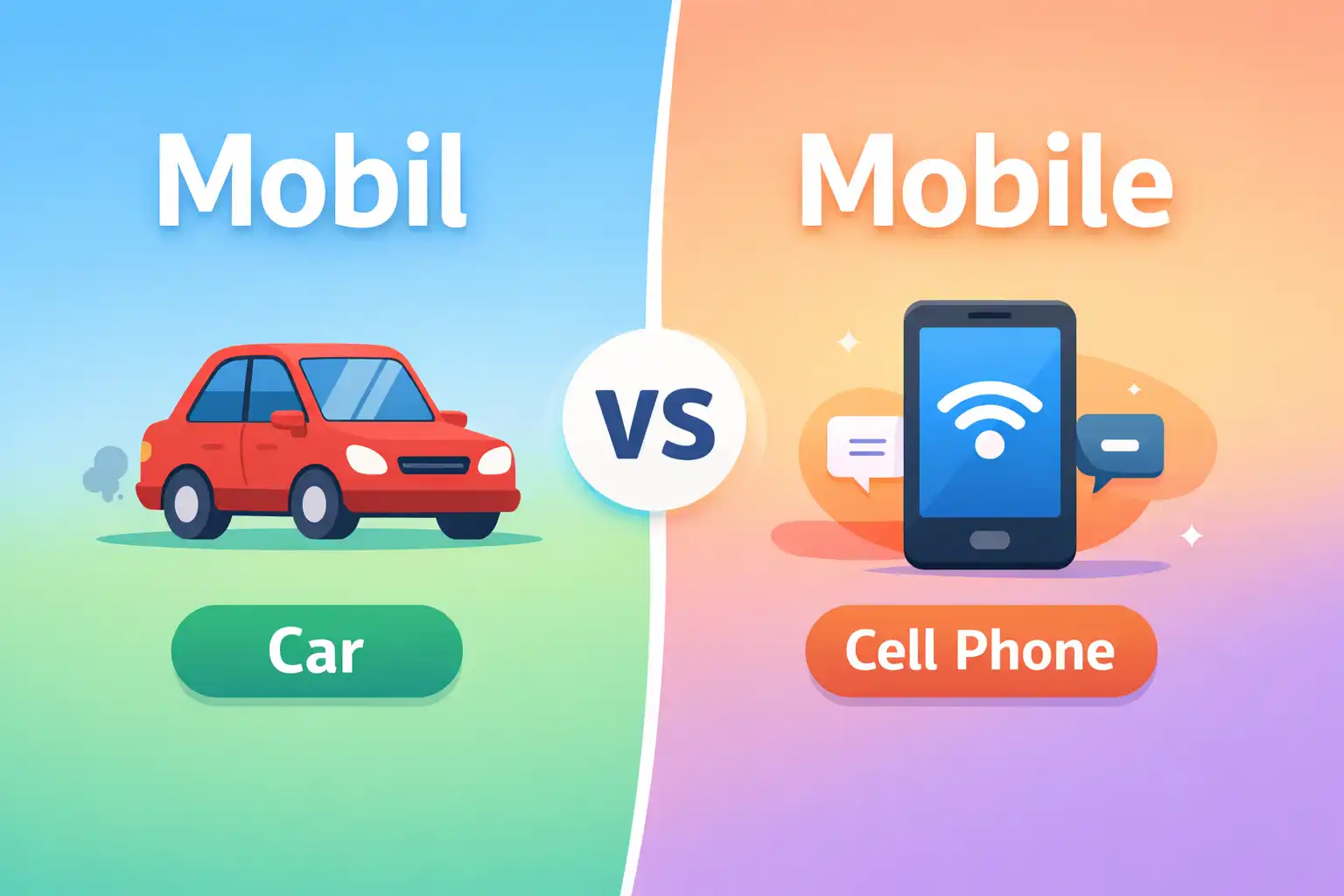
Many people search “mobil vs mobile” because the two words look almost the same. One letter is missing, yet the meaning can change. Students, writers, and ESL learners often feel unsure when they see these words in articles, brand names, or online posts.
The confusion grows because “mobile” is a common English word, but “Mobil” also appears often in business names, especially in the oil industry. As a result, people sometimes think both spellings work the same way. They do not.
This article explains the difference in clear and simple terms. You will learn the meaning of each word, their origin, and how people actually use them today. You will also see real examples from daily writing so you can quickly choose the correct spelling in emails, news writing, or social media.
Mobil vs Mobile – Quick Answer
Mobile is a common English word. It usually means something that can move or a mobile phone.
Mobil is mostly a brand spelling, especially linked to the oil company ExxonMobil.
Quick rule:
• Use mobile for phones or anything that can move
• Use Mobil only when referring to the brand name
Examples:
• I bought a new mobile phone.
• The company Mobil sells fuel products.
• She works in mobile app development.
The Origin of Mobil vs Mobile
The word mobile comes from the Latin word mobilis. It means able to move. English adopted the word many centuries ago. At first, writers used it to describe objects that could move easily.
Later, the meaning expanded. Technology changed how people use the word. Now “mobile” often refers to phones, apps, or devices that work anywhere.
The spelling Mobil has a different story. It became popular because of the oil brand Mobil, which later joined with Exxon to form ExxonMobil. The brand chose this shorter spelling as a unique name. It was not meant to replace the normal English word.
Because both spellings appear online and in advertisements, readers sometimes assume they are interchangeable. That assumption creates the confusion many people search about today.
Editors often notice this mistake in blog posts or student writing where someone writes “mobil phone” instead of “mobile phone.”
British vs American English Spelling
In this case, British and American English use the same spelling: mobile.
There is no regional spelling difference between the two countries.
However, confusion still happens because the brand spelling Mobil exists. People may think it is a shorter British version. That is not correct.
Here is a simple comparison.
| Feature | Mobile | Mobil |
| Standard spelling | Yes | No |
| Used in everyday English | Yes | No |
| Brand name | No | Yes |
| Used in technology terms | Yes | Rare |
Examples:
British English
• I forgot my mobile phone at home.
American English
• Mobile banking is very common now.
Brand usage
• Mobil is part of the ExxonMobil company.
Therefore, both British and American writers normally use mobile in standard language.
How to Choose the Right Word Fast
Choosing between mobil vs mobile becomes easy once you know the context.
For US writing, always use mobile when you talk about phones, apps, or devices. American media and business writing follow this rule consistently.
For UK and Commonwealth English, the same rule applies. British publications also use mobile in normal language.
For global or professional writing, the safest choice remains mobile. This spelling appears in technology, marketing, and education worldwide.
Only use Mobil when you clearly refer to the brand name.
Quick check:
If the sentence talks about technology, phones, apps, or movement, the correct spelling is mobile.
If the sentence refers to the oil company brand, then Mobil is correct.
Common Mistakes with Mobil vs Mobile
Writers often make small spelling errors because both words look similar. These mistakes appear frequently in student essays, blog posts, and online comments.
Here are the most common ones.
❌ I bought a new mobil phone
✅ I bought a new mobile phone
Explanation: “Mobile phone” is the correct English phrase.
❌ She works in mobil app development
✅ She works in mobile app development
Explanation: Technology terms always use “mobile”.
❌ My mobil device is slow today
✅ My mobile device is slow today
Explanation: The standard spelling is “mobile”.
❌ I filled fuel at mobile station
✅ I filled fuel at Mobil station
Explanation: Here the brand name Mobil is correct.
Editors often see these errors when writers type quickly or rely on autocorrect tools that miss context.
Mobil vs Mobile in Real Life Examples
Seeing the words in real situations helps remove confusion.
Email writing
Correct:
“I will send the report from my mobile phone.”
News writing
“Mobile payments are growing fast in many countries.”
Social media posts
“I just launched my first mobile app today.”
Professional writing
“Mobile marketing helps companies reach users on smartphones.”
Brand context
“ExxonMobil announced new investments in energy projects.”
These examples show that mobile dominates everyday language, while Mobil appears mainly in brand references.
Mobil vs Mobile – Word Usage Patterns and Search Trends
Search patterns show that mobile is extremely common in modern English. The word appears in technology, marketing, software development, and telecommunications.
Students, writers, and business professionals often search the comparison “mobil vs mobile” when they notice the missing letter.
ESL learners also search this topic because both words appear online. However, dictionaries usually list only mobile as the standard word.
One real-world situation where confusion happens is mobile technology writing. Someone might type “mobil app design” or “mobil device management.” These phrases look incorrect to editors and search engines.
Because of that, correct spelling matters for clarity and credibility in professional writing.
Mobil vs Mobile Comparison Table
| Feature | Mobile | Mobil |
| Meaning | Something that can move; also a phone or portable device | A brand spelling used by ExxonMobil |
| Part of speech | Adjective and noun | Proper noun |
| Context of use | Technology, communication, movement | Business or brand reference |
| Formal vs informal | Used in both formal and informal writing | Mostly used in brand context |
| Common mistakes | Misspelled as “mobil” | Used mistakenly instead of mobile |
| Correct example | “Mobile apps help businesses grow.” | “Mobil produces fuel products.” |
This table quickly shows that mobile is the correct general word, while Mobil is a brand name.
Frequently Asked Questions
Is mobil the same as mobile?
No. Mobile is the correct English word. Mobil mainly refers to a brand name.
Which spelling is correct in formal writing?
Formal writing uses mobile. The spelling mobil appears only in brand references.
Can mobil and mobile be used interchangeably?
No. They have different uses. Mobile is a normal word, while Mobil is a proper noun.
Why do people confuse mobil and mobile?
The words look almost identical. Also, the Mobil brand appears often in advertisements and online content.
Can grammar tools catch this mistake?
Sometimes. Many grammar tools highlight mobil as a spelling error unless it appears in a brand context.
Is there a British vs American spelling difference?
No. Both British and American English use mobile.
What is the easiest rule to remember?
If the sentence talks about phones, apps, or devices, the correct spelling is mobile.
Conclusion
The confusion between mobil vs mobile mostly comes from spelling similarity. Only one letter separates the two, but their usage is very different.
The word mobile is the correct and standard English spelling. People use it for phones, apps, technology, and anything that can move. It appears in both British and American English, and it works in formal as well as informal writing.
On the other hand, Mobil is mainly a brand name, especially linked to the ExxonMobil energy company. Outside that brand context, the spelling rarely appears in normal English.
Writers, students, and ESL learners often make mistakes when typing quickly. However, the rule becomes simple once you remember the real purpose of each word.
Overall, keep one easy rule in mind:
Use “mobile” for everyday language and technology. Use “Mobil” only for the brand name.
Following this rule will help your writing stay clear, accurate, and professional.

James Holloway writes detailed guides on confusing English words and grammar usage with clear side-by-side comparisons.