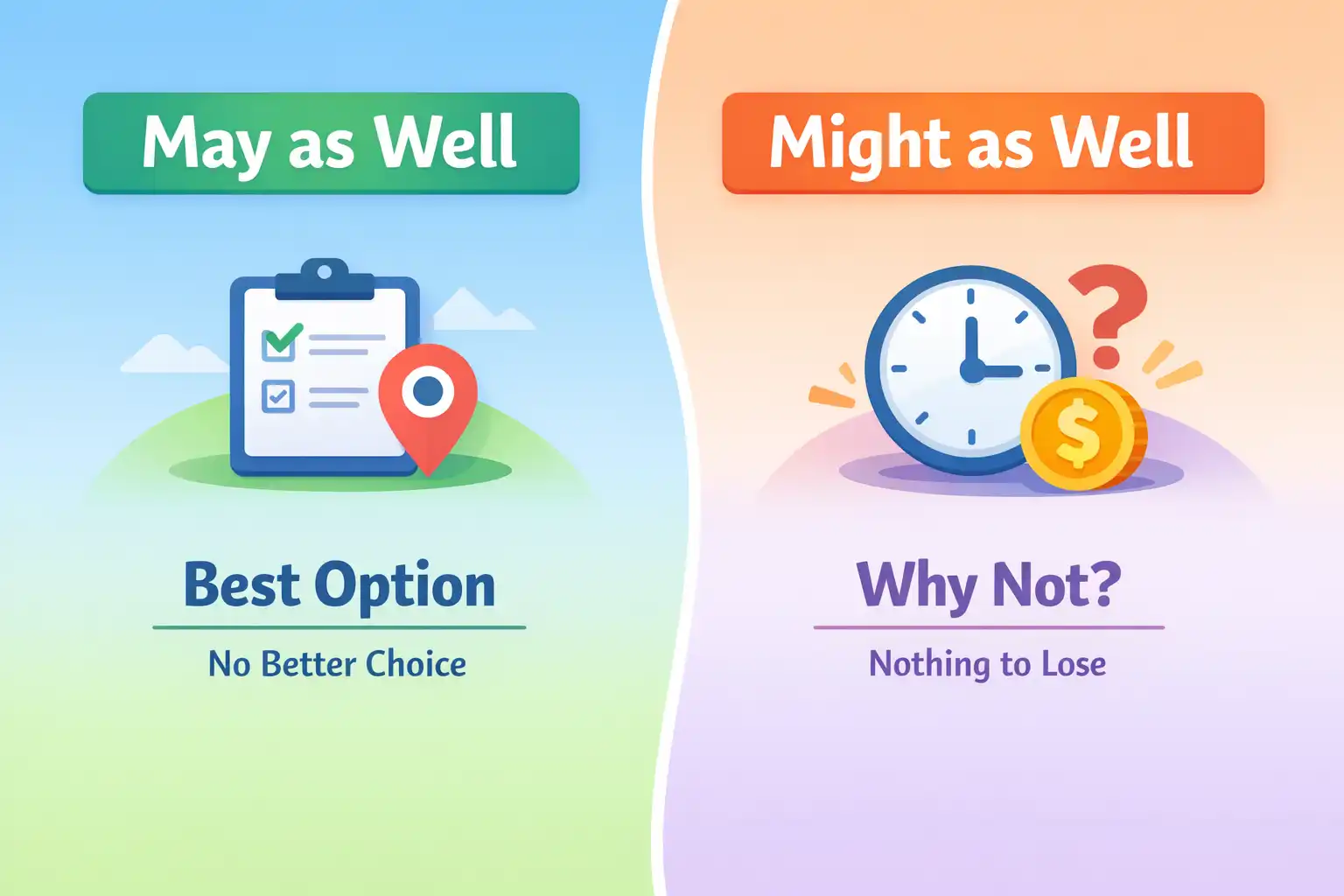
Many English learners feel confused about may as well and might as well. Both sound similar, and both often mean the same thing. But small differences in tone can matter. So people are not always sure which one to use.
In simple terms, these phrases help us talk about choices when there is no better option. You use them when something seems reasonable, even if it is not perfect. In this guide, you will learn the meaning, grammar, examples, and easy rules to choose the right phrase with confidence.
Quick Answer: May as Well vs Might as Well (Difference + Rule)
- Both phrases mean: there is no better option, so this is okay to do
- Might as well is more common in modern English
- May as well sounds slightly more formal or old-fashioned
Examples:
- We are early. We might as well get coffee.
- It’s raining. We may as well stay home.
✅ Easy rule: If you are unsure, use might as well.
Origin & History (with sources): May/Might + “As Well”
The words may and might both come from Old English. They originally showed possibility or permission.
Over time, English speakers began using as well after these modal verbs. This created phrases that suggested a reasonable choice when options were limited.
So the meaning slowly became:
“This option is just as good as any other.”
Reason for confusion today
The confusion happens because:
- Both phrases mean almost the same thing
- Both are grammatically correct
- Native speakers often use them interchangeably
- Learners expect a strict rule, but the difference is mainly tone
Today, the real difference is not grammar — it is style and frequency.
US vs UK Usage: Frequency, Tone, and Preference
There is no spelling difference between British and American English for these phrases. Both regions write them the same way.
But usage preference is slightly different.
- Americans use might as well more often
- British speakers may use both forms
Examples
- US: We might as well leave now.
- UK: We may as well leave now.
Comparison Table US vs UK
| Phrase | US Usage | UK Usage | Notes |
| might as well | Very common | Common | Most natural choice globally |
| may as well | Less common | Common | Slightly formal tone |
So the spelling does not change. Only the frequency and tone change slightly.
How to Choose Fast (Tone + Context Rules)
US
Use might as well. It sounds natural and modern.
UK / Commonwealth
Both are correct. But might as well still feels more natural in casual speech.
Global or professional writing
Use might as well unless you want a slightly formal tone.
Because spelling does not vary, the choice depends on tone, not location.
Common Mistakes with may as well vs might as well
Here are frequent learner errors.
❌ Incorrect → ✅ Correct
❌ We may as well to go now.
✅ We may as well go now.
Explanation: Do not use to after the phrase.
❌ I might as well went home.
✅ I might as well go home.
Explanation: Use the base verb after the phrase.
❌ You might as well can try.
✅ You might as well try.
Explanation: Do not add another modal verb.
❌ We may as well going.
✅ We may as well go.
Explanation: Use the base verb, not -ing form.
May as Well vs Might as Well in Everyday Examples
Emails
- We finished early, so we might as well send the report today.
- Since the meeting is canceled, we may as well work from home.
News
- With no opposition, the team might as well win the match easily.
Social Media
- It’s Sunday. I might as well sleep all day 😄
- No plans tonight, so I may as well watch a movie.
Formal or Professional Writing
- Given the current data, we may as well proceed with the proposal.
Both phrases work, but formal writing sometimes prefers may as well.
May as Well vs Might as Well – Usage Patterns & Frequency Evidence
Language data shows that might as well appears more often than may as well in modern English.
Large text databases such as Google Books Ngram Viewer show a clear trend:
- Might as well increased strongly after the 1900s
- May as well stayed stable or declined slightly
- Today, might as well is more common in everyday writing and speech
Many grammar references also note this pattern. For example, Cambridge English explains that both phrases have the same meaning, but might as well is more frequent in spoken English.
Why frequency matters
Because people hear might as well more often, it feels more natural. That is why learners usually prefer it.
Typical user groups searching this topic
- ESL learners
- Students studying modal verbs
- Writers checking tone differences
- Professionals writing emails in English
Real-world confusion scenario
Imagine a manager writes:
“We may as well delay the launch.”
The sentence is correct. But some readers may think the tone sounds less confident or slightly formal. If the writer used might as well, the message would feel more natural and conversational.
So frequency affects perception, even when grammar is correct.
Search interest shows that many learners look for this topic because:
- Students want grammar clarity
- ESL learners want correct usage
- Writers want natural tone
- Professionals want accurate communication
In general trends, might as well appears more often in speech, movies, and online writing.
Real-world confusion scenario
Imagine a business email:
“We might as well cancel the project.”
This can sound negative or careless if the reader misunderstands the tone. The writer may simply mean there is no better option. But the reader might think the writer does not care.
So context matters.
Comparison Table
| Feature | May as well | Might as well |
| Meaning | A reasonable choice with no better option | Same meaning |
| Part of speech | Modal phrase | Modal phrase |
| Context of use | Slightly formal or neutral | Most common in speech |
| Formal vs informal | Neutral to formal | Neutral to informal |
| Common mistakes | Adding “to” after phrase | Same mistakes |
| Correct example | We may as well start now. | We might as well start now. |
This table shows the phrases are almost identical. The main difference is frequency and tone.
People Also Ask (FAQs)
What is the difference between may as well and might as well?
Both mean there is no better option, so something is reasonable to do. Might as well is more common in modern English, while may as well can sound slightly more formal.
Is may as well the same as might as well?
Yes. The meaning is almost identical. The difference is mainly tone and frequency, not grammar.
Which one is correct in formal writing?
Both are correct. However, may as well sometimes sounds a little more formal, so writers may prefer it in professional contexts.
Why do Americans say “might as well”?
Because language usage changed over time. In modern American English, might as well became the more natural and common expression.
What does might as well mean?
It means doing something is reasonable because there is no better choice available.
Example: “We’re already here, so we might as well start.”
What does “may well” mean?
“May well” is different from “may as well.” It means something is likely or probable.
Example: “She may well win the prize.”
What is the main difference between may and might?
Both show possibility. Might often suggests slightly less certainty than may, but in “as well” phrases the difference is very small.
How do you use may have and might have?
Both describe past possibility.
Example: “He may have left early.” / “He might have left early.”
Are there may as well vs might as well exercises?
Yes. Practice usually focuses on choosing the correct phrase based on tone and context.
Conclusion
The difference between may as well vs might as well is small, but understanding it helps you sound more natural in English. Both phrases express the idea that one option is as good as any other. They show acceptance of a situation when better choices do not exist.
The key point is usage style. Might as well is more common in everyday speech, especially in American English. May as well can sound slightly more formal or traditional, but it is still correct.
One mistake to always avoid is adding to after the phrase. Remember to use the base verb form instead.
Overall, both phrases work in most situations. In short, if you want the safest choice, use might as well. Finally, the easiest rule to remember is:
When unsure, choose might as well.

James Holloway writes detailed guides on confusing English words and grammar usage with clear side-by-side comparisons.