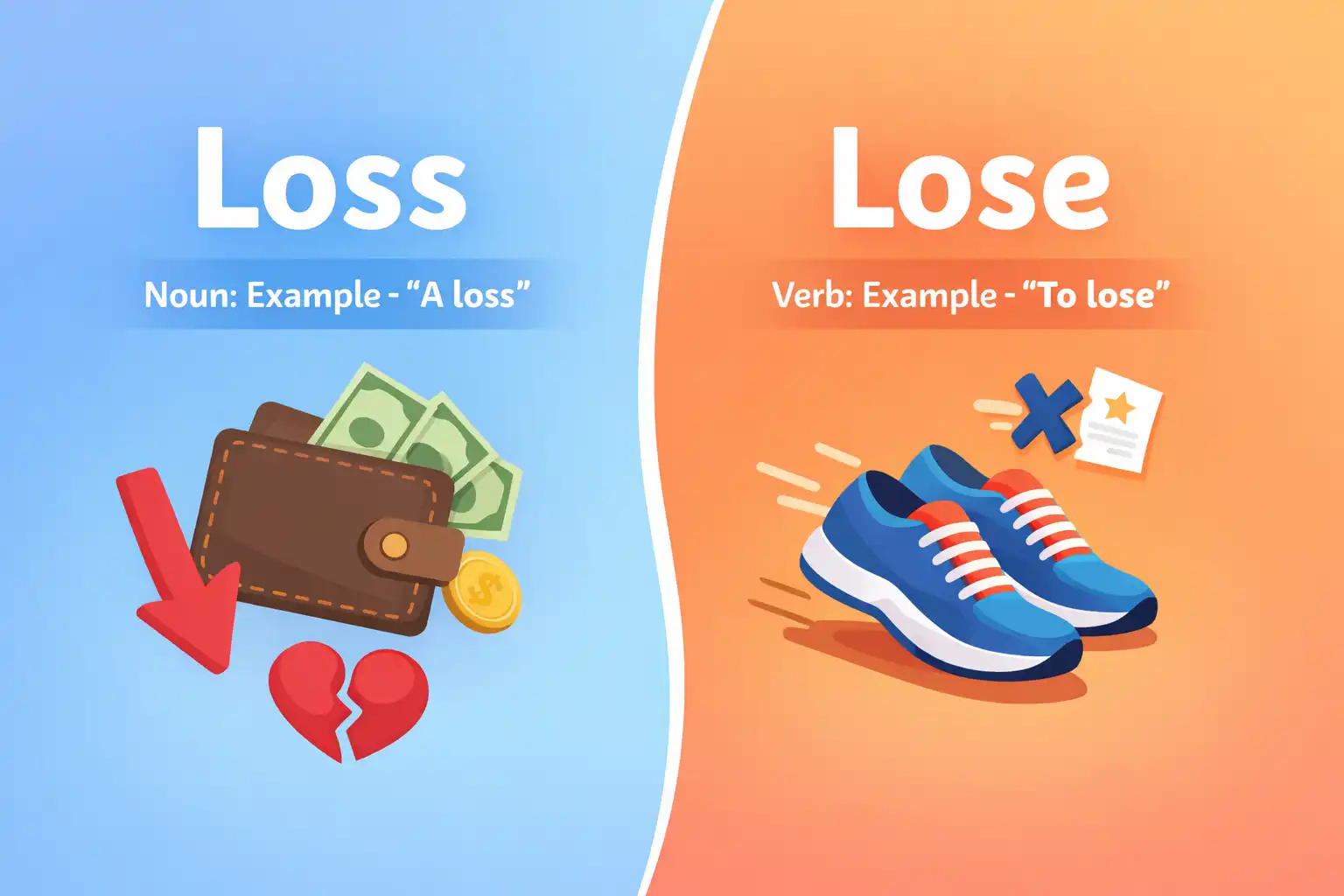
Many English learners struggle with loss vs lose. The words look almost the same. They sound similar too. Because of this, people often mix them up in writing.
You may see sentences like “I will loss the game” or “The company lose was huge.” These mistakes happen often. Even good writers sometimes confuse the two.
The problem matters because each word has a different grammar role and meaning. One is a noun. The other is a verb. When used incorrectly, the sentence becomes confusing or wrong.
So, this article explains the difference in a very clear way. You will learn the meaning of each word, why people confuse them, and how to choose the right one quickly. You will also see real examples from emails, news, and everyday writing. By the end, the difference between loss and lose will feel simple and easy to remember.
Loss vs Lose – Quick Answer
Meaning of Loss
Loss is a noun. It describes something that was lost.
Examples:
• The company reported a financial loss.
• The team suffered a big loss.
Meaning of Lose
Lose is a verb. It means to no longer have something.
Examples:
• I do not want to lose my keys.
• She may lose the race.
Easy rule:
Use lose for actions. Use loss for results.
The Origin of Loss vs Lose
The words loss and lose come from Old English. Both share the root word los, which meant destruction or ruin. Over time, English created two different forms from the same root.
The verb form became lose, meaning to misplace something or fail to win.
The noun form became loss, meaning the result after something is gone.
For example, early English texts used losian as a verb that meant “to perish” or “to be destroyed.” Later, the spelling slowly changed to lose.
However, the noun form kept a shorter spelling. So it became loss.
This history explains why the words look related but behave differently. Writers often confuse them because they share the same root and similar pronunciation.
British vs American English Spelling
There is no spelling difference between British and American English for these words.
Both regions use:
• Lose – verb
• Loss – noun
However, confusion still appears in writing because the pronunciation is close.
| Word | Part of Speech | Example |
| Lose | Verb | Do not lose your ticket |
| Loss | Noun | The company reported a loss |
In contrast to many English words, there is no regional spelling variation here. The rules stay the same worldwide.
How to Choose the Right Word Fast
Choosing between loss vs lose becomes easy when you check the grammar role.
First, ask if the word describes an action.
If yes, use lose.
Example:
I might lose my phone.
Next, check if the word describes a result or condition.
If yes, use loss.
Example:
The phone’s loss upset me.
Now consider the audience.
US writing
American English follows the same rule. Writers use lose for verbs and loss for nouns.
UK and Commonwealth writing
The rule stays exactly the same. There is no spelling variation.
Global professional writing
Editors usually check grammar roles. If the word describes an action, they use lose. If it names the result, they use loss.
This quick grammar check helps writers avoid mistakes instantly.
Common Mistakes with Loss vs Lose
Writers often confuse the words because they sound similar. Also, spell check tools may not catch the error if the sentence still looks grammatically possible.
Here are common mistakes.
❌ I do not want to loss my wallet.
✅ I do not want to lose my wallet.
Explanation: The sentence needs a verb.
❌ The company will lose of money this year.
✅ The company will report a loss this year.
Explanation: The sentence needs a noun.
❌ Our team had a big lose yesterday.
✅ Our team had a big loss yesterday.
Explanation: A result requires the noun.
Editors often see these mistakes in student essays and quick online writing.
Loss vs Lose in Real Life Examples
Understanding real usage helps the difference stick.
Emails
Correct:
We cannot afford to lose this client.
The contract loss will hurt our revenue.
News writing
Correct:
The team suffered a heavy loss in the final match.
Experts warn businesses may lose customers during inflation.
Social media
Correct:
I always lose my charger.
The loss of my data was painful.
Professional writing
Correct:
The company recorded a loss last quarter.
If we lose this deal, the project will stop.
These examples show how the verb and noun work in everyday language.
Loss vs Lose – Word Usage Patterns and Search Trends
Many people search for loss vs lose because of spelling confusion.
Students often struggle with the difference during writing practice. ESL learners also face difficulty because the pronunciation sounds almost identical.
Writers usually confuse them when typing quickly. For example, someone may write “I will loss my job” instead of “lose my job.”
Grammar tools sometimes catch the mistake, but not always. If the sentence structure still works, the tool may miss it.
One real situation where misuse causes confusion appears in business reports. Writing “the company lose was significant” looks unprofessional. Correct usage matters in formal communication.
Because of this, understanding the difference improves clarity and credibility.
Loss vs Lose Comparison Table
| Feature | Loss | Lose |
| Meaning | The result of losing something | To stop having something |
| Part of Speech | Noun | Verb |
| Context | Finance, sports, emotional situations | Actions, events, outcomes |
| Formal vs Informal | Common in formal writing | Used in both formal and casual writing |
| Common Mistake | Using it as a verb | Using it as a noun |
| Correct Example | The company reported a loss. | I might lose my keys. |
This table helps readers quickly see the difference.
Frequently Asked Questions
Is loss the same as lose?
No. Loss is a noun and lose is a verb. One describes a result, while the other describes an action.
Which word is correct in formal writing?
Both are correct when used properly. Formal writing uses lose for actions and loss for results.
Can loss and lose be used interchangeably?
No. They have different grammar roles. Using them interchangeably creates errors.
Why do people confuse loss and lose?
The spelling looks similar and the pronunciation sounds close. Because of this, writers often type the wrong word.
Can grammar tools catch this mistake?
Sometimes. However, tools may miss it if the sentence structure still appears correct.
Is there a British vs American difference?
No. Both forms are identical in British and American English.
How can I remember the difference easily?
Think of lose as an action and loss as the outcome.
Conclusion
The difference between loss vs lose becomes simple once you understand their roles in a sentence.
Lose is always a verb. It describes the action of no longer having something or failing to win.
Loss is always a noun. It describes the result after something is gone.
Many writers confuse these words because they sound alike and share the same root. However, the grammar rule stays consistent in all types of English.
So when writing, pause for a moment and check the sentence. If you need an action, choose lose. If you need a result or condition, choose loss.
Overall, this small grammar check can prevent many writing mistakes. It also helps your writing look clear and professional.
Finally, remember one simple rule:
Lose is the action. Loss is the result.

James Holloway writes detailed guides on confusing English words and grammar usage with clear side-by-side comparisons.