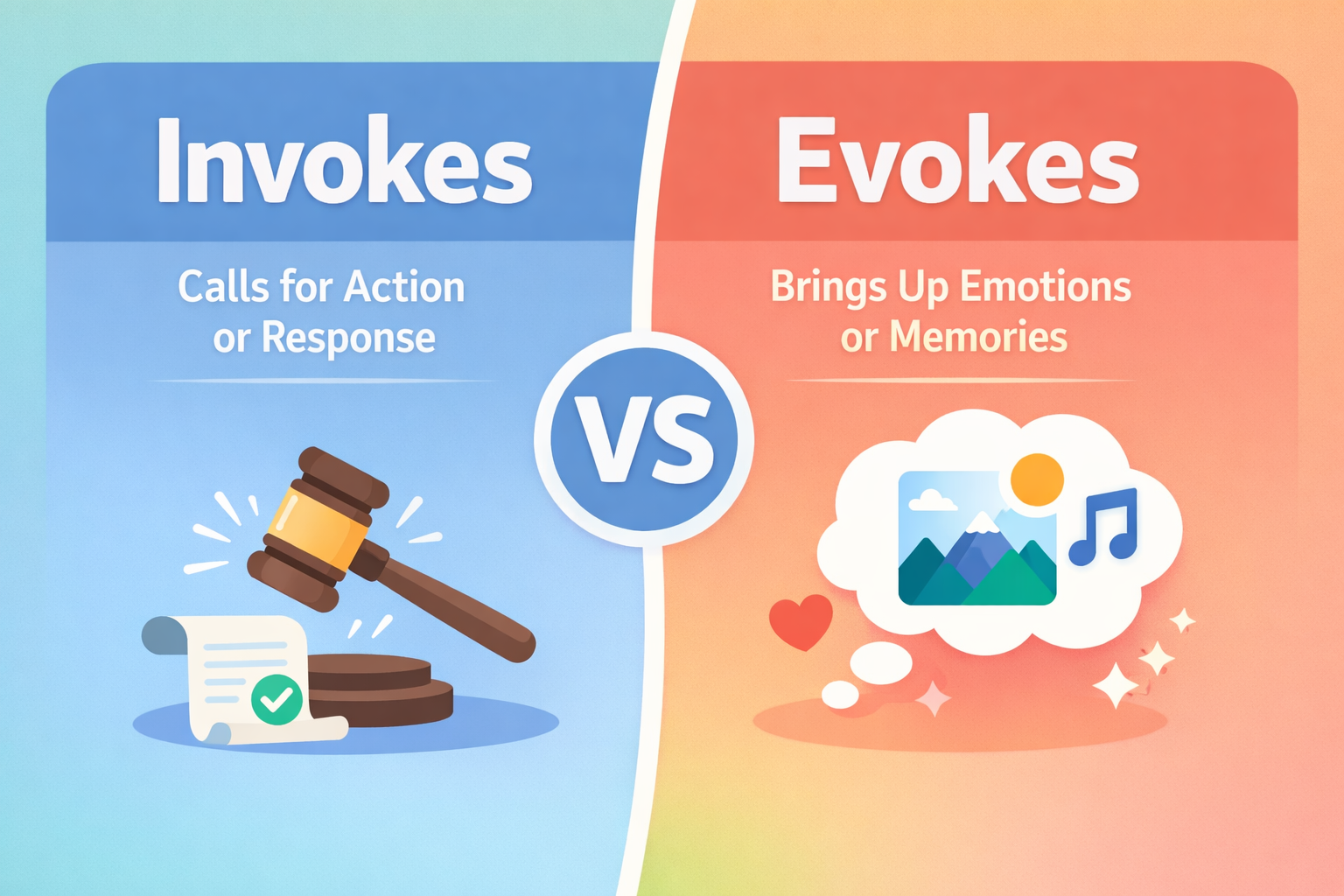
Many learners pause when they see invokes and evokes. The words look close. They sound close. So people think they mean the same thing. But they do not. This small mix-up can change meaning in writing, speech, and exams.
Writers often confuse these words in essays, emails, and articles. Editors also see this mistake often. The problem grows because grammar tools do not always catch it. As a result, sentences can sound wrong or unclear.
In this guide, you will learn the real difference between invokes vs evokes. You will see when to use each word, why people mix them up, and how to choose fast. The goal is simple. After reading, you should never feel confused again.
Invokes vs Evokes – Quick Answer
Invokes means to call on something for help, power, or authority.
Evokes means to bring a feeling, memory, or image to mind.
- Use invoke for rules, laws, or powers.
- Use evoke for emotions, memories, or images.
Easy rule:
If you call on something → invoke
If you feel something → evoke
The Origin of Invokes vs Evokes (Simple History)
Both words come from Latin. This shared root is one reason people confuse them.
Invoke comes from invocare. It means “to call upon.” In the past, people used it for prayers, laws, and authority. Today, the idea stays the same. You still call on something when you invoke it.
Evoke comes from evocare. It means “to draw out.” Over time, this word moved into feelings and memories. Now, it means to bring something to the mind or heart.
Because both words started with “calling,” they seem similar. However, their paths changed. One stayed with action and authority. The other moved to emotion and thought.
British English vs American English Spelling
There is no spelling difference between British and American English.
- ✅ invoke (US and UK)
- ✅ evoke (US and UK)
The confusion is not about spelling. Instead, it is about usage and tone.
| Word | US English | UK English |
| invoke | Same | Same |
| evoke | Same | Same |
In contrast to many English words, these do not change across regions. So you only need to focus on meaning.
How to Choose the Right Word Fast
Choosing between invokes vs evokes becomes easy when you think about purpose.
US Usage
In American writing, invoke often appears in legal or formal text. Evoke appears in creative or emotional writing.
UK / Commonwealth Usage
The pattern stays the same. Writers use invoke for authority and evoke for feelings.
Global or Professional Writing
In global English, clarity matters most. Therefore, use:
- Invoke when something is used or applied
- Evoke when something is felt or imagined
Quick test:
Ask, “Am I using power or feeling?”
Power → invoke
Feeling → evoke
Common Mistakes with Invokes vs Evokes
Writers often swap these words by mistake. Below are common errors and fixes.
❌ The speech invoked strong emotions.
✅ The speech evoked strong emotions.
❌ She evoked her right to remain silent.
✅ She invoked her right to remain silent.
The pattern is clear. Laws and rights are invoked. Feelings and memories are evoked.
Invokes vs Evokes in Everyday Examples
Emails
- He invoked company policy in his reply.
- Her message evoked trust and calm.
News
- The judge invoked the constitution.
- The image evoked public sympathy.
Social Media
- This rule is often invoked online.
- That photo evoked childhood memories.
Formal or Professional Writing
- The contract invokes legal authority.
- The story evokes a sense of hope.
Each example shows a clear line between action and emotion.
Invokes vs Evokes – Usage Patterns & Search Interest
Students, ESL learners, and writers often search invokes vs evokes because grammar books explain it poorly. The words appear in exams, legal texts, and essays. So mistakes matter.
In professional writing, misuse can confuse readers. For example, saying a law evokes authority sounds wrong. It suggests emotion, not action. That small error can reduce trust.
Overall, people want a fast rule. They want clarity. This article solves that exact problem.
📊 Comparison Table: Invokes vs Evokes
| Feature | Invoke | Evoke |
| Meaning | Call upon or use | Bring to mind or feeling |
| Part of speech | Verb | Verb |
| Context | Law, rules, power | Emotions, memories |
| Formal or informal | Mostly formal | Formal and informal |
| Common mistake | Used for emotions | Used for authority |
| Correct example | He invoked the law. | The song evoked joy. |
This table removes confusion at a glance.
❓ Semantic FAQs (People Also Ask)
Is invoke the same as evoke?
No. Invoke is about calling on authority. Evoke is about feelings.
Which one is correct in formal writing?
Both are correct. Use invoke for rules. Use evoke for emotions.
Can they be used interchangeably?
No. Using the wrong one changes meaning.
Why do people confuse them?
They sound similar and share a Latin root.
Can grammar tools catch this mistake?
Sometimes, but not always. Meaning-based errors are hard to detect.
Is there a British vs American difference?
No. The meaning stays the same in both.
Conclusion
Overall, the difference between invokes vs evokes is simple once you see it clearly. Invoke is about action. You use it when you call on laws, rules, or authority. Evoke is about feeling. You use it when something brings memories, images, or emotions to mind.
The most common mistake is using invoke for emotions. That error can confuse readers and weaken your message. So always pause for one second before choosing.
Final rule to remember:
If you use something → invoke
If you feel something → evoke
In short, this single test will keep your writing clear and correct every time.

James Holloway writes detailed guides on confusing English words and grammar usage with clear side-by-side comparisons.