You see the words inclusivity and inclusiveness and you pause. They look like twins. They feel like the same idea. So you type “inclusivity vs inclusiveness” and hope someone will say, “Use this one, not that one.”
This mix-up happens a lot in real writing. It shows up in school essays, workplace emails, and even news posts. People often pick one word because it “sounds right,” not because it fits the sentence. But then the line feels off, or the tone feels too corporate, or the meaning gets fuzzy.
In this guide, you will learn the clear difference in a simple way. You will see when each word fits best, what mistakes to avoid, and how editors usually fix this in clean English. You will also get easy examples you can copy for your own writing.
Inclusivity vs Inclusiveness – Quick Answer
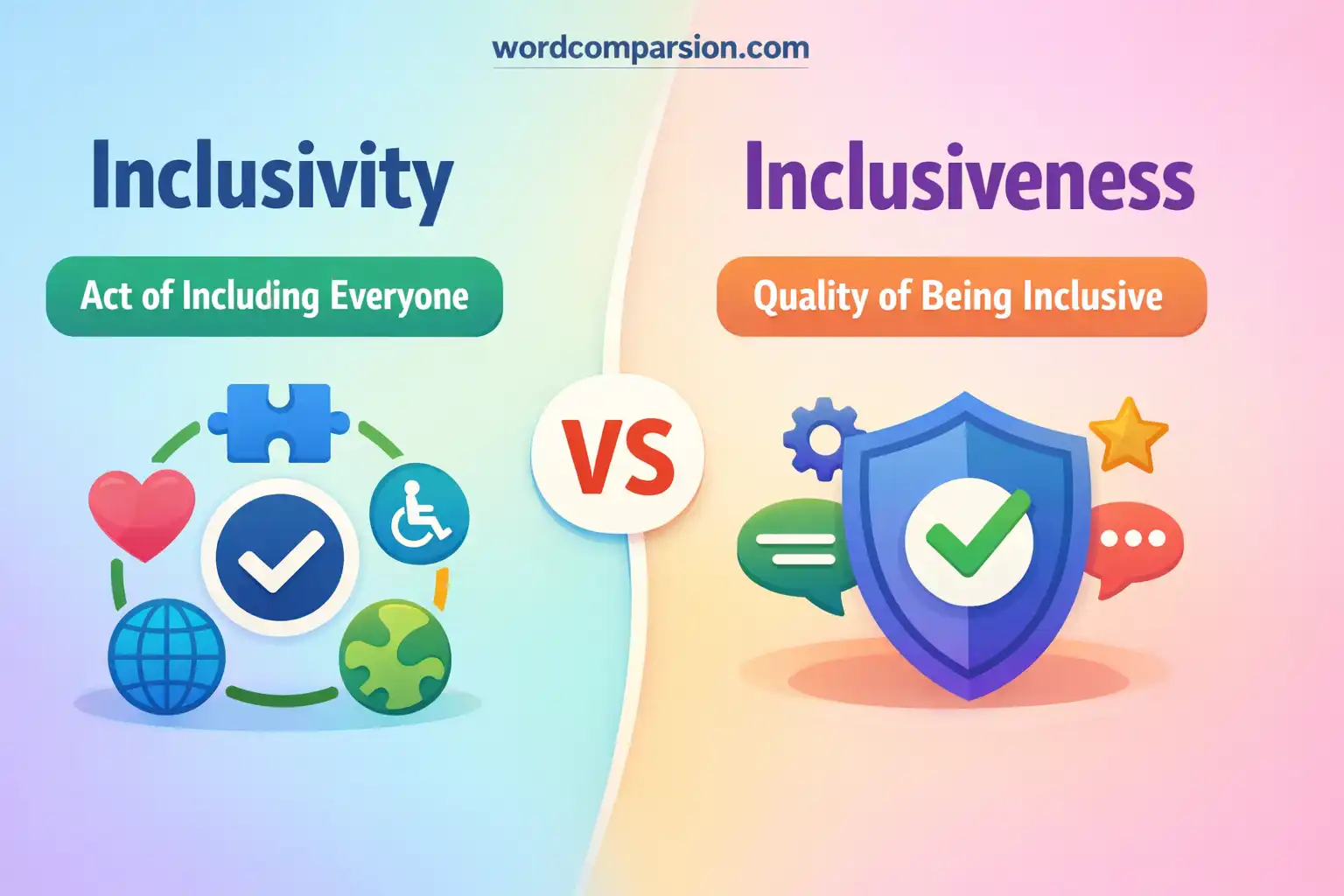
Inclusivity and inclusiveness both relate to including people, but they “feel” different in use.
- Inclusivity = the idea, goal, or policy of including everyone.
Example: “The school supports inclusivity.” - Inclusiveness = the quality of being inclusive in real life.
Example: “Her style shows inclusiveness.”
Easy rule: Use “inclusivity” for programs and plans. Use “inclusiveness” for a lived feeling or trait.
The Origin of Inclusivity vs Inclusiveness
Both words come from include, which comes from Latin roots meaning “to shut in” or “to enclose,” and later “to contain.” Over time, English used include for bringing people or things into a group.
Now the two nouns grew in slightly different ways:
- Inclusiveness feels older and more “plain English.” It sounds like a normal quality, like kindness or fairness.
- Inclusivity feels newer and more “system language.” People use it in policy talk, training, and leadership writing.
So the confusion today makes sense. The words share the same heart. But they point to different angles.
Writers often confuse them because they both answer the same big question: “Are people included?” Yet one word often fits the plan, while the other fits the lived result.
British English vs American English Spelling
Here is the good news: there is no British vs American spelling difference for these two words.
- UK: inclusivity, inclusiveness
- US: inclusivity, inclusiveness
So the choice is not about spelling. It is about tone and usage.
Still, the endings can help you “hear” the difference:
| Ending | What it often suggests | Quick feel |
| -ness | a quality in real life | warm, human |
| -ity | an idea, standard, or system | formal, policy |
But you can’t follow this rule 100% of the time. Use it as a hint, not a law.
Which Spelling Should You Use?
Since spelling does not change by region, use audience and tone to choose the better word.
For the US audience
“Inclusivity” shows up a lot in workplace, school, and program writing. It sounds modern and goal-focused. Still, “inclusiveness” can sound more natural in a human story.
For the UK / Commonwealth audience
Both words work. “Inclusiveness” often feels a bit more classic and less corporate. “Inclusivity” still appears often in policy and education.
For global or professional writing
Pick the word that matches your sentence role:
- If you talk about a strategy, initiative, policy, or training, choose inclusivity.
- If you describe a culture, vibe, behavior, or personal trait, choose inclusiveness.
Common Mistakes with Inclusivity vs Inclusiveness
Editors usually see these mistakes again and again. The fixes are simple.
❌ Incorrect → ✅ Correct
- ❌ “Her inclusivity made new students feel safe.”
✅ “Her inclusiveness made new students feel safe.”
(This is a personal trait in action.) - ❌ “The company launched an inclusiveness policy.”
✅ “The company launched an inclusivity policy.”
(This is a plan or policy.) - ❌ “We need more inclusiveness in our hiring process.”
✅ “We need more inclusivity in our hiring process.”
(Hiring is a system.) - ❌ “The workshop taught inclusiveness goals for schools.”
✅ “The workshop taught inclusivity goals for schools.”
(Goals and teaching frameworks fit “inclusivity.”)
One mistake matters most: using “inclusivity” to describe a person’s warmth in a moment. It can sound stiff, even when you mean something kind.
Inclusivity vs Inclusiveness in Everyday Examples
Think of a small story.
A new student joins a class. He sits alone. He speaks softly. The teacher wants him to feel welcome.
Now watch how the words change the meaning.
Emails
- “Our new policy focuses on inclusivity for all students.”
- “Your inclusiveness during group work helps others speak up.”
News
- “The city announced a new inclusivity program for public spaces.”
- “Residents praised the inclusiveness of the event.”
Social media
- “We’re building inclusivity in our community rules.”
- “I felt real inclusiveness at that meetup today.”
Formal or professional writing
- “The plan outlines measurable steps for inclusivity in hiring.”
- “Team leaders should model inclusiveness in meetings.”
See the pattern? One word often sits next to program, plan, policy, rules, steps. The other often sits next to felt, showed, modeled, welcomed.
Inclusivity vs Inclusiveness – Usage Patterns & Search Interest
People search this topic because they face one of these moments:
- They write a school paragraph and want the “correct” word.
- They write a workplace message and fear sounding wrong.
- They hear both words and wonder if one is outdated.
- They use a grammar tool and it does not flag the choice.
Search interest also rises because both words appear in public talk. Students, ESL learners, writers, HR teams, teachers, and editors all meet these words often. So confusion spreads fast.
One real-world scenario can cause trouble:
A manager writes, “Thank you for your inclusivity today.”
Some readers may understand it, but it can feel odd. It may sound like the manager praises a policy, not a person. If the manager writes, “Thank you for your inclusiveness today,” the message feels warmer and clearer.
So the problem is not just “which word is right.” The problem is which word fits the human moment.
Comparison Table: Inclusivity vs Inclusiveness
| Point | Inclusivity | Inclusiveness |
| Core meaning | the goal or principle of including everyone | the quality of being welcoming and including |
| Part of speech | noun (idea / framework) | noun (trait / lived behavior) |
| Best context | policies, programs, systems, initiatives | culture, tone, actions, personal behavior |
| Formal vs informal | more formal, often institutional | more natural, often conversational |
| Common mistakes | used to describe a person’s warmth | used to name a policy or strategy |
| Correct example | “The school improved inclusivity in admissions.” | “Her inclusiveness helped quiet students join.” |
Semantic FAQs (People Also Ask)
Is inclusivity the same as inclusiveness?
No. They share the same idea, but inclusivity fits plans and systems, while inclusiveness fits traits and real moments.
Which one is correct in formal writing?
Both can be correct. Still, formal policy writing often prefers inclusivity because it sounds goal-based and structured.
Can I use them interchangeably?
Sometimes, yes. But your sentence may sound stiff or unclear. So choose the word that matches policy vs behavior.
Why do people confuse them?
They look similar, and they both relate to including people. Also, many texts use them without clear examples, so learners copy the confusion.
Can grammar tools catch this mistake?
Usually not. Both words are real and spelled correctly. Tools may not know what meaning you want in your sentence.
Is there a British vs American difference?
No. Both US and UK English use both words. The choice depends on tone and context, not spelling.
Which word sounds more “human”?
“Inclusiveness” often sounds more personal and warm, especially when you talk about how someone acts or how a place feels.
Conclusion
Inclusivity vs inclusiveness feels confusing because the words share the same base idea. Yet they work best in different spots. Inclusivity usually names the goal, the policy, or the system that aims to include people. Inclusiveness usually names the living quality you can feel in a room, a team, or a person’s actions.
One mistake to always avoid is this: don’t use “inclusivity” when you mean a person’s warm behavior in a moment. That choice can make your sentence sound cold or overly formal.
Overall, keep one rule in your pocket. If it sounds like a plan, use inclusivity. If it sounds like a feeling or a trait, use inclusiveness. Finally, read your sentence out loud. The better word usually “fits” your voice right away.

James Holloway writes detailed guides on confusing English words and grammar usage with clear side-by-side comparisons.