What Is the Difference Between Enquiry and Inquiry?
Many people get confused about enquiry vs inquiry. Both words look almost the same. They also sound the same. But writers often stop and wonder which one they should use.
This confusion happens because English spelling changes across regions. British English and American English sometimes use different spellings for the same word. So students, bloggers, and professionals often mix these two forms.
You may see enquiry in UK writing. But you may also see inquiry in news reports, research papers, and government documents. Because of this, many people ask: Which one is correct? The answer depends on where you are writing and what style you follow.
In this guide, you will learn the difference between enquiry vs inquiry, their meanings, pronunciation, examples, and how to choose the right one quickly. You will also see common mistakes and real-world usage.
Enquiry vs Inquiry – Quick Answer
Meaning of enquiry vs inquiry
Both words mean asking for information or investigating something.
- Enquiry → Common in British English
- Inquiry → Standard in American English
Examples
- “I sent an enquiry about the course.”
- “The government started an inquiry into the accident.”
Easy rule:
Use inquiry in American writing and enquiry in British-style writing.
The Origin of Enquiry vs Inquiry
The words enquiry and inquiry come from the same root.
Both started from the Latin word inquirere, which means to seek or to ask. Later, the word moved into Old French as enquerre, and then into Middle English.
In early English writing, both spellings existed together. Writers used them almost interchangeably. Over time, regional spelling differences appeared.
In British English, enquiry became common for general questions. Meanwhile, inquiry often appeared in formal investigations. But this rule is not strict today.
Modern dictionaries, including the Oxford Dictionary, show that both spellings mean almost the same thing.
So historically, there was never a strong difference in meaning. The difference mostly comes from spelling preference by region.
Reason for Confusion Today
Today, confusion exists for several reasons.
First, both words look and sound almost identical. Their pronunciation is the same:
/ɪnˈkwaɪəri/
Second, the internet mixes English styles. A website from the US may use inquiry, while a UK blog may use enquiry.
Third, some grammar guides once suggested a difference:
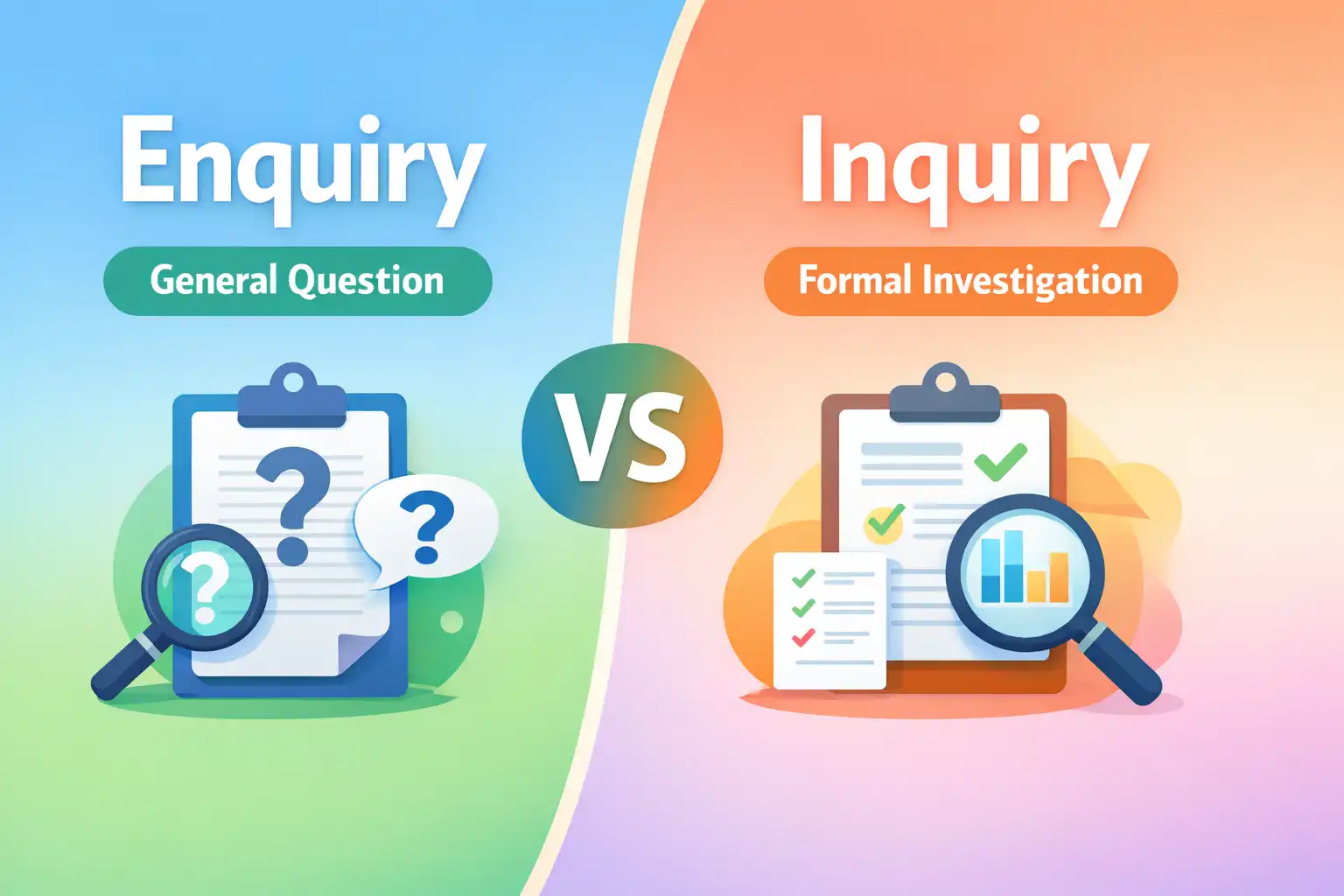
- Enquiry → simple question
- Inquiry → formal investigation
But modern usage rarely follows this rule. Most writers now use spelling based on their region instead.
Because of this shift, many people search for enquiry vs inquiry meaning, enquiry vs inquiry example, and enquiry vs inquiry synonym.
British English vs American English Spelling
The biggest difference between enquiry vs inquiry is regional spelling.
British English
- Common spelling: Enquiry
- Used in emails, customer questions, or general requests
American English
- Standard spelling: Inquiry
- Used in all situations
Examples
British style:
- “I have an enquiry about your services.”
American style:
- “I have an inquiry about your services.”
Simple Comparison
| Region | Preferred Spelling |
| United Kingdom | Enquiry |
| United States | Inquiry |
| Canada | Often Inquiry |
| Australia | Enquiry |
Both spellings are correct. But the location of the audience matters.
How to Choose the Right Word Fast
Choosing the correct spelling becomes easy when you know your audience.
US Writing
Use inquiry.
American English almost always uses this spelling. It appears in:
- news reports
- academic papers
- business communication
Example:
“The company opened an inquiry into the issue.”
UK / Commonwealth Writing
Use enquiry.
British English prefers this spelling in everyday writing.
Example:
“I sent an enquiry about hotel prices.”
Countries like Australia, India, and New Zealand often follow this style.
Global or Professional Writing
If you write for an international audience, inquiry is often safer. Many global companies use American spelling for consistency.
However, either spelling works if you stay consistent.
Common Mistakes with Enquiry vs Inquiry
Here are frequent errors writers make.
Using Both Spellings in the Same Text
❌ Incorrect
“The enquiry started after the inquiry report.”
✅ Correct
“The inquiry started after the inquiry report.”
Explanation:
Choose one spelling style and stay consistent.
Mixing Regional Styles
❌ Incorrect
“I sent an inquiry to a UK university.”
✅ Correct
“I sent an enquiry to a UK university.”
Explanation:
Match spelling to the regional style.
Confusing the Verb Forms
❌ Incorrect
“I will enquiry about the job.”
✅ Correct
“I will enquire about the job.”
Explanation:
Enquiry / inquiry are nouns.
Enquire / inquire are verbs.
Enquiry vs Inquiry in Everyday Examples
Let’s see how the words appear in real situations.
Emails
“I am writing to make an enquiry about your training program.”
“I would like to submit an inquiry regarding my order.”
News
“The government launched an inquiry into the accident.”
Social Media
“Quick enquiry: does anyone know a good dentist here?”
Formal or Professional Writing
“The committee opened a public inquiry to review the case.”
Common Usage Patterns of Enquiry and Inquiry
Search patterns show that many people look for enquiry vs inquiry UK, enquiry vs inquiry pronunciation, and enquiry vs inquiry Oxford dictionary.
Typical users include:
- students learning English
- ESL learners
- writers and editors
- professionals writing emails
One real-world example shows how confusion happens.
Imagine a UK university website. It uses enquiry form for student questions. But an American student may expect the spelling inquiry form.
The meaning stays the same, but the spelling difference can confuse readers.
Enquiry vs Inquiry Comparison Table
| Feature | Enquiry | Inquiry |
| Meaning | Asking for information | Asking for information or formal investigation |
| Part of Speech | Noun | Noun |
| Context of Use | British English communication | American English writing |
| Formal vs Informal | Used in general questions | Often used in formal or official contexts |
| Common Mistake | Using it in American writing | Mixing with enquiry in UK texts |
| Correct Example | “I sent an enquiry about the course.” | “The court opened an inquiry into the case.” |
People Also Ask (FAQs)
Is enquiry or inquiry correct?
Both are correct. Enquiry is common in British English, while inquiry is standard in American English.
What is the meaning of enquiry?
Enquiry means asking for information or requesting details about something.
Example: “She made an enquiry about the job.”
Is it inquiry or enquiry in India?
Many Indian writers use enquiry, following British English style. However, inquiry also appears in international communication.
Is it my inquiry or my enquiry?
Both are correct. Choose inquiry for American English and enquiry for British-style writing.
When to use enquire vs inquire?
Use enquire as the verb in British English and inquire in American English.
Example: “Please enquire about the schedule.”
What does “inquiry” mean?
Inquiry means a request for information or a formal investigation into a problem or event.
Is enquiry the same as inquiry?
Yes. They share the same meaning. The difference mainly comes from regional spelling.
Which one is correct in formal writing?
Formal writing usually follows regional style. American documents use inquiry, while British documents often use enquiry.
Is enquiry vs inquiry pronunciation different?
No. Both words have the same pronunciation: /ɪnˈkwaɪəri/.
Enquiry vs Inquiry: Final Answer
The difference between enquiry vs inquiry is simple once you understand the spelling rules.
Both words mean asking for information or investigating something. They come from the same historical root and share the same pronunciation.
The key difference is regional usage.
- Enquiry → mostly used in British English
- Inquiry → standard spelling in American English
In professional or global writing, inquiry often appears more frequently. But British organizations still use enquiry in emails, websites, and customer forms.
The most important thing is consistency. Do not mix both spellings in the same document.
Overall, remember this easy rule:
If your audience follows American English, use inquiry.
If your audience follows British English, use enquiry.
In short, the words mean the same thing. Only the spelling changes.

James Holloway writes detailed guides on confusing English words and grammar usage with clear side-by-side comparisons.