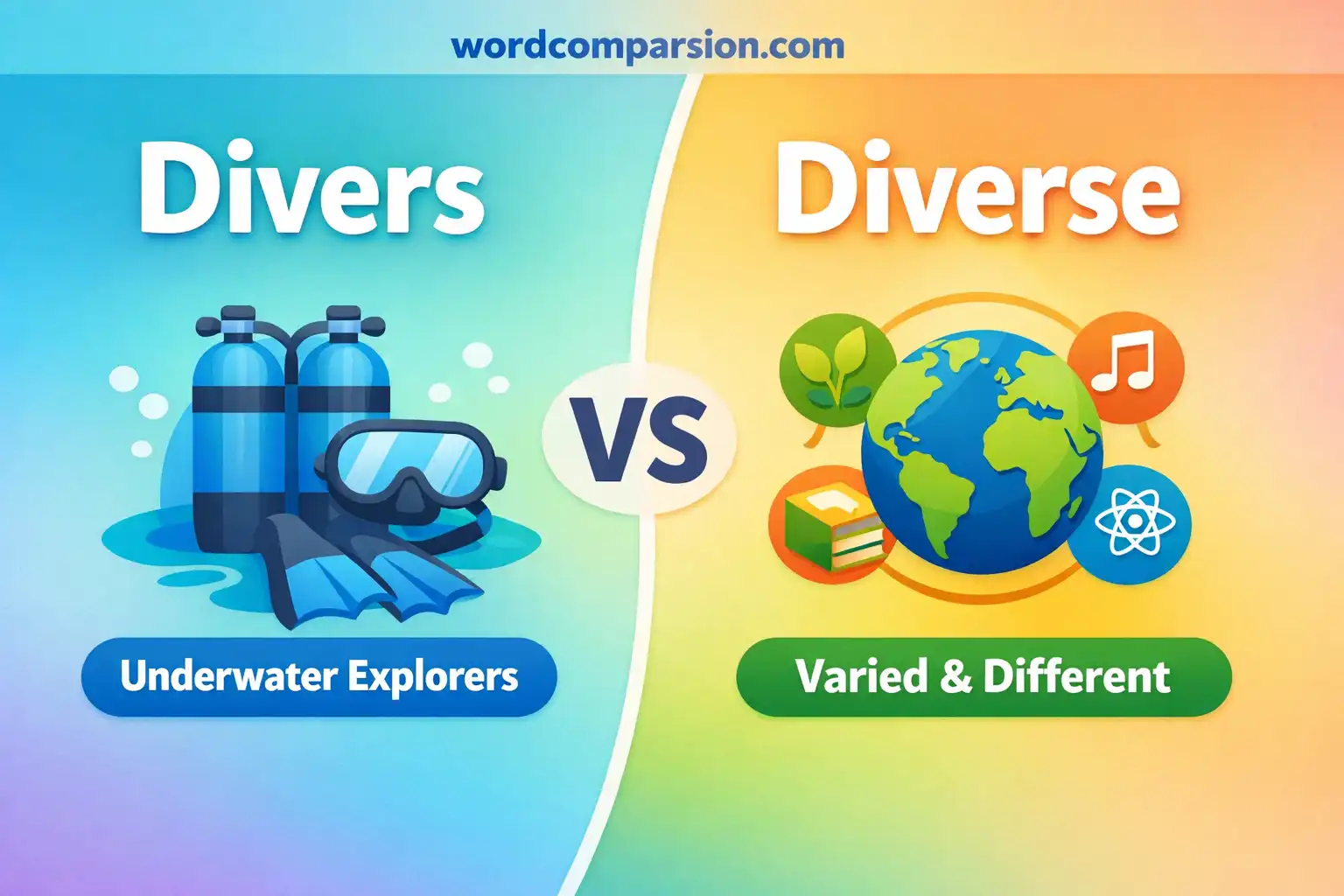
You may have seen the words divers and diverse and paused for a second. They look almost the same. They sound close too. So many writers, students, and ESL learners mix them up. Some even think they are spelling versions of the same word.
But they are not the same at all.
This confusion often appears in emails, essays, and online posts. A writer may say, “We have divers ideas,” when they really mean “diverse ideas.” The sentence then feels strange, and the meaning becomes unclear. Because of this, readers may misunderstand the message.
In this article, you will learn the clear difference between divers vs diverse, where each word comes from, and how to use them correctly in real life. By the end, you will never mix them up again.
Divers vs Diverse – Quick Answer
- Diverse means different from each other.
- Divers means several or various (older or formal use).
- Both are adjectives, but diverse is common today.
- Easy rule: If you mean many kinds, use diverse.
Examples:
- We have diverse opinions in the team. ✅
- The report lists divers reasons. ✅ (formal/old style)
The Origin of Divers vs Diverse
Both words come from Latin and Old French. They share the same root idea: different.
Diverse came into English through French and stayed popular in daily language. People used it often, and they still do today.
Divers, however, is much older in style. Writers used it more in the past, especially in formal or literary texts. Over time, people stopped using it in speech. Now, you mostly see it in legal writing, old books, or very formal documents.
Because they look so similar and share history, writers often think one is just a spelling mistake of the other. But today, they live very different lives in English.
British English vs American English Spelling
There is no spelling difference between British and American English for these words.
| Word | US Spelling | UK Spelling | Meaning |
| divers | divers | divers | several, various (formal/old) |
| diverse | diverse | diverse | many different kinds |
However, diverse is used in both regions every day. Divers feels rare in both.
Which Spelling Should You Use?
This depends on your audience and tone.
- US audience: Use diverse almost always.
- UK / Commonwealth: Still use diverse in normal writing.
- Formal, legal, or literary writing: You may see divers.
If you want your writing to feel modern, clear, and natural, choose diverse.
Common Mistakes with Divers vs Diverse
Writers often confuse them because of how they look.
❌ We discussed divers solutions.
✅ We discussed diverse solutions.
❌ Our team has divers backgrounds.
✅ Our team has diverse backgrounds.
❌ She shared divers opinions.
✅ She shared diverse opinions.
The mistake happens when someone wants to say many kinds but uses divers instead.
Divers vs Diverse in Everyday Examples
Here is how people use diverse correctly in daily life.
Emails
Our company supports a diverse workplace.
News
The city has a diverse population.
Social media
I love meeting people from diverse cultures.
Professional writing
The research used a diverse data set.
Now look at divers, which feels formal:
Formal document
The contract lists divers conditions.
You can see the tone difference right away.
Divers vs Diverse – Usage Patterns & Search Interest
Today, students, ESL learners, and content writers often search this topic. They see divers in old texts or legal papers, then wonder if it is correct.
Editors also notice this mistake often. A writer wants to sound smart, so they use divers, but the sentence then feels strange and outdated.
In real life, this misuse can make writing look unnatural. For example, in a job application, writing “divers skills” may confuse the reader or feel incorrect.
Quick Comparison Table
| Feature | Divers | Diverse |
| Meaning | several, various | many different kinds |
| Part of speech | adjective | adjective |
| Context of use | formal, old, legal | modern, everyday |
| Formal vs informal | very formal | works in all tones |
| Common mistake | used instead of diverse | rarely misused |
| Correct example | divers reasons were given | diverse ideas help teams |
This table shows why diverse is safer in most cases.
FAQs
Is divers the same as diverse?
No. Divers means several. Diverse means many different kinds.
Which one is correct in formal writing?
Both can be correct, but diverse sounds more natural today.
Can they be used interchangeably?
No. Their meanings are close but not the same.
Why do people confuse them?
They look almost identical and share the same origin.
Can grammar tools catch this mistake?
Sometimes. But many tools do not flag divers as wrong.
Is there a British vs American difference?
No. Both regions prefer diverse in modern writing.
Conclusion
The confusion between divers vs diverse comes from history and spelling. They share roots, and they look alike. But their modern use is very different.
Divers is old, formal, and rare. You may see it in legal papers or classic books. Diverse is common, modern, and natural in daily writing.
Overall, if you want to say many kinds of things, always choose diverse. This choice will keep your writing clear and easy to read.
Finally, remember this simple rule:
If you mean different types, use diverse.

James Holloway writes detailed guides on confusing English words and grammar usage with clear side-by-side comparisons.