Many learners mix up critique vs critic because both words relate to opinions and judgment. At first glance, they seem almost the same. But they are not. This confusion often appears in writing, emails, and even social media posts. People may say “I gave a critic” when they mean “I gave a critique.” That small mistake can change the meaning a lot.
So, what is the real difference? One word is an action or process, and the other is a person. This article will help you understand both words in a simple way. You will learn how to use them correctly, avoid common mistakes, and choose the right word fast in real life.
Critique vs Critic – Quick Answer
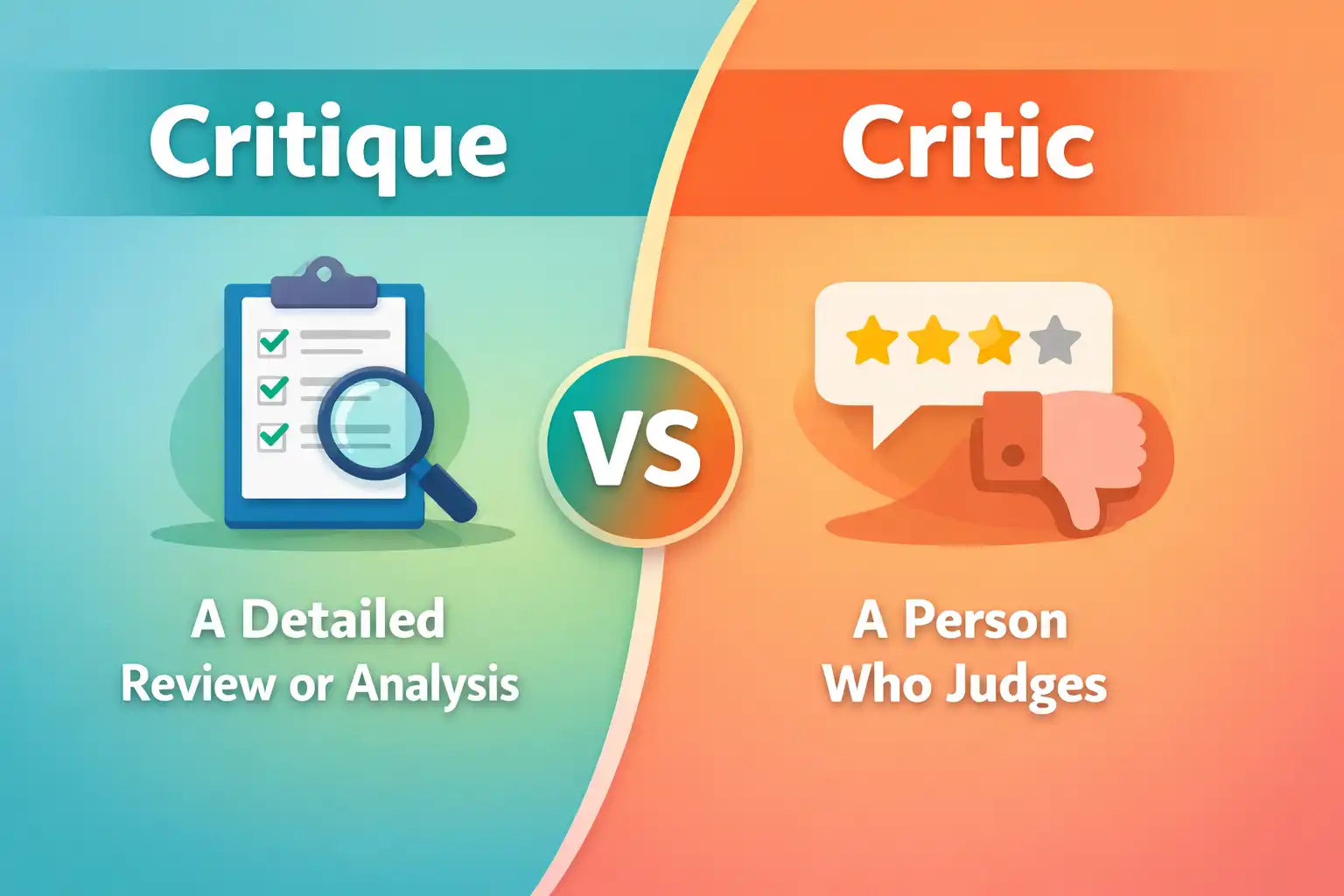
Meaning of Critique
- A detailed review or analysis of something
- Focuses on strengths and weaknesses
- Used as a noun and sometimes a verb
Examples
- She wrote a critique of the movie
- The teacher will critique your essay
Meaning of Critic
- A person who gives opinions or reviews
- Often judges books, movies, or art
Examples
- He is a film critic
- Critics praised the new book
Easy Rule:
Use critique for the review. Use critic for the person.
The Origin of Critique vs Critic
Both words come from the same root. They come from the Greek word kritikos, which means “able to judge.” Later, the words entered French and then English.
Critic appeared first in English. It meant a person who judges or evaluates work. Over time, it became common in art, literature, and media.
Critique came later from French. It refers to the act of reviewing or analyzing something. It often suggests a more detailed and careful evaluation.
So, the confusion exists because both words share the same base meaning. However, their roles are different today. One is the reviewer, and the other is the review.
British vs American English Spelling
There is no major spelling difference between British and American English for these words. Both forms use:
- Critique
- Critic
However, usage style may vary slightly. For example, British writing may use critique more in academic settings, while American writing uses both words in general and professional contexts.
Small comparison:
Aspect | British English | American English
Spelling | Same | Same
Usage tone | Slightly formal | Both formal and casual
Common use | Academic writing | Media and daily use
In contrast to many English words, these do not change spelling across regions.
How to Choose the Right Word Fast
Choosing between critique and critic is simple if you focus on the role.
For US readers:
- Use critique when talking about feedback or review
- Use critic when talking about a person
For UK and Commonwealth:
- Same rules apply
- Slightly more formal tone in writing
Global or professional writing:
- Use critique in reports, reviews, and feedback
- Use critic when referring to experts or reviewers
If you feel confused, ask yourself one question:
“Am I talking about a person or a review?”
That answer will guide you.
Common Mistakes with Critique vs Critic
Writers often mix these two words because they sound similar.
❌ Incorrect: He gave me a critic
✅ Correct: He gave me a critique
Explanation: “Critic” is a person, not feedback.
❌ Incorrect: She is a famous critique
✅ Correct: She is a famous critic
Explanation: A person is always a “critic.”
❌ Incorrect: I will critic your work
✅ Correct: I will critique your work
Explanation: The verb form is “critique,” not “critic.”
These errors are common in ESL writing and student essays.
Critique vs Critic in Real Life Examples
Emails:
- Please send your critique of the report by Friday
- The critic shared his opinion on the design
News:
- Critics loved the new film
- The article included a critique of government policy
Social Media:
- This is my critique of the latest phone
- Many critics are talking about this trend
Professional Writing:
- The report offers a deep critique of the system
- A well-known critic reviewed the book
These examples show how each word fits in real use.
Critique vs Critic – Word Usage Patterns and Search Trends
People often search for critique vs critic because the words look similar. Students and ESL learners search this topic the most. Writers also check this when editing content.
Search trends show that:
- “Critique meaning” is common among learners
- “Critic definition” is searched in media and journalism topics
A real problem happens in writing reviews. For example, someone may write “my critic of the movie” instead of “my critique.” This mistake can confuse readers and reduce clarity.
So, learning this difference improves both writing and communication.
Comparison Table: Critique vs Critic
Feature | Critique | Critic
Meaning | A detailed review | A person who reviews
Part of Speech | Noun / Verb | Noun
Context | Feedback, analysis | Person, expert reviewer
Formal vs Informal | Often formal | Both formal and casual
Common Mistake | Used for person | Used for review
Correct Example | Her critique was helpful | The critic liked the film
This table gives a quick and clear difference.
FAQs
Is critique the same as critic?
No. Critique is a review, while a critic is a person who gives that review.
Which one is correct in formal writing?
Both are correct. Use critique for analysis and critic for the person.
Can they be used interchangeably?
No. They have different meanings and roles.
Why do people confuse them?
They share the same root word and sound similar.
Can grammar tools catch this mistake?
Sometimes. But context matters, so tools may miss it.
Is there a British vs American difference?
No major difference. Both use the same spelling and meaning.
Can critique be a verb?
Yes. You can say “I will critique your work.”
Conclusion
In short, critique vs critic is a simple but important difference. A critique is the review itself. A critic is the person giving that review. Many learners confuse them because they sound alike and share the same origin.
Now you know how to use both words in real situations. You can write better emails, clearer essays, and more accurate content. One common mistake to avoid is using “critic” when you mean feedback. That small error can confuse your message.
Overall, remember this easy rule:
If it is a person, use critic. If it is feedback, use critique.
This one tip will help you stay correct every time.

Moses Jhon is a dedicated content writer known for producing high-quality, reader-focused, and SEO-optimized content. He has experience crafting blog posts, website content, articles, and marketing copy across different niches. His writing style combines creativity, clarity, and strategy to help businesses grow their online presence and engage their target audience effectively.