You are writing a quick email, and you type “Dear costumer.” It looks fine, so you hit send. Then your friend replies, “Why did you call them a costume maker?” Now you feel stuck, because you meant “buyer,” not “person who makes costumes.”
This mix-up happens a lot because the two words look almost the same. One extra letter changes the whole meaning. Spellcheck may not save you either, because both words are real words. So the mistake can slip into school work, job emails, and even news posts.
In this guide, you will learn the simple difference, where each word comes from, and how to pick the right one fast. You will also see short examples you can copy and use right away.
Costumer vs Customer – Quick Answer
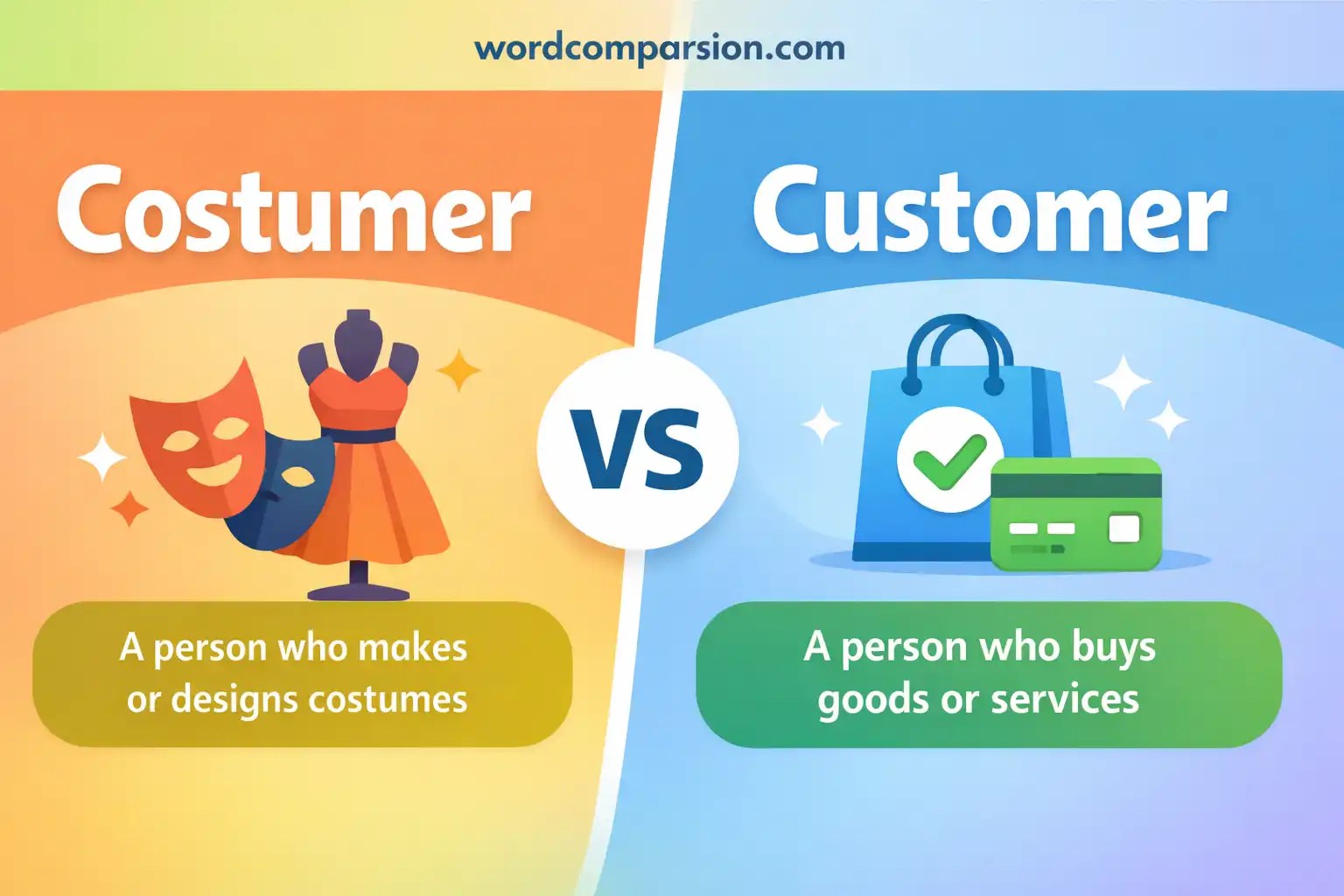
Costumer means a person who makes or sells costumes, or works with costumes in theater and film.
Customer means a person who buys something from a shop, brand, or business.
- Use customer for buyers: “A customer paid online.”
- Use costumer for costumes: “The costumer fixed the dress.”
Easy rule: If money is involved, choose customer. If costumes are involved, choose costumer.
The Origin of Costumer vs Customer
These words look like twins, but they grew up in different homes.
Customer comes from the idea of “custom,” which connects to how people buy, trade, and do business. Long ago, a “customer” was linked to a usual buyer, a person who comes back again and again. So the word stayed close to shops, services, and selling.
Costumer comes from costume. A costume is a special outfit for a role, a show, or a theme event. So a costumer works with those outfits. You might see a costumer in a theater, on a film set, or in a costume shop.
Now the confusion makes sense. The words share many letters, and both sit near “custom.” Also, both appear in work settings, so writers mix them up. Editors often see this mistake in emails and website pages because the wrong word still “looks right.”
British English vs American English Spelling
This pair is not a UK vs US spelling difference. Both British English and American English use the same spellings:
- customer = buyer
- costumer = costume worker
So the problem is not country spelling. The problem is meaning.
Here is a quick mini table to make it clear:
| Word | What it means | Quick clue |
| customer | a buyer of goods or services | pays, buys, orders |
| costumer | a costume maker or costume seller | costumes, theater, film |
In contrast to words like “colour/color,” you do not change spelling by region here. You change spelling only when you change meaning.
Which Spelling Should You Use?
Pick the word based on your message, not your location.
US audience
Use customer when you mean a buyer. Use costumer only for costume work. This stays true in stores, apps, and support chats.
UK / Commonwealth audience
The same rule applies. A UK reader expects customer for buyers. A UK reader reads costumer as a costume job.
Global or professional writing
Use customer almost all the time because most business writing talks about buyers. Use costumer only if you are writing about costumes, fashion shows, drama clubs, or film crews.
If you work in sales, marketing, or support, you almost always need customer. If you work in theater, you may use costumer more often. Still, you choose by context, not by country.
Common Mistakes with Costumer vs Customer
Writers often make the same errors, so you can learn them fast.
- Using costumer in business writing
❌ Incorrect: “We care about every costumer.”
✅ Correct: “We care about every customer.”
Why: You are talking about buyers, not costumes. - Using customer in theater or film credits
❌ Incorrect: “Customer: Sara Khan”
✅ Correct: “Costumer: Sara Khan”
Why: The role is about costumes. - Mixing them in a sentence with “service”
❌ Incorrect: “Our costumer service is open.”
✅ Correct: “Our customer service is open.”
Why: Customer service helps buyers and users. - Letting spellcheck decide
❌ Incorrect: “The tool didn’t underline it, so it’s fine.”
✅ Correct: “I checked the meaning, so it’s right.”
Why: Both words are correct words, so tools may miss the mistake.
Costumer vs Customer in Everyday Examples
Seeing the words in normal life helps the brain lock the meaning in.
Emails
- Customer: “Hello, I am a customer. I need help with my order.”
- Costumer: “Hi, I am the costumer for the school play. We need more hats.”
News
- Customer: “The company refunded customers after the delay.”
- Costumer: “The film costumer won praise for the period outfits.”
Social media
- Customer: “Shout-out to every customer who supported us this week!”
- Costumer: “Behind the scenes: our costumer made this cape in one day.”
Formal or professional writing
- Customer: “We improved the customer experience and reduced wait time.”
- Costumer: “The costumer prepared outfits for the full cast.”
Also notice a small clue: customer often sits near words like order, refund, support, price, and payment. Costumer often sits near words like dress, fabric, stage, actor, and scene.
Costumer vs Customer – Usage Patterns & Search Interest
People search this topic because the mistake feels embarrassing and easy to make. It shows up most in:
- students writing essays and emails
- ESL learners building vocabulary
- writers and bloggers who publish fast
- business owners writing “customer service” pages
- job seekers sending formal emails
Customer is more common in daily life because buying and selling happens everywhere. Costumer is less common because it belongs to a smaller world, like theater, film, cosplay shops, and costume design.
Here is one real-life moment where the wrong word causes trouble:
A small brand posts, “We love our costumers.” Some readers laugh, and some readers feel unsure. The message shifts from “buyers” to “costume makers,” so the brand sounds careless. That is why this confusion matters. One letter can change trust.
Comparison Table: Costumer vs Customer
| Point | Costumer | Customer |
| Meaning | person who makes, sells, or manages costumes | person who buys goods or services |
| Part of speech | noun | noun |
| Context of use | theater, film, events, costume shops | stores, online shopping, services, support |
| Formal vs informal | can be formal in job titles and credits | common in both formal and informal writing |
| Common mistakes | used by accident in business writing | used by accident in costume-related writing |
| Correct example | “The costumer repaired the actor’s jacket.” | “The customer asked for a refund.” |
Semantic FAQs (People Also Ask)
Is costumer the same as customer?
No. Costumer relates to costumes. Customer relates to buying.
Which one is correct in formal writing?
Both are correct, but only in the right context. Business writing usually needs customer.
Can I use them interchangeably?
No, because the meanings differ. The swap changes your message.
Why do people confuse them?
They look almost the same, and both are real words. So the mistake slips through.
Can grammar tools catch this mistake?
Sometimes, but not always. Many tools miss it because both spellings are valid.
Is there a British vs American difference?
No. Both UK and US English use the same spellings and meanings.
What is the most common phrase people misspell?
“Customer service.” People sometimes write “costumer service,” but that is wrong.
Conclusion
Costumer vs customer feels tricky at first, but the fix is simple. Customer means a buyer, so you use it for shopping, orders, support, and business writing. Costumer means a costume worker, so you use it for theater, film, and costume design.
The biggest mistake to avoid is using costumer when you mean customer, especially in “customer service” text. That one typo can make your message look careless, even if your idea is good. So slow down for one second and check the meaning.
Overall, the best memory rule is easy: money equals customer, costumes equal costumer. In short, look for the topic of your sentence, then pick the word that matches the real world you are talking about. Finally, if you still feel unsure, swap in “buyer.” If “buyer” fits, you want customer.

James Holloway writes detailed guides on confusing English words and grammar usage with clear side-by-side comparisons.