Many people search for copyright or copywrite because these two words look similar. However, their meanings are very different. As a result, confusion happens often. Students, bloggers, business owners, and ESL learners face this problem daily. They see the words online, in emails, or in legal notices. Then they feel unsure which one is correct.
Moreover, spellcheck tools do not always help. Sometimes, the wrong word still looks correct. Therefore, mistakes spread fast on websites, social media, and even professional documents. In contrast, one small spelling error can change the meaning completely.
This article solves that problem clearly. First, it explains what each word means. Then, it shows why people confuse them. Additionally, it explains where each word fits in real life. You will also see examples, tables, and common mistakes. Finally, you will learn one simple rule to remember forever. Overall, this guide gives you confidence to use the right word every time.
Start from the “word comparison home page” to compare more words.
Copyright or Copywrite – Quick Answer
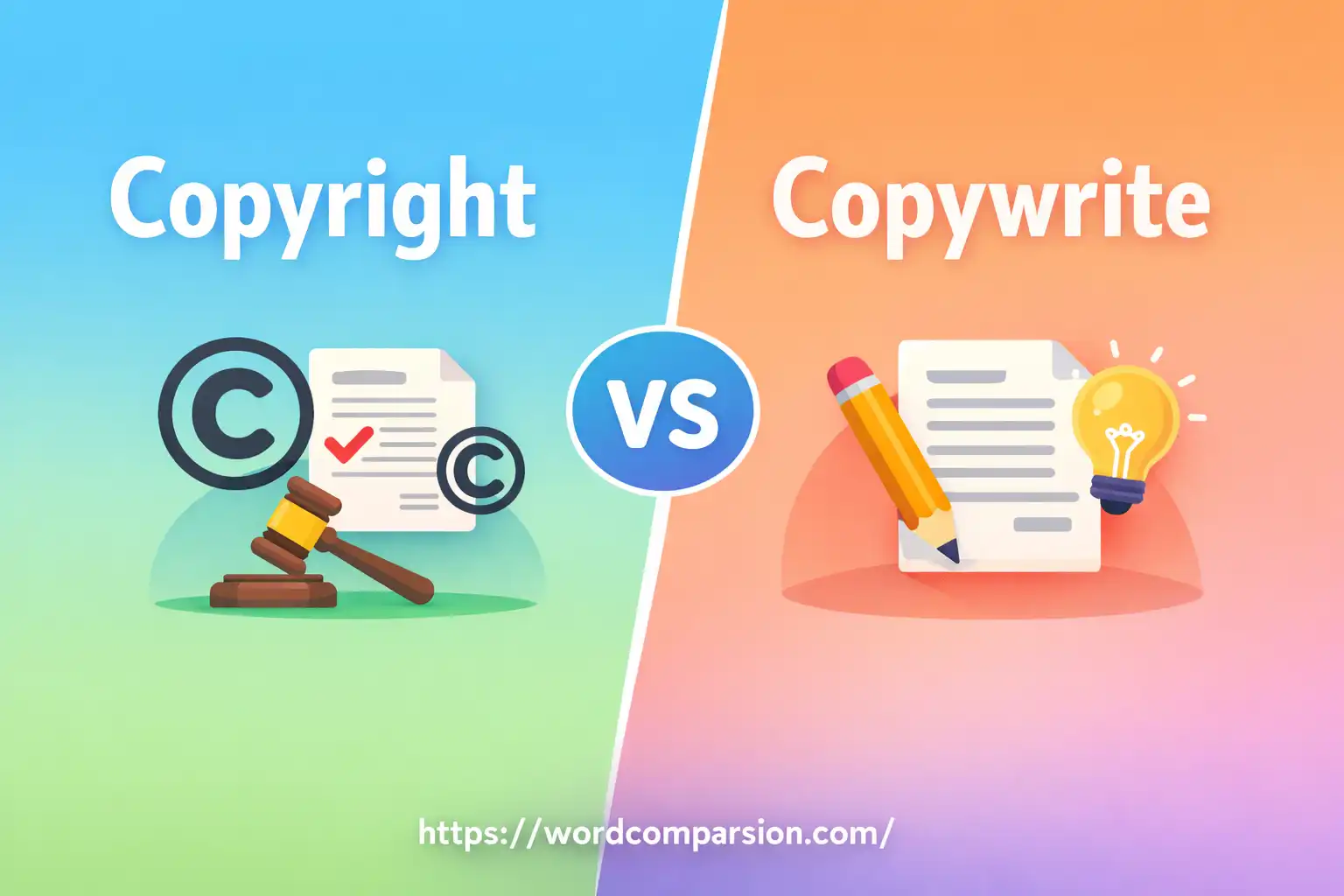
Copyright is a legal word. It protects creative work like books, music, and videos.
Copywrite is not a legal term. It is usually a spelling mistake.
Example:
- ✅ This photo has copyright protection.
- ❌ This photo has copywrite protection.
The Origin of Copyright or Copywrite
The word copyright comes from two old words: copy and right. Originally, it meant the right to make copies of a work. Therefore, authors and creators used it to protect their content. Over time, laws adopted this term worldwide.
In contrast, copywrite has no legal origin. People created it by mistake. They mixed copyright with copywriting. As a result, the wrong word spread through typing errors and misunderstanding.
Moreover, modern digital content increased this confusion. People see “copy,” “write,” and “rights” together often. Therefore, the brain connects them incorrectly. Overall, history supports only one correct word.
For similar mix-ups, visit the “commonly confused words” pillar page.
British English vs American English Spelling
There is no spelling difference between British and American English for this word. Both use copyright.
However, confusion still appears worldwide. This happens because English learners assume spelling changes by region.
| Aspect | British English | American English |
| Correct spelling | copyright | copyright |
| Alternative form | none | none |
| Copywrite | ❌ incorrect | ❌ incorrect |
In contrast, words like colour and color change by region. Copyright does not.
Which Spelling Should You Use?
You should always use copyright in every situation.
- United States: Use copyright for legal, academic, and online content.
- UK / Commonwealth: Use copyright without changes.
- Global or professional writing: Use copyright only.
Meanwhile, copywrite should never appear in formal writing. Additionally, legal documents must avoid it completely. Therefore, one choice works everywhere.
Common Mistakes with Copyright or Copywrite
People make the same errors again and again. However, fixing them is easy.
- ❌ This blog is copywrite protected.
✅ This blog is copyright protected. - ❌ Do not copy without copywrite.
✅ Do not copy without copyright. - ❌ He owns the copywrite of this song.
✅ He owns the copyright of this song.
The mistake happens because “write” feels logical. However, logic does not match law here.
Copyright or Copywrite in Everyday Examples
In daily life, correct usage matters more than people think.
Emails:
Please respect the copyright of this document.
News:
The publisher holds the copyright to the article.
Social Media:
This video is shared under copyright rules.
Formal or professional writing:
All images remain under copyright law.
Meanwhile, copywrite never fits in any of these cases. If you’re comparing similar terms, our “how to use rosin or resin” article can help.
Copyright or Copywrite – Google Trends & Usage Data
Search data shows a clear pattern. Many users type copywrite, but most results explain copyright. Therefore, confusion drives the search.
- By country: High confusion appears in the US, UK, India, and Pakistan.
- By user type: Students, bloggers, ESL learners, and new writers search most.
- Correct usage vs mistakes: Correct usage dominates trusted websites. Mistakes appear on low-quality pages.
As a result, learning the correct word improves writing quality instantly.
Comparison Table: Copyright vs Copywrite
| Feature | Copyright | Copywrite |
| Meaning | Legal protection for creative work | No real meaning |
| Part of speech | Noun | Incorrect form |
| Context of use | Law, media, publishing | None |
| Formal vs informal | Used in both | Not acceptable |
| Common mistakes | Misspelled as copywrite | Confused with copyright |
| Correct example | This book has copyright protection | ❌ This book has copywrite |
This table removes confusion fast and clearly.
Semantic FAQs (People Also Ask)
Is copyright the same as copywrite?
No. Only copyright is correct.
Which one is correct in formal writing?
Copyright is always correct.
Can they be used interchangeably?
No. Copywrite is wrong.
Why do people confuse them?
Because “write” sounds logical with “copy.”
Can grammar tools catch this mistake?
Sometimes. However, manual checking is safer.
Is there a British vs American difference?
No. Both use copyright.
Conclusion
Overall, the confusion between copyright or copywrite comes from spelling, not meaning. One word has legal power. The other has none. Therefore, choosing correctly matters in every form of writing.
Copyright protects books, videos, music, photos, and digital content. Moreover, it applies worldwide. In contrast, copywrite is only a typing mistake. It does not exist in law, grammar, or professional English.
When you write emails, blogs, contracts, or posts, always pause for one second. Ask yourself which word protects creative rights. The answer is always the same. Finally, remember this simple rule:
If you mean legal protection, use copyright. Never use copywrite.
Related reading: see “buy or bye” for another commonly mixed-up pair.

James Holloway writes detailed guides on confusing English words and grammar usage with clear side-by-side comparisons.