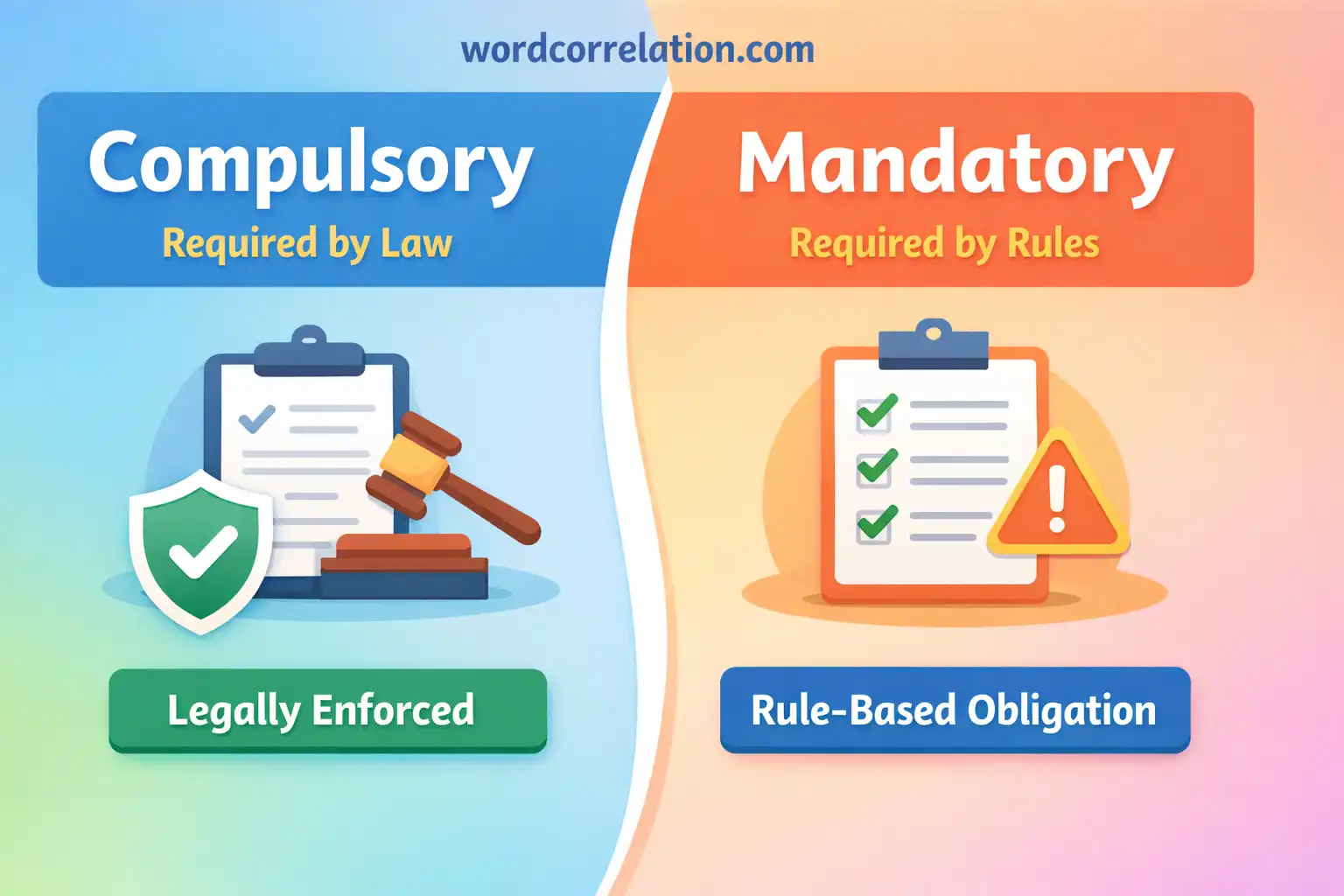
People often search compulsory vs mandatory because both words feel the same. Teachers use them. Governments use them. Forms use them. So readers start to wonder: is there a real difference, or are we just repeating the same idea with two fancy words? That confusion matters, because small word choices change tone.
A rule can sound strict, legal, or polite depending on the word. Writers mix them up all the time, and students copy what they see online. But the mistake creates unclear messages. A workplace email may sound too harsh. A school notice may sound too legal.
This article solves that problem in plain English. You will learn what each word really means, when to use it, and how to avoid the one mistake editors see again and again.
Compulsory vs Mandatory – Quick Answer
- Both words mean something you must do
- Compulsory sounds educational or institutional
- Mandatory sounds legal or official
- Example: School attendance is compulsory
- Example: Seat belts are mandatory
Easy rule: use compulsory for systems like school, but use mandatory for laws and regulations.
The Origin of Compulsory vs Mandatory
The word compulsory comes from Latin roots that mean to force together. Schools and institutions used it early, so the word grew close to education. Over time, people linked it with structured systems like exams, attendance, and training programs.
The word mandatory also comes from Latin, but its root relates to orders and authority. Legal systems adopted it quickly. Governments then used it in laws, policies, and regulations. That background explains why the word feels stronger today.
However, modern English blends the meanings. Daily speech does not follow strict history. That overlap causes confusion, especially for ESL learners. Writers often treat the words as perfect twins, but tone still matters.
British English vs American English Spelling
There is no spelling difference between British and American English for these words. Both regions write:
- compulsory
- mandatory
The difference is not spelling. It is tone and context.
In contrast, British English often uses compulsory more in education. American English prefers mandatory in legal or corporate settings. Still, both regions understand either word.
| Region | Preferred tone example |
| UK | Compulsory school attendance |
| US | Mandatory safety training |
Which Spelling Should You Use?
Since spelling does not change, your choice depends on audience and tone.
For US writing, mandatory fits legal, business, and policy documents. It sounds direct and official.
For UK or Commonwealth readers, compulsory feels natural in academic or institutional writing. It sounds structured but less aggressive.
For global or professional communication, choose based on tone. Use mandatory when you want legal clarity. Use compulsory when describing systems or requirements inside organizations.
The key is consistency. Mixing both words randomly confuses readers.
Common Mistakes with Compulsory vs Mandatory
Writers repeat the same errors, and editors spot them quickly.
❌ The meeting is compulsory by law
✅ The meeting is mandatory by law
(Law requires mandatory)
❌ Military service is mandatory education
✅ Military service is compulsory education
(System requirement fits compulsory)
❌ Attendance is mandatory for students
✅ Attendance is compulsory for students
(Education tone matches better)
The mistake usually happens when people ignore tone. The meaning stays correct, but the sentence sounds awkward.
Compulsory vs Mandatory in Everyday Examples
These words appear everywhere, so context matters.
Emails
Attendance at the training is mandatory due to safety policy.
News
The country introduced compulsory voting for citizens.
Social media
Homework feels compulsory, but coffee is mandatory.
Professional writing
Completion of the course is compulsory for certification.
Each example shows tone choice. Legal or safety rules lean toward mandatory. Institutional systems lean toward compulsory.
Compulsory vs Mandatory – Usage Patterns & Search Interest
Search interest comes mostly from students, ESL learners, and professional writers. Many users meet both words in textbooks and government documents. Then they notice the subtle tone difference.
Editors often report that misuse creates unnecessary tension. A workplace memo that says “mandatory participation” can sound threatening. Meanwhile, “compulsory participation” sounds administrative.
A real scenario appears in HR writing. A company announcement once labeled a team-building event as mandatory. Employees reacted negatively because the word felt strict. Changing it to compulsory softened the tone without changing the rule.
Language affects perception, even when meaning stays the same.
Comparison Table
| Feature | Compulsory | Mandatory |
| Meaning | Required by system | Required by authority or law |
| Part of speech | Adjective | Adjective |
| Context | Education, institutions | Legal, corporate, safety |
| Tone | Administrative | Official, strict |
| Common mistake | Used for laws | Used for school rules |
| Correct example | Compulsory exams begin Monday | Helmets are mandatory by law |
FAQs
Is compulsory the same as mandatory?
They share meaning, but tone differs. Compulsory fits systems. Mandatory fits authority.
Which is correct in formal writing?
Both work, but context decides tone.
Can they be interchangeable?
Yes in meaning, but not always in style.
Why do people confuse them?
They both mean “required,” so learners ignore tone.
Can grammar tools catch this mistake?
Most tools check spelling, not tone.
Is there a British vs American difference?
No spelling difference exists. Only tone preference changes.
Conclusion
The confusion around compulsory vs mandatory comes from shared meaning but different tone. Both words signal obligation. Still, readers feel a difference. Compulsory connects to structured systems like school or certification. Mandatory connects to law, authority, and official enforcement.
Writers should focus on context, not dictionary definitions. The biggest mistake is using mandatory when a softer institutional tone fits better. That choice can make writing sound harsh. Meanwhile, using compulsory in legal situations weakens clarity.
Overall, tone guides the decision. In short, choose mandatory laws and strict authority. Choose compulsory systems and institutional requirements. Finally, remember this rule: law equals mandatory, system equals compulsory. That simple pattern prevents nearly every misuse.

James Holloway writes detailed guides on confusing English words and grammar usage with clear side-by-side comparisons.