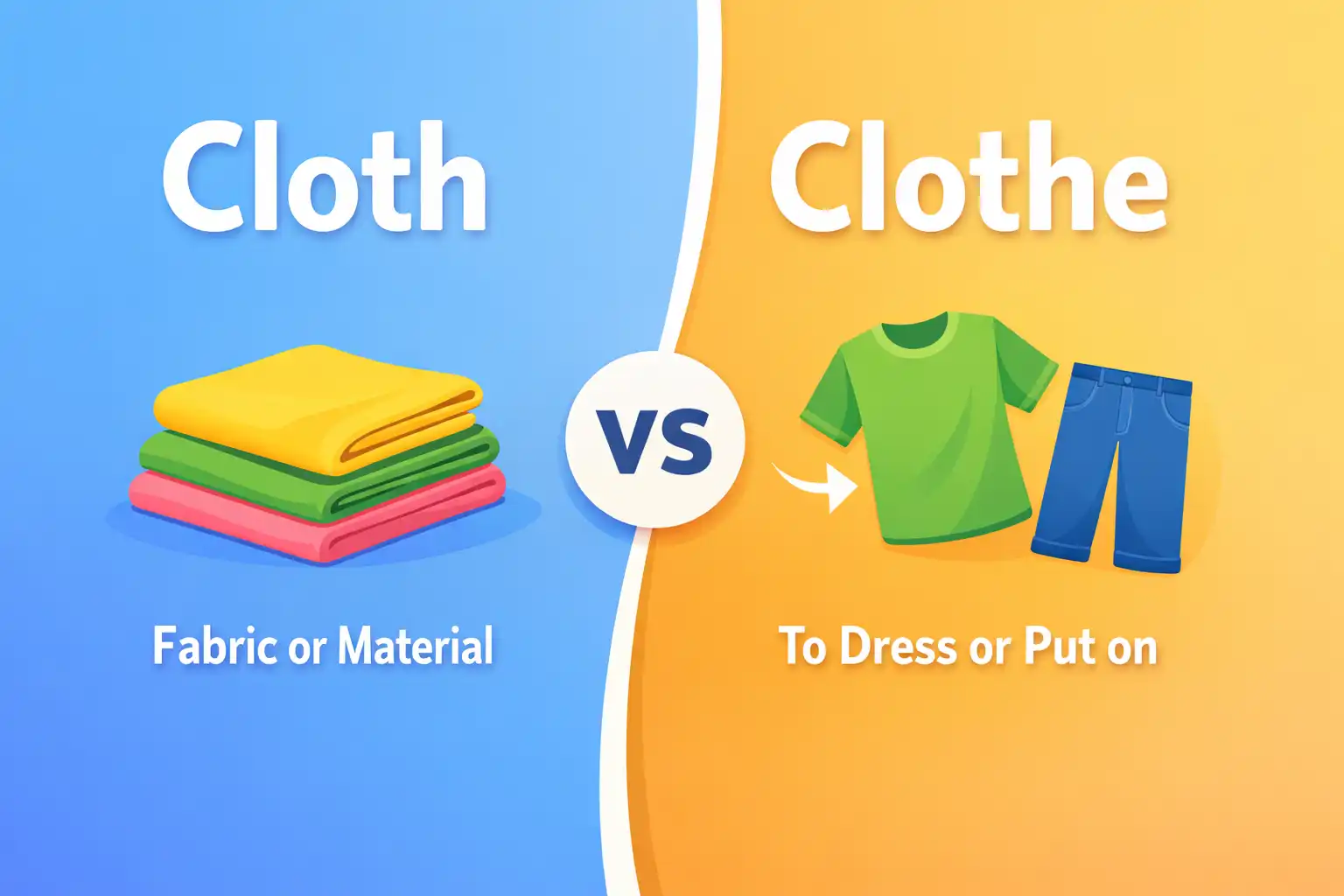
Many English learners search for cloth vs clothe because the two words look almost the same. Only one letter changes, yet the meaning changes a lot. This small difference often causes confusion in writing, emails, school work, and everyday conversation.
Writers often mix these words because both relate to clothing and fabric. Also, spell check tools may not catch the mistake. For example, someone may write “Please cloth the children” when they actually mean “clothe.” The sentence still looks correct, but the meaning becomes wrong.
This article solves that problem in a very clear way. You will learn the meaning of each word, how they are used in real sentences, and the simple rule that helps you choose the correct one quickly. By the end, the difference between cloth and clothe will feel easy and natural.
Cloth vs Clothe – Quick Answer
Cloth and clothe are different in grammar and meaning.
Meaning of Cloth
- Cloth is a noun.
- It means fabric or material used to make clothes or clean things.
- Example: She wiped the table with a cloth.
Meaning of Clothe
- Clothe is a verb.
- It means to dress someone or provide clothing.
- Example: The charity helps clothe poor families.
Easy rule:
If you talk about material, use cloth.
If you talk about dressing someone, use clothe.
The Origin of Cloth vs Clothe
Understanding the origin of these words helps explain the confusion.
The word cloth comes from the Old English word “clāth.” It originally meant a piece of woven fabric. People used cloth to make garments, blankets, and household items. Over time, the meaning stayed very stable. Even today, cloth still refers to fabric or material.
The word clothe developed from the same root. However, it became a verb. Its meaning changed to put clothing on someone or provide garments. Because of this shared origin, the spelling of the two words stayed very similar.
Now the confusion becomes clear. Both words come from the same historical root and both relate to clothing. However, one became a thing and the other became an action.
Editors often see mistakes when writers do not notice the noun vs verb difference. This small grammar change creates most errors with cloth vs clothe today.
British vs American English Spelling
In many English word comparisons, spelling changes between American and British English. However, cloth vs clothe does not change across regions.
Both US English and UK English use the same spelling.
Cloth remains cloth, and clothe remains clothe in all major English varieties.
Small differences appear only in related words such as clothing or clothes, but the core words stay the same.
Here is a quick comparison:
| Word | US English | UK English | Meaning |
|---|---|---|---|
| Cloth | Cloth | Cloth | Fabric or material |
| Clothe | Clothe | Clothe | To dress someone |
So the confusion is not about spelling differences. Instead, the confusion comes from grammar and usage.
How to Choose the Right Word Fast
Choosing between cloth and clothe becomes easy when you focus on the type of word you need.
First, check if the sentence needs a noun or a verb.
If the sentence talks about material or fabric, the correct word is cloth.
If the sentence describes the action of dressing someone, the correct word is clothe.
Here are quick examples.
Correct noun usage:
- She cleaned the mirror with a soft cloth.
- The shop sells cotton cloth.
- The artist covered the table with a cloth.
Correct verb usage:
- The charity works to clothe homeless people.
- Parents must clothe their children in winter.
- The group helps clothe disaster victims.
Now consider the audience context.
US writing
American writing uses both words the same way. However, everyday speech prefers clothes or dress instead of the verb clothe.
UK and Commonwealth writing
British English also uses clothe, especially in formal or humanitarian contexts.
Global or professional writing
In professional writing, clothe often appears in reports about aid programs or charities. Meanwhile, cloth appears in manufacturing, textiles, or household contexts.
A simple check works well.
If you can replace the word with fabric, use cloth.
If you can replace it with dress, use clothe.
Common Mistakes with Cloth vs Clothe
Many errors happen because writers confuse noun and verb forms.
Here are some common mistakes.
❌ Incorrect: She cleaned the table with a clothe.
✅ Correct: She cleaned the table with a cloth.
Explanation: The sentence needs a thing, not an action.
❌ Incorrect: The charity helps cloth poor children.
✅ Correct: The charity helps clothe poor children.
Explanation: The sentence needs a verb, not a noun.
❌ Incorrect: I bought a cleaning clothe.
✅ Correct: I bought a cleaning cloth.
Explanation: A cleaning cloth is an object.
❌ Incorrect: Parents must cloth their kids in winter.
✅ Correct: Parents must clothe their kids in winter.
Explanation: Dressing someone requires the verb form.
Editors often notice that writers replace clothe with dress to avoid mistakes. This works in casual writing, but clothe remains correct in formal contexts.
Cloth vs Clothe in Real Life Examples
Seeing real examples helps learners remember the difference more easily.
Emails
Correct email example:
“Please bring a cleaning cloth for the equipment.”
Another email example:
“The program aims to clothe families affected by the flood.”
News Writing
News often uses clothe when discussing humanitarian work.
Example:
“The organization works to clothe refugees during the winter season.”
News also uses cloth when discussing textiles.
Example:
“The company produces eco-friendly cotton cloth.”
Social Media
Social media uses cloth more often in casual posts.
Example:
“Use a soft cloth to clean your phone screen.”
Sometimes charities use clothe in awareness campaigns.
Example:
“Our mission is to clothe children in need.”
Professional Writing
Formal reports may include both words.
Example:
“The factory manufactures medical cloth for hospitals.”
Another example:
“The project will help clothe displaced families.”
These examples show how each word appears in different contexts.
Cloth vs Clothe – Word Usage Patterns and Search Trends
Search trends show that cloth vs clothe is a common question among English learners.
Students and ESL learners search this phrase when writing essays or assignments. Many want to confirm whether the correct spelling is cloth or clothe.
Professional writers also search the phrase while editing content. The words look almost identical, so quick verification helps avoid errors.
One real scenario often causes confusion.
A writer may type:
“The charity works to cloth homeless people.”
The sentence seems correct at first glance. However, the meaning becomes wrong because cloth cannot act as a verb.
Readers may still understand the message, but the mistake signals poor grammar.
Because of this, editors and teachers frequently explain the noun vs verb difference between these words.
Cloth vs Clothe Comparison Table
| Feature | Cloth | Clothe |
|---|---|---|
| Meaning | Fabric or material | To dress someone |
| Part of Speech | Noun | Verb |
| Context of Use | Cleaning, textiles, fabric | Dressing people, aid programs |
| Formal vs Informal | Used in both contexts | More common in formal writing |
| Common Mistake | Used instead of clothe | Used instead of cloth |
| Correct Example | She wiped the glass with a cloth. | The charity helps clothe families. |
This table removes most confusion instantly.
FAQs About Cloth vs Clothe
Is cloth the same as clothe?
No. Cloth is a noun that means fabric. Clothe is a verb that means to dress someone.
Which word is correct in formal writing?
Both are correct, but they appear in different contexts. Formal reports often use clothe when discussing humanitarian work.
Can cloth and clothe be used interchangeably?
No. One is a noun and the other is a verb, so they cannot replace each other in sentences.
Why do people confuse cloth and clothe?
The words share the same root and look almost identical. Only one letter changes, so mistakes happen easily.
Can grammar tools catch this mistake?
Some tools detect it, but many do not. The sentence may still look correct grammatically.
Is there a British vs American difference?
No. Both cloth and clothe use the same spelling in American and British English.
Is clothe common in everyday conversation?
Not always. Many speakers use dress instead. However, clothe remains correct in formal writing.
Conclusion
The confusion between cloth vs clothe comes from their very similar spelling and shared history. Both words connect to clothing and fabric, but they play very different roles in a sentence.
Cloth is a noun. It refers to fabric, textile material, or cleaning cloths. People use this word when talking about objects or materials.
Clothe is a verb. It describes the action of dressing someone or providing clothing. This word often appears in formal writing, especially when discussing charity, aid programs, or social support.
Many writers make mistakes because they forget the grammar difference. When that happens, sentences may look correct but still contain errors.
Overall, remembering one simple rule helps avoid confusion.
If the word refers to material, choose cloth.
If the sentence describes dressing someone, choose clothe.
In short, cloth is a thing, and clothe is an action. This quick rule makes the difference easy to remember every time.

James Holloway writes detailed guides on confusing English words and grammar usage with clear side-by-side comparisons.