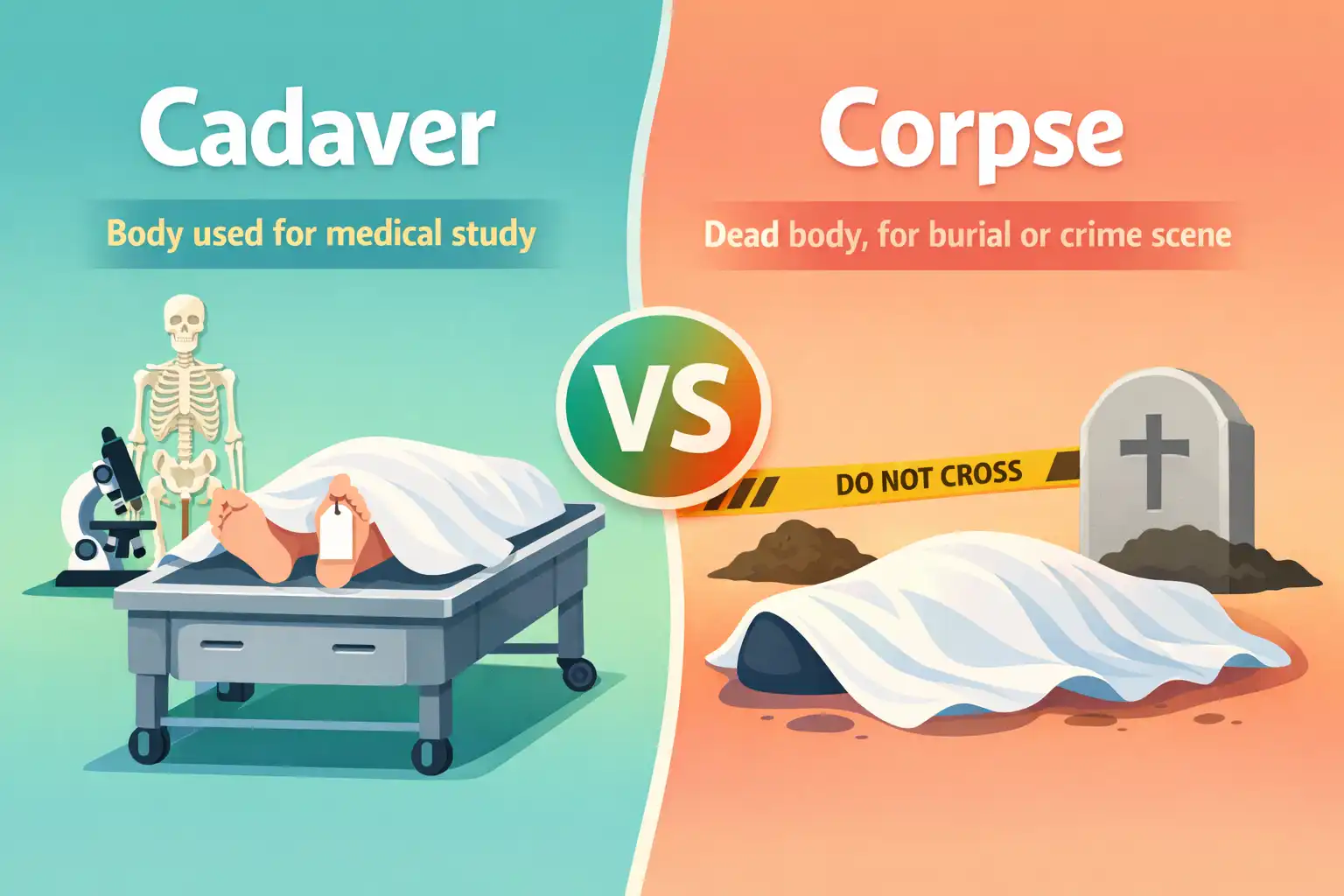
Many people search for cadaver vs corpse because both words describe a dead human body. At first glance, they seem the same. Yet the meaning changes depending on the situation. Because of this, students, writers, and even journalists often use the wrong word.
The confusion usually happens in medical, academic, and everyday writing. Someone may read the word cadaver in a science book. Then they may see corpse in a news report. Both refer to a dead body, but the tone and context are very different. Using the wrong word can make writing sound strange or incorrect.
Editors often notice this mistake in beginner writing. For example, a student may say “the police found a cadaver,” which sounds unnatural. On the other hand, a medical report might say “corpse,” which feels too informal for science language.
This article solves that problem. You will learn the exact difference between cadaver and corpse, when to use each word, and how professionals use them in real life. By the end, you will know a simple rule that helps you choose the correct word every time.
Cadaver vs Corpse – Quick Answer
Meaning of Cadaver
- A dead human body used for medical study or scientific research
- Mostly used in medicine, anatomy, and education
- Formal and technical word
Examples
- Medical students study a cadaver in anatomy class.
- The university received a donated cadaver for research.
Meaning of Corpse
- A dead human body in general use
- Common in news, police reports, and everyday language
- Neutral but less technical
Examples
- Police discovered a corpse in the forest.
- The story described a corpse found in an abandoned building.
Easy rule:
Use cadaver in medical or scientific settings. Use corpse in normal or general situations.
The Origin of Cadaver vs Corpse
Understanding the origin of these words helps explain why they feel different today.
The word cadaver comes from Latin. It comes from cadere, which means “to fall.” In ancient times, the term described a body that had fallen in death. Later, scholars used the word in scientific and medical texts. Because of this history, the word still sounds technical and academic today.
Medical schools began using the word widely during the Renaissance period, when anatomy study became more common. Students needed real bodies to learn about organs, bones, and muscles. Those bodies were called cadavers.
The word corpse also comes from Latin. It evolved from corpus, which means “body.” Over time, the word entered French and then English. Unlike cadaver, this word moved into everyday language.
As a result, writers and speakers used corpse in stories, newspapers, and crime reports. The meaning stayed simple: a dead human body.
Because both words come from Latin and describe the same thing, people often confuse them today. However, the tone and context are what separate them.
British vs American English Spelling
In this case, there is no spelling difference between British and American English.
Both countries use the same spelling:
| Word | British English | American English |
| Cadaver | Cadaver | Cadaver |
| Corpse | Corpse | Corpse |
The difference is not about spelling. Instead, the difference is about usage and tone.
For example:
- A British medical journal will say cadaver study.
- An American news article will say corpse discovered.
So the spelling remains the same, but the context changes the word choice.
How to Choose the Right Word Fast
Choosing between cadaver and corpse becomes easy once you think about who is speaking and why.
For medical or academic writing
Use cadaver.
Medical students, anatomy teachers, and researchers use this word because it fits scientific language.
Example
- The class examined a cadaver to learn about the nervous system.
For news or general writing
Use corpse.
Journalists, police reports, and everyday conversation prefer this word.
Example
- Investigators found a corpse near the river.
For global or professional communication
Think about the tone.
If the writing relates to medicine or research, use cadaver. If the topic is general or narrative, use corpse.
This simple step prevents awkward wording.
Common Mistakes with Cadaver vs Corpse
Writers often mix these words because both refer to a dead body. Still, the wrong choice can make writing sound unnatural.
Here are common mistakes.
❌ Incorrect: The police discovered a cadaver in the park.
✅ Correct: The police discovered a corpse in the park.
Explanation: Police reports usually use corpse, not cadaver.
❌ Incorrect: Students examined the corpse during anatomy class.
✅ Correct: Students examined the cadaver during anatomy class.
Explanation: Medical education prefers the scientific term cadaver.
❌ Incorrect: The news reported a cadaver found in the alley.
✅ Correct: The news reported a corpse found in the alley.
Explanation: Journalism rarely uses cadaver unless discussing science.
Writers avoid these errors by remembering the context rule.
Cadaver vs Corpse Comparison Table
| Feature | Cadaver | Corpse |
| Meaning | Dead human body used for study | Dead human body in general |
| Part of Speech | Noun | Noun |
| Context of Use | Medical schools, anatomy, research | News, crime reports, everyday speech |
| Formal vs Informal | Technical and academic | Neutral general word |
| Common Mistake | Used in police or news writing | Used in medical research writing |
| Correct Example | Students studied the cadaver in anatomy lab | Police found a corpse in the forest |
This table quickly shows the main difference between the two words.
Cadaver vs Corpse in Real Life Examples
Understanding real situations makes the difference clearer.
Emails
Medical context
- The university received a cadaver donation for anatomy training.
General context
- The report described a corpse found at the scene.
News writing
- Authorities discovered a corpse during the investigation.
News articles rarely use cadaver unless discussing research or education.
Social media
- A history page might say scientists studied an ancient cadaver.
However, crime discussions usually mention a corpse.
Professional writing
Medical research
- Researchers examined the cadaver to study muscle structure.
Crime investigation reports
- Officers located the corpse after the search.
These examples show how context controls the word choice.
Cadaver vs Corpse – Word Usage Patterns and Search Trends
Search interest for cadaver vs corpse usually comes from students, writers, and ESL learners. Many people see the words in different places and want to understand the difference.
Medical students often encounter the word cadaver during anatomy classes. Meanwhile, readers of crime news or fiction regularly see the word corpse.
Writers also search for this comparison because incorrect use can sound unnatural. For example, a novel describing a crime scene should normally use corpse, not cadaver. Using the wrong word may make the dialogue feel unrealistic.
Another common situation appears in education websites and textbooks. A beginner reader might think both words are identical. Yet experienced editors quickly notice the context difference.
Because of this confusion, comparison searches like cadaver vs corpse remain popular among learners and writers.
FAQs About Cadaver vs Corpse
Is cadaver the same as corpse?
No. Both mean a dead human body, but cadaver is used in medical study while corpse is used in general situations.
Which word is correct in formal writing?
Both can be correct. Use cadaver in scientific or medical writing. Use corpse in journalism or general reports.
Can cadaver and corpse be used interchangeably?
Not usually. The context determines the correct word. Medical study uses cadaver, while everyday writing uses corpse.
Why do people confuse cadaver and corpse?
Both words describe a dead body and come from Latin roots. Because of this, many learners assume they mean exactly the same thing.
Can grammar tools detect this mistake?
Most grammar tools focus on spelling and grammar. They may not always detect context mistakes like cadaver vs corpse.
Is there a British vs American difference?
No. Both regions use the same spelling and meaning for cadaver and corpse.
Which word sounds more scientific?
Cadaver sounds more scientific because medical education and research commonly use it.
Conclusion
The difference between cadaver vs corpse becomes simple once you understand the context.
Both words refer to a dead human body, yet they belong to different language settings. The word cadaver appears mainly in medical education, anatomy study, and scientific research. Medical students often learn about the human body by studying cadavers in a laboratory environment.
The word corpse, on the other hand, appears in everyday language. News reports, crime stories, and general descriptions usually prefer this word because it sounds natural outside academic settings.
Writers often confuse these terms because their meanings overlap. However, the tone of the sentence changes depending on the word you choose. Using cadaver in a police report or corpse in a medical research paper can sound awkward.
Overall, the safest rule is easy to remember.
Use cadaver for science and medical study.
Use corpse for general descriptions of a dead body.
Following this rule helps your writing stay clear, natural, and correct in any situation.

James Holloway writes detailed guides on confusing English words and grammar usage with clear side-by-side comparisons.