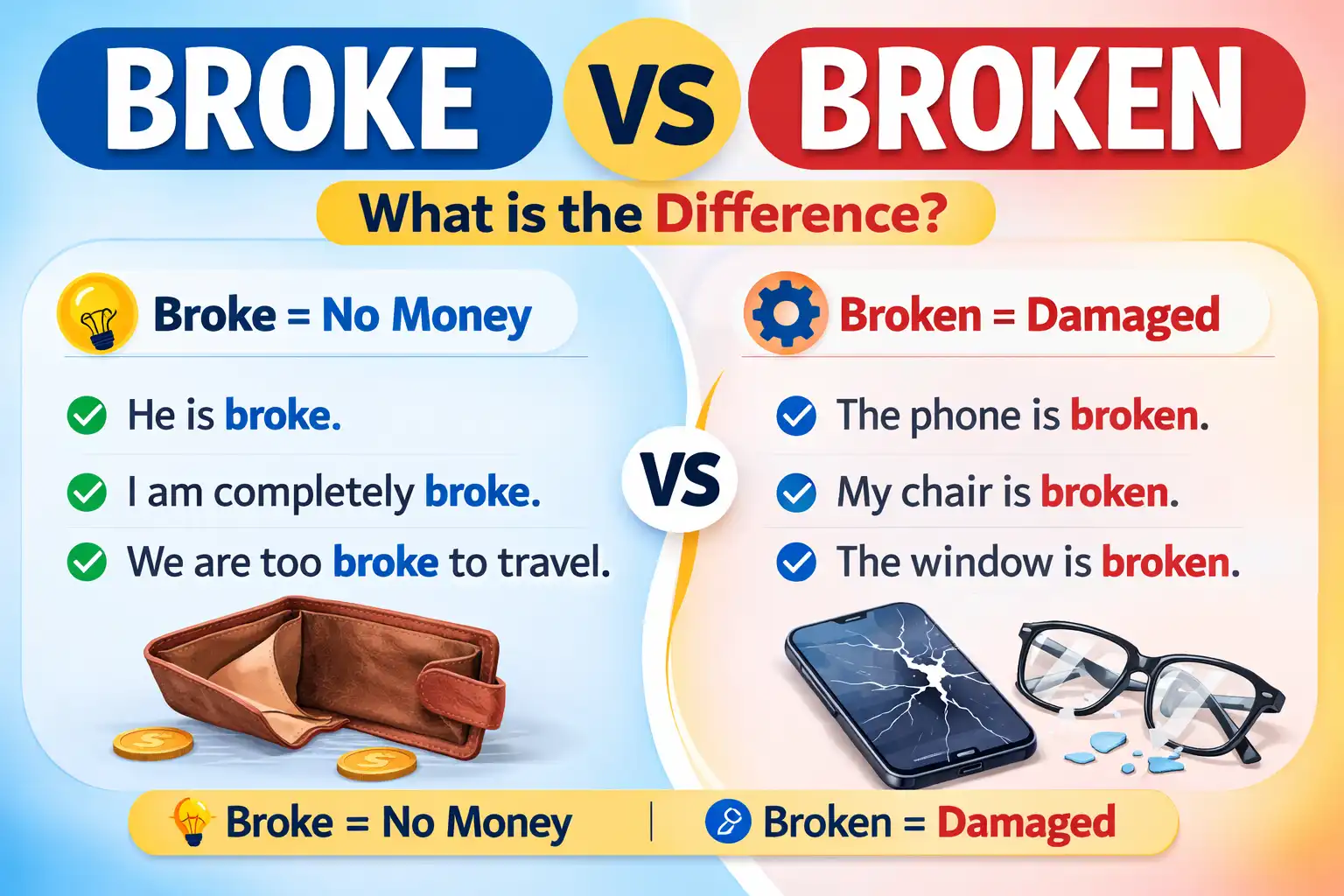
Many English learners stop for a moment when they see broke and broken. Both words come from the verb break, and both describe something that is damaged or no longer working. So confusion happens often. A student may write “My phone is broke.” However, the correct form should be “My phone is broken.”
This mistake appears in emails, essays, social media posts, and even professional writing. The words look similar, and their meanings feel close. Yet they play different roles in grammar. One works as a past tense verb, while the other works as a past participle and adjective.
Because of this, writers often mix them up. Editors also see this error often in beginner and ESL writing. Understanding the difference helps your sentences sound clear and correct.
In this guide, you will learn the exact meaning of broke vs broken, when to use each word, and how to choose the correct one quickly. You will also see real examples, common mistakes, and a simple rule that makes the choice easy.
Broke vs Broken – Quick Answer
Meaning of Broke
- Past tense of the verb break
- Shows an action that already happened
Examples
- I broke my glasses yesterday.
- She broke the window.
Meaning of Broken
- Past participle or adjective of break
- Describes the result of damage
Examples
- The window is broken.
- My laptop is broken.
Easy rule:
Use broke for an action in the past.
Use broken to describe the condition of something.
The Origin of Broke vs Broken
Both broke and broken come from the Old English word “brecan.” This verb meant to shatter, split, or destroy. Over time, English verbs developed different forms for tense and grammar.
Old English verbs usually had three main forms:
- Base form
- Past tense
- Past participle
For the verb break, the forms became:
- Break
- Broke
- Broken
So the difference between broke vs broken started as a normal grammar pattern in English verbs.
However, confusion grew later because broken can act as an adjective. When people say “The phone is broken,” they describe a condition, not an action.
Modern English also shortened many verb patterns in casual speech. Because of this, some learners try to use broke in the same place as broken, which creates grammar mistakes.
British vs American English Spelling
There is no spelling difference between British and American English for broke vs broken. Both regions use the same forms and the same grammar rules.
The difference lies only in how the words function in a sentence, not in spelling.
Example comparisons:
| Sentence | Correct Usage |
|---|---|
| I broke the glass. | Past action |
| The glass is broken. | Condition |
Both American and British writers follow the same pattern.
In contrast to other words like color/colour, this pair does not change spelling by region.
How to Choose the Right Word Fast
Choosing between broke and broken becomes easy once you focus on the sentence structure.
First, ask one simple question:
Is the sentence describing an action or a condition?
If the sentence describes an action in the past, use broke.
Example
- He broke the chair.
If the sentence describes the result or state, use broken.
Example
- The chair is broken.
For global writing, academic work, or professional communication, these grammar rules stay the same everywhere.
Now remember a quick pattern:
Action → broke
Result or condition → broken
This rule works in almost every sentence.
Common Mistakes with Broke vs Broken
Many writers use the wrong form because both words feel similar. Here are the most common errors.
❌ My laptop is broke.
✅ My laptop is broken.
Explanation: The sentence describes the condition of the laptop.
❌ The boy broken the toy yesterday.
✅ The boy broke the toy yesterday.
Explanation: The sentence describes a past action.
❌ My car has broke down.
✅ My car has broken down.
Explanation: Present perfect tense requires the past participle broken.
❌ She has broke the rule.
✅ She has broken the rule.
Explanation: Perfect tenses always use broken, not broke.
Writers often make these mistakes because they remember the past tense but forget the participle form.
Broke vs Broken in Real Life Examples
Understanding grammar becomes easier when you see real situations.
Emails
Incorrect
My printer is broke, so I cannot send the documents.
Correct
My printer is broken, so I cannot send the documents.
News
Correct usage
The storm broke several windows in the city.
Result description
Many buildings now have broken glass.
Social Media
Post example
I accidentally broke my phone today.
Follow-up comment
Now my screen is completely broken.
Professional Writing
Correct sentence
The technician confirmed that the machine was broken.
Action sentence
Someone broke the safety lock earlier.
In daily communication, the difference becomes clear once you think about action vs result.
Broke vs Broken – Word Usage Patterns and Search Trends
Search engines show that many users type “broke vs broken” when they write essays, homework, or emails. Students and ESL learners search this phrase often because the two words appear very similar.
Grammar checkers sometimes catch the mistake. However, they may miss it when the sentence structure is complex. For example, a sentence like “The system has broke again” may not always trigger an automatic correction.
Editors frequently see this error in beginner writing. The confusion usually appears in sentences with “is,” “has,” or “have.”
Example scenario:
A student writes:
“My computer is broke.”
The sentence sounds understandable, but it is grammatically incorrect. Correct usage should be:
“My computer is broken.”
Misusing these words can make writing look less professional. Because of this, learning the correct pattern helps writers communicate more clearly.
Broke vs Broken Comparison Table
| Feature | Broke | Broken |
|---|---|---|
| Meaning | Action of breaking in the past | Result or condition after breaking |
| Part of Speech | Past tense verb | Past participle or adjective |
| Context of Use | Describes something someone did | Describes something damaged |
| Formal vs Informal | Used in all writing | Used in all writing |
| Common Mistake | Used instead of “broken” after “is” | Used instead of past tense |
| Correct Example | She broke the mirror. | The mirror is broken. |
This table makes the difference clear at a glance.
Frequently Asked Questions
Is broke the same as broken?
No. Broke describes a past action, while broken describes a condition or result.
Which word is correct in formal writing?
Both are correct. However, they must follow the correct grammar rule. Use broke for past actions and broken for results.
Can broke and broken be used interchangeably?
No. They serve different grammatical roles. Using them interchangeably often creates incorrect sentences.
Why do people confuse broke and broken?
The words share the same root verb break, and their meanings seem similar. This makes learners mix them up.
Can grammar tools detect this mistake?
Sometimes yes, but not always. Complex sentences can confuse automated grammar tools.
Is there a British vs American difference?
No. Both forms remain the same in British and American English.
Can broken act as an adjective?
Yes. Broken often describes the condition of something. Example: a broken phone.
Conclusion
The difference between broke vs broken becomes simple once you understand their grammar roles. Both words come from the verb break, yet they function differently in a sentence.
Use broke when you describe a past action. For example, someone broke a window or broke a rule. The focus stays on what happened.
Use broken when you describe the result or condition of something. A broken window or a broken phone shows the state after the action.
Writers often confuse these forms because they look similar. However, the sentence structure reveals the correct choice. If the sentence contains verbs like is, has, or have, the correct form usually becomes broken.
Overall, the key idea is simple. Think about whether your sentence describes an action or a result.
Final rule to remember:
Action in the past → broke.
Condition after damage → broken.

James Holloway writes detailed guides on confusing English words and grammar usage with clear side-by-side comparisons.