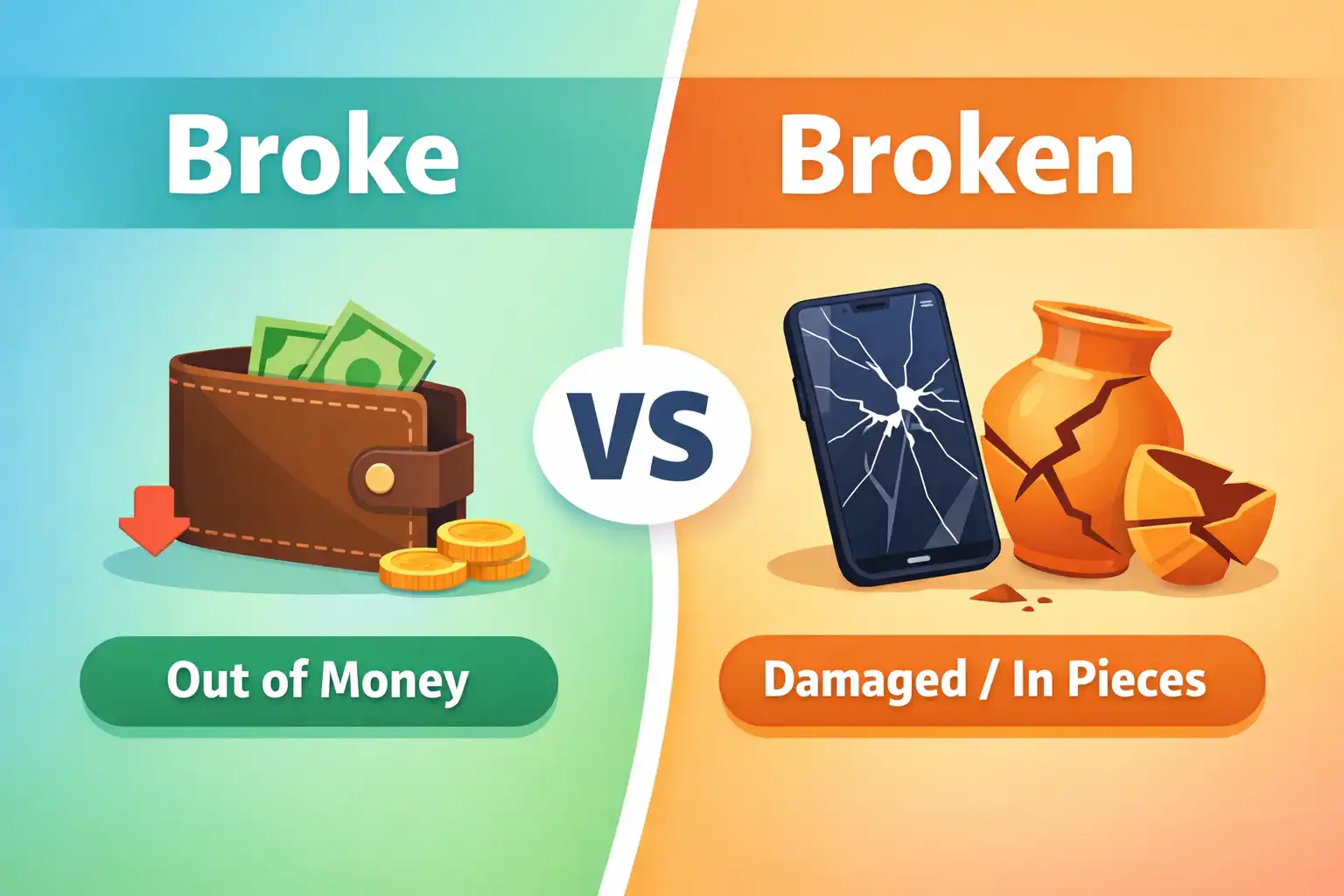
Many English learners mix up broke and broken. The words look similar, and both come from the verb break. But they do not work the same way in sentences. One is a past tense verb, and the other is a past participle or adjective.
So mistakes happen often. You may hear “I have broke it” or “My phone is broke.” These sound wrong in standard English. This guide will help you avoid that confusion. You will learn meaning, grammar, examples, and when to use each word correctly.
Quick Answer: broke vs broken
- Broke = past tense of break
- Broken = past participle or adjective
Examples:
- I broke my glass yesterday.
- My glass is broken now.
✅ Easy rule:
If you use has / have / had / is / was, choose broken, not broke.
Why “break” becomes broke/broken (irregular patter
Both words come from the Old English verb brecan, which means “to split” or “to destroy.” Over time, English created different forms of the verb:
- break (present)
- broke (past)
- broken (past participle)
This pattern is common in English irregular verbs, like:
- speak → spoke → spoken
- write → wrote → written
Reason for confusion today
Modern speech sometimes uses broke as an adjective in casual language, especially in American slang (“I’m broke”). Because of this, learners assume it works everywhere. But standard grammar still separates the roles clearly.
US vs UK Usage: Grammar stays the same, slang differs
There is no spelling difference between British and American English for broke and broken. Both forms are identical worldwide.
However, there is a small difference in usage tone:
- American English uses broke more often in informal speech (especially for money).
- British English prefers broken in formal grammar situations.
Examples
- US informal: I’m broke this week.
- UK formal: The machine is broken.
| Context | US | UK |
| Grammar form | Same | Same |
| Spelling | Same | Same |
| Informal slang use | More common | Less common |
So the confusion is not about spelling. It is about grammar and tone.
How to Choose the Right Word Fast
Here is a quick guide based on audience and context.
US
Use broke for past tense.
Use broken after helping verbs.
Example:
- I broke the chair.
- The chair is broken.
UK / Commonwealth
The same rule applies. Grammar does not change.
Global or professional writing
Always choose broken after:
- is / was / were
- has / have / had
- been / being
Professional writing prefers correct grammar over slang.
Common Mistakes with broke vs broken
Here are frequent errors learners make.
❌ I have broke my phone.
✅ I have broken my phone.
Explanation: After have, use past participle.
❌ The car is broke.
✅ The car is broken.
Explanation: After is, use adjective form.
❌ My arm has broke.
✅ My arm has broken.
❌ He was broke the window.
✅ He broke the window.
Explanation: Do not use “was” with simple past verbs like broke.
Broke vs Broken in Everyday Examples
Emails
- I accidentally broke the screen yesterday.
- The screen is now broken, so I need repair.
News
- The storm broke several trees.
- Many power lines were broken.
Social Media
- I broke my diet again 😅
- My laptop is broken… help!
Formal or professional writing
- The technician reported that the equipment was broken.
- The employee broke company policy.
Broke vs Broken – Usage Patterns & Search Interest
Search interest stays high because learners often struggle with irregular verbs. Students, ESL learners, and writers commonly search this topic.
Typical user groups include:
- English learners
- School students
- Content writers
- Professionals writing emails
Real-world confusion scenario
A job applicant writes:
“I have broke the system.”
This creates a negative impression because grammar looks incorrect. Using broken fixes the issue immediately.
Comparison Table
| Feature | Broke | Broken |
| Meaning | Past action of break | Result state of damage |
| Part of speech | Past tense verb | Past participle / adjective |
| Context of use | Yesterday, last week, past event | After has/have/is/was |
| Formal vs informal | Neutral verb | Preferred in formal grammar |
| Common mistakes | Using after “has” | Using as simple past |
| Correct example | I broke my watch. | My watch is broken. |
This table removes confusion quickly: action = broke, state = broken.
People Also Ask (Semantic FAQs)
What is the difference between broken and broke?
Broke is past tense. Broken is past participle or adjective. The choice depends on grammar structure.
Is it broke or is it broken?
Correct: It is broken. After “is,” use broken.
What is the difference between broken and break?
Break is present tense. Broken describes the result after damage.
What is the difference between poor and broke?
Poor means having little money long-term.
Broke means having no money right now (often temporary).
When to use broke?
Use broke for past actions:
“I broke my phone.”
Is broken English correct?
Yes. “Broken English” means English with mistakes or limited fluency.
Is broke the same as broken?
No. They come from the same verb, but grammar roles differ.
Which one is correct in formal writing?
Both are correct, but only when used properly. Formal writing often uses broken more because it appears with passive structures.
Conclusion
The difference between broke and broken is easy once you know their roles. Both come from the verb break, but they are used in different grammar situations. Broke shows a past action. Broken shows a result or condition and often appears with helping verbs like is or has.
A common mistake is using broke after helping verbs. For example, “I have broke my phone” is incorrect. The correct form is “I have broken my phone.” This small change makes your English sound natural and correct.
In short:
- Action in the past → broke
- State or result → broken
Finally, remember one simple rule:
If you see is / was / has / have — use broken, not broke.

James Holloway writes detailed guides on confusing English words and grammar usage with clear side-by-side comparisons.