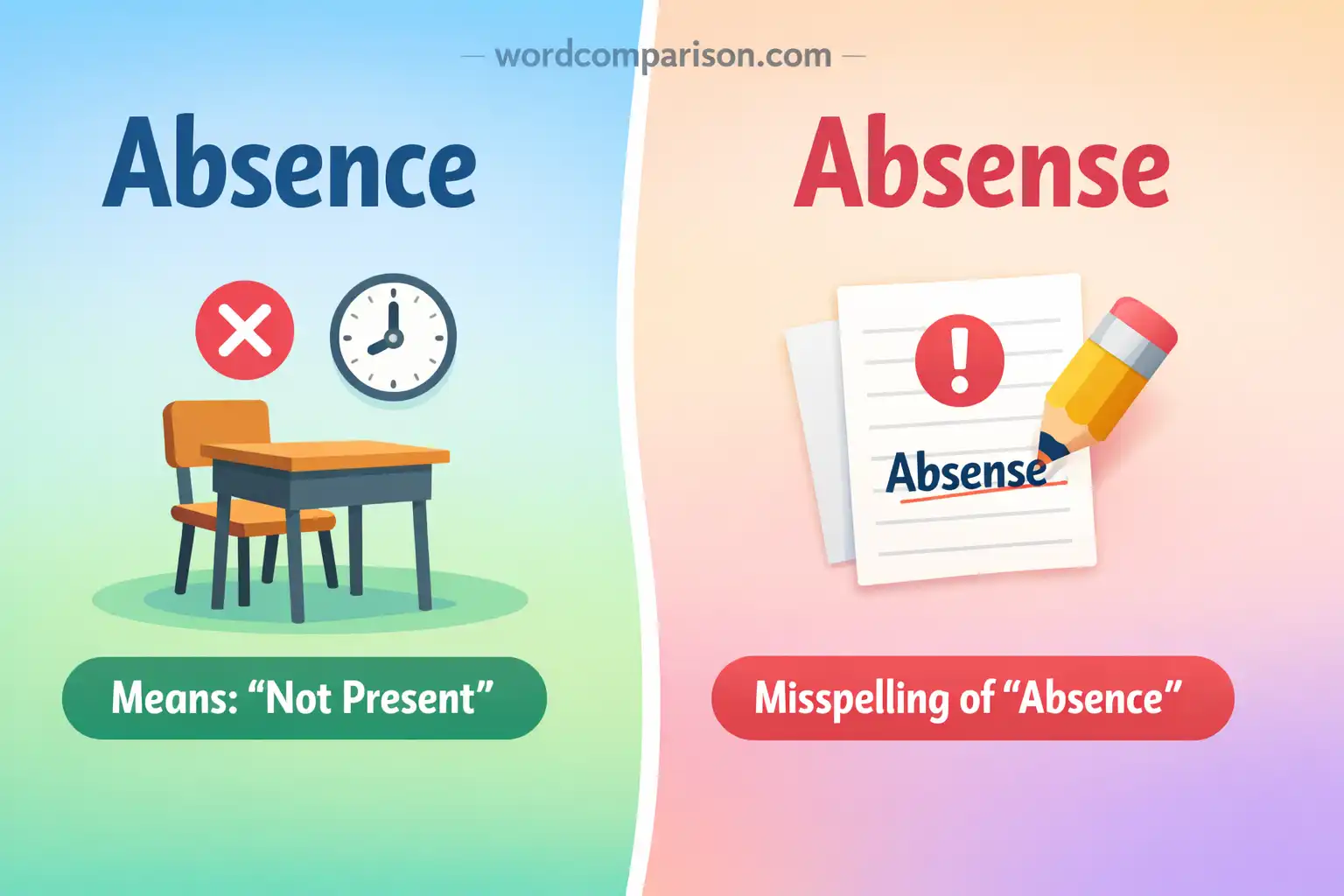
You type a word fast. You send the email. Then, a red line appears. The word is absense. You meant to write absence. This small mistake happens every day. Students do it. Writers do it. Even professionals do it when they rush.
This confusion is very common because the words sound the same. When we speak, we hear “ab-sense.” So many people write it the way they hear it. But English spelling does not always follow sound. That is where the problem begins.
In this guide, you will learn the simple truth about absence vs absense. You will see why people mix them up, where the mistake happens, and how to avoid it forever. By the end, you will know one easy rule that keeps you right every time.
Absence vs Absense – Quick Answer
- Absence is the correct spelling.
- Absense is always wrong.
- Use absence when someone or something is not present.
Example:
- She apologized for her absence from class.
- ❌ Her absense was noted.
Easy rule: If you mean “not present,” always write absence with C, never S.
The Origin of Absence vs Absense
The word absence comes from Latin. It comes from absentia, which means “being away.” Later, it moved into Old French as absence. Then it entered English with the same spelling.
The letter C has always been part of the word’s history. It never changed to S.
So why do people write absense today?
Because of sound.
When we say the word, it sounds like ab-sense. Our brain connects the sound to the common word sense. So the fingers type S instead of C. This is a sound mistake, not a grammar mistake.
Writers often confuse words when sound and spelling do not match. Editors usually see this error in emails, essays, and school work.
British English vs American English Spelling
There is no difference between British and American English for this word.
| Version | Correct Spelling |
| American English | absence |
| British English | absence |
| Australian English | absence |
| Canadian English | absence |
In contrast to words like color/colour or center/centre, this word stays the same everywhere.
So, location does not matter. The spelling rule stays fixed.
Which Spelling Should You Use?
You should always use absence.
- In the US → absence
- In the UK → absence
- In formal writing → absence
- In emails → absence
- In school work → absence
There is no situation where absense is correct. It is simply a spelling error.
Common Mistakes with Absence vs Absense
Many mistakes happen in fast writing.
❌ I am sorry for my absense yesterday.
✅ I am sorry for my absence yesterday.
❌ The absense of rules caused confusion.
✅ The absence of rules caused confusion.
The mistake often appears when people write quickly without spell check.
Absence vs Absense in Everyday Examples
You can see this word in many places.
Emails
Sorry for my absence from the meeting.
News
The absence of rain caused crop damage.
Social Media
My long absence from Instagram is over!
Professional Writing
The report explains the absence of data in this section.
In each case, the spelling never changes.
Absence vs Absense – Usage Patterns & Search Interest
Many students and ESL learners search for absence vs absense because they are unsure which one is right. The words sound identical. Spell check tools often catch the error, but people still want to understand why.
This mistake also happens in workplaces. For example, an employee writes an email about their “absense.” The message is clear, but the spelling looks unprofessional. That small error can affect how the writing feels.
So the confusion matters in real life.
Quick Comparison Table
| Feature | Absence | Absense |
| Meaning | Not being present | No meaning (wrong spelling) |
| Part of speech | Noun | Not a word |
| Context of use | Formal and informal writing | Never used |
| Formal vs informal | Works in all contexts | Incorrect everywhere |
| Common mistake | Spelled with S | — |
| Correct example | Her absence was noted. | ❌ Her absense was noted. |
This table removes the confusion fast.
FAQs About Absence vs Absense
Is absense a real word?
No. It is a spelling mistake.
Why do people write absense?
Because the word sounds like “sense.”
Is absence correct in formal writing?
Yes. It is correct everywhere.
Is there a British vs American difference?
No. The spelling is the same.
Can grammar tools catch this mistake?
Yes. Most spell check tools mark “absense” as wrong.
Can I ever use absense?
No. You should never use it.
Do many people make this mistake?
Yes. It is a very common typing error.
Conclusion
The confusion between absence vs absense comes from sound, not meaning. When we speak, the word sounds like it should have an S. But history, spelling rules, and correct English all say it must have a C.
Overall, the word absence is the only correct form. It works in every country, every type of writing, and every situation. Meanwhile, absense is just a common error that happens when we type too fast or trust our ears more than spelling.
Finally, remember this simple rule:
If you mean “not present,” write absence with a C.
That one rule will keep you right every time.

James Holloway writes detailed guides on confusing English words and grammar usage with clear side-by-side comparisons.